The Tagada disco ride is one of the most iconic spinning amusement attractions found in funfairs and theme parks around the world. Known for its high-energy movement, unpredictable bouncing, and music-driven experience, it attracts thrill-seekers who enjoy group interaction and physical excitement. One of the most frequently asked questions is: how many passengers can actually sit in a Tagada disco ride at once?
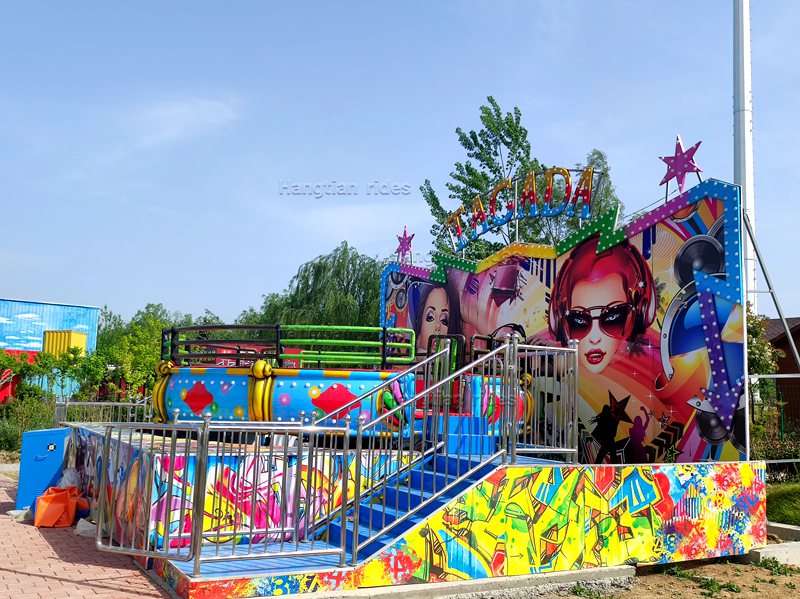
The seating capacity of a Tagada disco ride depends on its diameter, design, and manufacturer specifications, but most standard models can accommodate between 20 and 40 passengers per cycle. Smaller versions designed for compact amusement spaces may hold around 12 to 20 riders, while larger professional installations can support up to 50 participants.
The riders sit along a circular bench without seatbelts, holding onto overhead bars for safety. Once the ride begins, the platform spins and bounces unpredictably, creating a shared group experience that relies heavily on balance and coordination.
Unlike traditional rides that focus on individual seating, the Tagada ride emphasizes collective motion. Riders are thrown into rhythmic bouncing and spinning movements, often synchronized with loud music and lighting effects. This shared chaos is part of what makes the attraction so popular among teenagers and young adults.
In many cases, riders naturally form reactions that resemble a coordinated performance, often referred to in entertainment culture as tagada dance. This spontaneous movement happens as passengers try to maintain balance while reacting to sudden jumps and spins.
Different versions of the ride exist, each offering a slightly different experience. The most common modern adaptation is often marketed as Crazy Disco tagada, which enhances the traditional concept with stronger lighting effects, faster rotation speeds, and more dynamic bouncing patterns. This version is designed to create a nightclub-like atmosphere inside the ride platform.
Another popular variation is the Jumping Tagada, which focuses more heavily on vertical bouncing motions rather than continuous spinning. In this version, passengers experience sharper lifts and drops, making the ride feel more intense even at lower speeds. Capacity remains similar, but the experience can feel more physically demanding due to the stronger impact forces.
While maximizing passenger capacity is important for operators, safety and comfort always determine the final configuration. The circular seating design ensures that weight is evenly distributed, and operators typically adjust the number of passengers based on group size, weight distribution, and ride intensity settings.
Overloading the ride can reduce its motion quality and increase safety risks, while underloading may affect balance and reduce the overall entertainment value. Therefore, operators carefully manage boarding procedures to maintain an optimal balance between capacity and performance.
The number of passengers directly affects the energy of the ride. A nearly full Tagada ride often feels more dynamic because the collective movement of riders enhances the bouncing and spinning effect. Laughter, reactions, and shifting body weight all contribute to the ride’s unpredictable rhythm.
In contrast, a lightly loaded ride may feel less intense and less synchronized, as there are fewer interactions between passengers to amplify movement.
A Tagada disco ride typically holds between 20 and 40 passengers, depending on its size and configuration. However, its appeal is not just about how many people it can carry, but how those riders interact during the experience. Whether expressed through the energetic tagada dance, the intensified atmosphere of a Crazy Disco tagada, or the high-impact motion of a Jumping Tagada, the ride transforms a simple seating arrangement into a shared thrill experience that defines modern amusement entertainment.