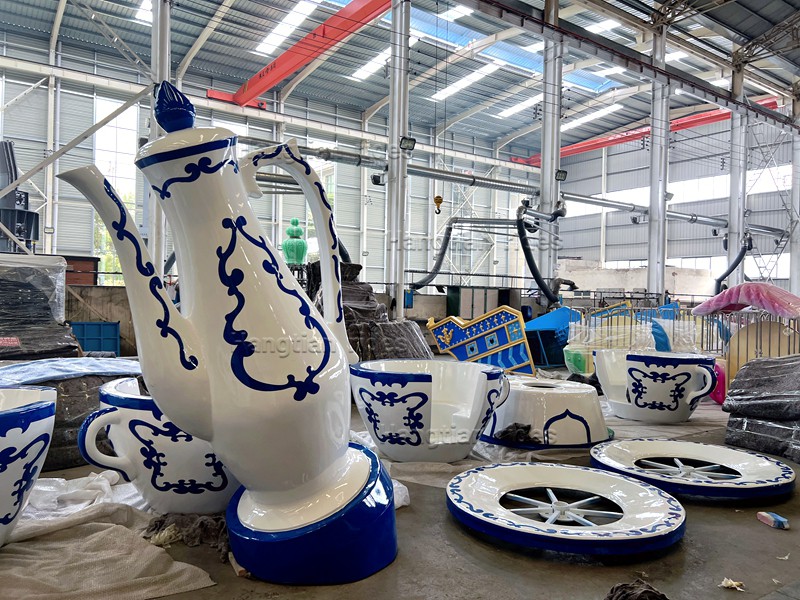
Safety assurance for tea cup rides for sale requires multi-layered control covering production standardization, pre-delivery testing and post-sales guidance, with all processes aligned to global amusement facility safety regulations.
I. Strict Production Process Control
The first step of safety control runs through the whole manufacturing process. All raw materials including steel frames, cockpit shells and electrical components must be tested for strength, flame resistance and insulation performance before entering the production line, to eliminate unqualified inputs from the source. Welding of the main support structure must be completed by certified technicians, and 100% non-destructive testing is required for each weld to avoid cracks or false welding that may cause structural damage during operation. The transmission system including motors, reducers and rotation bearings must be selected according to 1.5 times the maximum load design standard, to ensure sufficient safety redundancy even under long-term full-load operation. The emergency stop system should be installed in both the central control cabinet and each tea cup cockpit, with a response delay of less than 0.5 seconds to stop operation immediately when any abnormality occurs.
II. Pre-Delivery Compliance Testing
After production is completed, multi-dimensional testing must be carried out before the product is allowed to enter the market. First, conduct 72 hours of continuous no-load operation testing, recording the running stability of the turntable, rotation flexibility of each cockpit and temperature changes of the transmission system, to ensure no abnormal noise, vibration or overheating occurs during long-term operation. Then carry out 48 hours of full-load testing, placing simulated weight equivalent to the maximum passenger capacity in each cockpit, checking whether the main structure has deformation or settlement, and verifying the sensitivity of the emergency stop system under load conditions. Electrical safety testing is also mandatory, including insulation resistance testing, leakage protection testing and voltage adaptation testing, to ensure the equipment can operate safely under different regional power grid standards. All test data must be archived, and each product must be attached with a compliance certificate before leaving the factory.
III. Post-Sales Safety Guidance
Suppliers need to provide complete safety support for buyers after the product is sold. First, provide detailed installation manuals and send professional technicians to guide on-site installation if needed, to avoid safety risks caused by incorrect installation. Before the equipment is put into operation, conduct operation training for the park’s management personnel, covering daily inspection points, emergency handling procedures and passenger safety reminder specifications. Provide a clear regular maintenance schedule, including daily pre-operation inspection items, weekly transmission system lubrication requirements and annual full equipment inspection standards, to help operators maintain the equipment correctly during the whole lifecycle. During the warranty period, provide regular return visit services to track the operation status of the equipment, and replace worn parts in time to eliminate potential safety hazards.