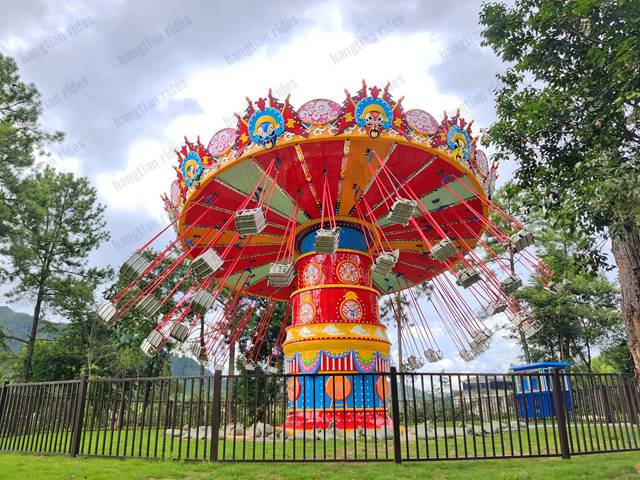
Operating the three Flying Chair Ride variants follows a core framework of pre-operation safety checks, controlled motion activation, and post-operation shutdown, with minor adjustments tailored to each model’s unique mechanics.
Pre-Operation Safety Checks (Universal for All Variants)
- Inspect all hanging chair harnesses and safety latches for wear or damage; ensure each latch locks securely to prevent passenger falls.
- Verify mechanical stability: Check swing arm tension for Swing and Electric Swing models, and rotation disk bearings for Rotating Flying Chair.
- Test emergency stop systems to confirm they trigger an immediate full stop of all motion.
- For Electric Swing Flying Chair, power on the digital control panel and run a 2-minute idle test to ensure smooth motor operation and uniform power distribution.
🎮 Step-by-Step Operation for Each Variant
First, here’s a quick comparison of core operational differences across the three variants:
| Variant |
Core Motion Control |
Unique Operational Step |
Typical Operating Speed/RPM |
| Swing Flying Chair |
Back-and-forth swing amplitude adjustment |
Lift swing arms to 2–3m height before activating swing |
0.5–1.5m peak swing amplitude |
| Rotating Flying Chair |
Rotation disk speed control |
Brief riders on passenger-controlled rotation (if available) |
10–15 RPM |
| Electric Swing Flying Chair |
Digital motorized swing + optional rotation |
Select pre-programmed ride mode via control panel |
1–2m swing amplitude; 8–12 RPM (if rotating) |
This table highlights key variables to help operators quickly reference model-specific requirements during daily operations.
- Guide passengers into assigned chairs, assist with harness adjustment, and confirm every rider is seated properly with no loose items in reach.
- Press the “Ascent” button to lift the swing arms to the pre-set operating height (typically 2–3 meters above ground, compliant with safety standards).
- Activate the “Swing” function, gradually increasing the back-and-forth amplitude to the maximum safe limit for the model.
- Monitor passenger behavior throughout the ride; reduce swing speed or initiate a slow stop if any rider shows signs of distress.
- Complete passenger boarding and safety checks identical to the Swing model; if the variant includes passenger-controlled cockpit rotation, brief riders on how to use this feature before starting.
- Start the central rotation disk at low speed, gradually accelerating to the designed operational RPM (usually 10–15 RPM for standard commercial models).
- For models with combined swing and rotation capabilities, activate the swing function after the disk reaches stable speed—this leverages the disk’s natural tilt to enhance riders’ swivel motion.
- Keep a constant eye on the ride’s balance; reduce rotation speed immediately if the disk shows uneven tilting or unusual noise.
- Conduct passenger boarding and safety verification, ensuring harnesses are adjusted for each rider’s body size.
- Use the digital control panel to select a ride mode (pre-programmed or custom) with desired swing amplitude and rotation speed (if applicable).
- Initiate the ride with a soft start, allowing the electric motor to build momentum smoothly to avoid jarring movements for passengers.
- During operation, monitor the control panel’s motor temperature indicator; pause the ride briefly if the temperature exceeds the safe threshold to prevent overheating.
🛑 Post-Operation Shutdown Protocol
- Gradually reduce all motion speeds to a complete stop, then lower the swing arms to the ground-level loading position.
- Deactivate all power sources and engage the main lock on the control panel to prevent unauthorized use.
- Perform a quick post-ride inspection of harnesses and mechanical components to identify any wear or damage from the session.
- Log ride operation duration, number of passengers, and any minor issues encountered for routine maintenance tracking.