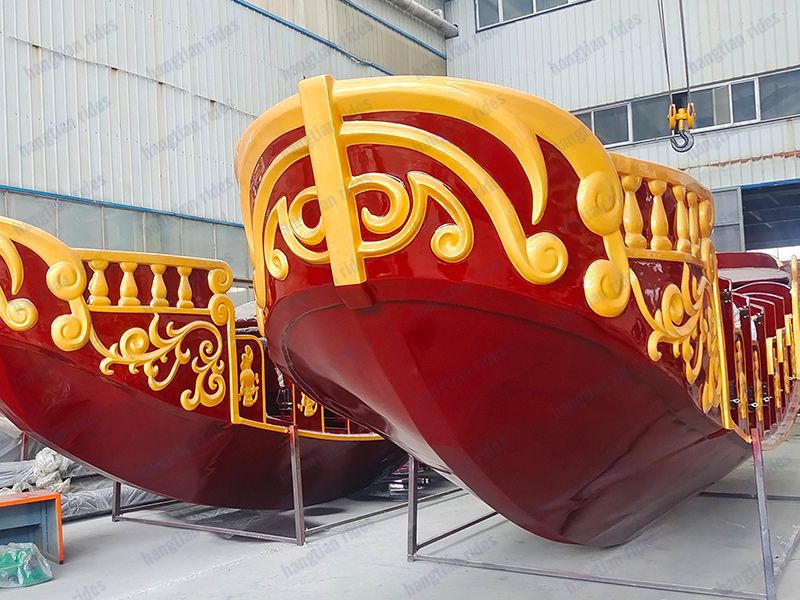
There is no widely documented specific invention date for the first Viking Ship Ride, but industry consensus places its emergence as a themed swing ship variant in the mid-20th century, directly laying the groundwork for pirate ship swing ride variants.
Since no official records of its exact invention date were found, amusement park industry consensus traces the first widespread Viking Ship Ride installations back to the 1950s and 1960s. It was developed as a themed twist on the classic swing ship ride, leveraging popular Viking-era imagery to boost rider engagement and differentiate itself in competitive park lineups.
📜Comparative Overview of Related Ride Variants
To clarify the core connections between the three ride types, here’s a breakdown of shared and distinct traits:
| Ride Type |
Core Mechanism |
Thematic Focus |
Peak Popularity Era |
| Swing Ship Ride |
Pivot-suspended swinging carriage |
Generic nautical/boat theme |
Early 20th century onwards |
| Viking Ship Ride |
Identical swing mechanism |
Viking historical imagery |
Mid-20th century onwards |
| Pirate Ship Swing Ride |
Identical swing mechanism |
Pirate adventure imagery |
Late 20th century onwards |
The Viking Ship Ride shares unbroken mechanical and experiential roots with traditional swing ship rides:
- Both rely on a large, boat-shaped carriage suspended from a central pivot, swinging back along an arc to create mild weightless sensations for riders.
- The core engineering principles, including tension-based suspension and momentum-driven motion, are identical—only themed aesthetics (Viking-style hull, decorative carvings) and occasionally slightly larger carriage sizes set the Viking Ship Ride apart.
The success of the Viking Ship Ride paved the way for pirate ship swing ride variants, which rose to popularity in the 1970s and 1980s:
- Park operators recognized the appeal of nautical-themed swing rides, shifting from Viking imagery to more universally recognizable pirate motifs (skull-and-crossbones, weathered hull designs) to broaden audience appeal.
- Mechanically, pirate ship swing rides retain the exact same swing arc and suspension system as Viking Ship Rides, with only minor adjustments to decorative details and carriage branding to fit the pirate theme.