Buyer Priorities | Procurement Standards | Payment Terms | Documentation | Pitfalls to Avoid
Preface
The Flying UFO (also known as Magic Disk, Space UFO, or Flying Disco) is one of the most popular medium-sized thrill rides in the amusement equipment market in recent years. It cleverly combines the swinging impact of a big pendulum with the reciprocating sway of a pirate ship, while叠加 high-speed turntable rotation. Passengers experience 360-degree rotation while sliding left and right along an arc-shaped track, feeling the dual stimulation of weightlessness and centrifugal force similar to space flight. From the standard 20-seat model to the enlarged 24-seat version, the Flying UFO has become a “crowd magnet” in major parks, scenic areas, and cultural tourism projects thanks to its sci-fi flying saucer styling, strong visual appeal, and high throughput.
However, the Flying UFO is classified as a large-scale amusement facility in the sliding coaster category. Its procurement decision involves multiple professional dimensions including equipment classification, certification compliance, drive systems, safety redundancy, civil foundations, and operating costs. A wrong selection can lead to inspection failure, low daily occupancy, high maintenance costs, or even hidden safety hazards.
This article systematically examines the ten core questions that buyers care about most when procuring Flying UFO rides, drawing on national special equipment safety regulations, industry technical standards, and firsthand manufacturing and operational experience, to provide a verifiable and actionable decision reference for procurement professionals.
Safety Red Line: Flying UFO rides are classified as large-scale amusement facilities (sliding coaster category). Their design, manufacturing, installation, modification, and repair all require corresponding special equipment qualifications. Based on operating speed and passenger capacity, equipment is divided into different classes, each corresponding to different licensing requirements and inspection standards. Buyers must treat certification compliance as a non-negotiable veto item — no price advantage can substitute for safety licensing.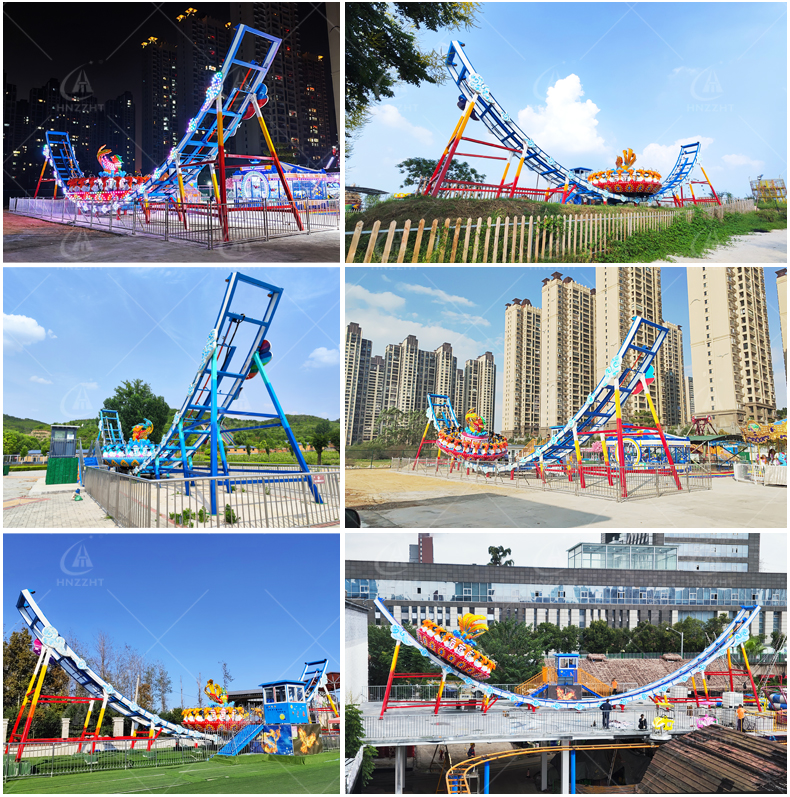
Certification Compliance & Equipment Classification
Equipment Classification and License Levels
The Flying UFO belongs to the sliding coaster category in special equipment classification. Its classification directly determines the manufacturing license level, inspection requirements, and operational supervision intensity. Based on operating speed and passenger capacity, equipment is divided into Class A and Class B. Buyers must first clarify the class of the equipment being purchased.

- Class A: Operating speed ≥5 m/s or operating height ≥10m; requires a manufacturing license issued by the State Administration for Market Regulation (SAMR) and type testing by a national-level inspection body
- Class B: Operating speed <5 m/s and operating height <10m; license issued by provincial market regulation department, provincial-level inspection
- The mainstream 20-seat Flying UFO has an operating speed of approximately 11.9 m/s and operating height of approximately 8m, typically managed as Class A
Note: Equipment classification follows the “higher of the two” principle — if either speed or height meets a higher class criterion, the equipment is managed at that higher class.
Core Certifications to Verify
- Special Equipment Production License: The manufacturer must hold a production license covering the corresponding class of sliding coaster facilities. Verify the permitted scope and validity period item by item.
- Type Test Certificate: Each specific model must pass type testing by a national or provincial special equipment inspection institute. One certificate per model is the core proof of equipment legality.
- Installation, Modification & Repair License: The installation unit must hold corresponding qualifications. After installation, the equipment must pass supervisory inspection before use registration can be processed.
- Supervisory Inspection Report: Mandatory inspection reports before factory shipment and after installation are essential documents for use registration and annual inspections.
- Export Target Market Certifications: CE and EN 13814 for the EU, ASTM F24/F2291 for North America, TÜV for Germany, SABER for some Middle Eastern countries.
Pitfall Warning: Some small factories may borrow another company’s qualifications or provide out-of-scope licenses. Buyers should verify certificate authenticity through the SAMR Special Equipment Public Information Query System, confirm that the production address matches the actual factory, and request the original type test report for the specific model.
Model Selection & Visitor Flow Matching
Mainstream Specification Comparison
| Comparison Item | 20-Seat Standard | 24-Seat Enlarged |
|---|---|---|
| Passenger Capacity | 20 persons | 22-24 persons |
| Track Length | approx. 30m | approx. 30-32m |
| Operating Height | approx. 8m | approx. 8-9m |
| Maximum Speed | approx. 11.9 m/s | approx. 12.2 m/s |
| Drive Power | approx. 50.5 kW | approx. 60 kW |
| Turntable Diameter | approx. 5.5-6m | approx. 6m |
| Footprint | approx. 27m × 11m | approx. 25-30m × 10-12m |
| Equipment Class | Class A | Class A |
| Applicable Scenarios | Medium parks, scenic areas, cultural tourism | Large parks, 4A/5A scenic areas, theme parks |
Note: The above are reference values for mainstream industry models; specific values are subject to each manufacturer’s official technical documentation.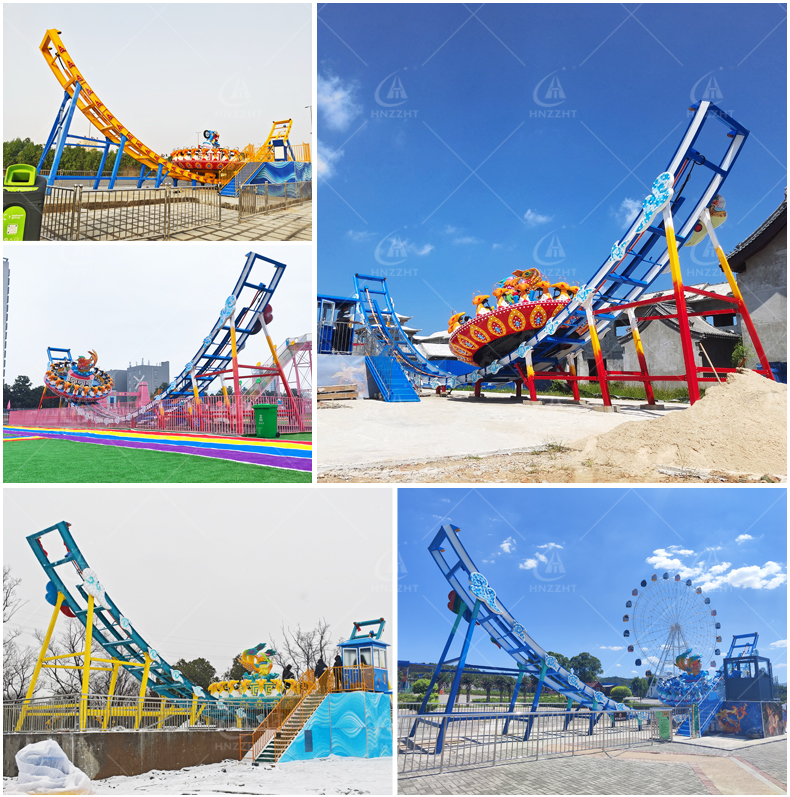
Selection Decision Logic
Choose 20-seat standard when: Site area is limited (under approx. 300m²), medium daily visitor flow, budget in the RMB 800K-1.2M range. Advantages: compact footprint, moderate investment, stable throughput — the cost-effective choice for small-to-medium parks. Disadvantages: relatively limited capacity, may cause long queues during holiday peaks.
Choose 24-seat enlarged when: 4A/5A scenic areas, large theme parks, high daily visitor flow with concentrated holiday surges. Advantages: larger capacity, stronger visual impact, higher hourly throughput (approx. 400-500 passengers), higher revenue ceiling during peak season. Disadvantages: higher investment, larger footprint, stricter foundation bearing capacity requirements.
Core Selection Principle: Visitor flow determines everything. Forcing a 24-seat ride into a low-traffic venue means frequent under-occupancy, wasting electricity and depreciation. Using a 20-seat ride during peak holiday crowds causes long queues and lost visitors. The right fit always matters more than bigger or more expensive.
Drive & Motion Systems
Dual-Motion Composite Principle
The core appeal of the Flying UFO lies in the “track sliding + turntable rotation” dual-motion composite:
- Track Sliding: Using an electric motor as the power source, after reduction through a gear reducer, it drives a friction wheel. The friction wheel contacts the UFO chassis, driving the entire UFO to slide back and forth along the crescent-shaped arc track, simulating the swinging impact of a big pendulum
- Turntable Rotation: The UFO turntable achieves 360-degree rotation through a rotary reducer driving a slewing bearing. Passengers experience centrifugal rotation while sliding
- The叠加 of two motions allows passengers to alternately experience weightlessness, hypergravity, and centrifugal force within one ride cycle — far richer in thrill layers than single-motion rides
Drive System Procurement Focus
- Motor and Reducer: Well-known brands (such as SEW, Guomao, Tongli, etc.) should be selected to ensure stable power output, low noise, and long service life
- Friction Wheel Material: High-wear-resistant polyurethane or rubber material. Confirm the replacement cycle and cost. Quality friction wheels can last 2-3 years, while inferior products need replacement within six months
- Slewing Bearing: The core component for turntable rotation. Select products from reputable manufacturers with factory inspection reports. The precision of the slewing bearing directly affects turntable operational smoothness
- Variable Frequency Control: Quality equipment uses VFD control to achieve smooth regulation of startup, acceleration, sliding, and deceleration, avoiding hard-start impacts on the structure and passengers
- Track Craftsmanship: Arc tracks should use seamless welding or precision butt joints, with smooth track surfaces free of steps, ensuring smooth sliding without jamming
Safety Protection System
Passenger Restraint System
- Safety Restraint Bar: The mainstream configuration is a pneumatic safety bar or ratchet-and-pawl bar. Premium equipment uses thickened pneumatic bars that auto-lock when inflated and remain locked when air pressure is lost (fail-safe design). Each seat’s bar operates independently with position detection
- Safety Belt: As secondary protection, made of high-strength polyester material with a special-tool-operated buckle. Some high-end models use five-point harnesses
- Dual Confirmation: After the operator checks each bar and belt, the platform safety confirmation button must be pressed before the ride can start
Operational Safety Protection
- Travel Limit: Dual protection of mechanical limits and electrical limits at both ends of the track prevents the UFO from exceeding the designed travel range
- Overspeed Protection: Equipped with speed sensors; automatically triggers braking when sliding or rotation speed exceeds the set value
- Emergency Stop Button: Both the control console and platform are equipped with red mushroom-head emergency stop buttons to cut power instantly
- Power-Off Protection: In the event of a sudden power outage, the equipment should decelerate slowly and safely dock at the platform position, rather than sliding freely
- Overload Protection: Motors and electrical systems are equipped with overload protection that automatically shuts down under abnormal loads
- Emergency Braking: Premium equipment’s emergency braking system undergoes strict testing, capable of stopping smoothly within 3 seconds under abnormal conditions
Structural Safety Requirements
According to GB 8408-2018, the maximum operating acceleration of Flying UFO-type equipment must not exceed specified limits, the main structure safety factor must not be less than 5.0, and emergency braking response time must be controlled within regulatory limits. Buyers should require the manufacturer to provide structural strength calculation reports and critical weld inspection reports. Connecting bolts between the arc track and supports should use Grade 8.8+ high-strength bolts with anti-loosening measures.
Structure & Materials
Steel Structure and Welding
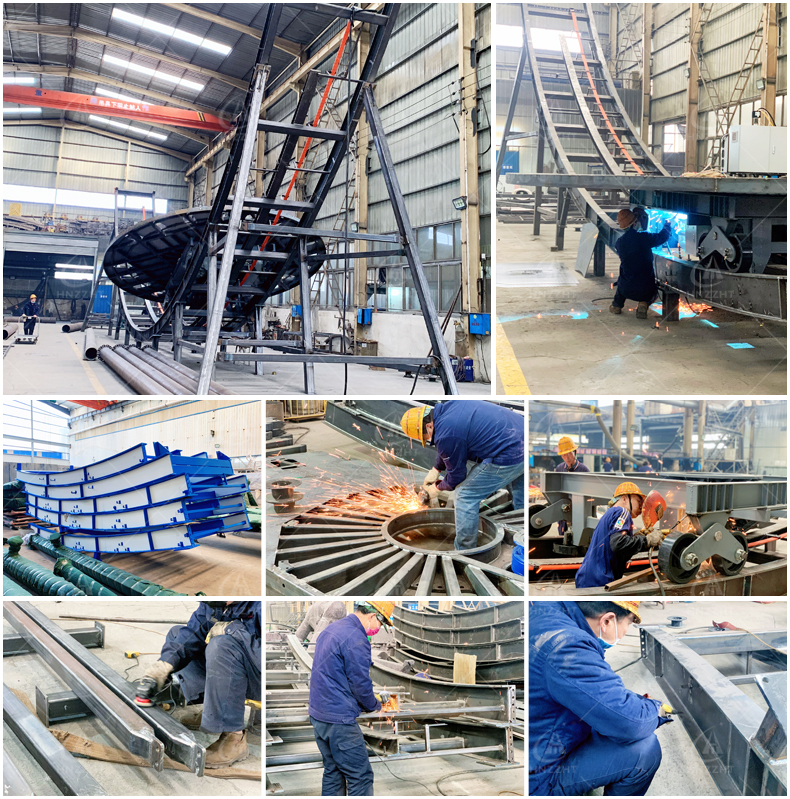
- Steel Selection: Arc tracks, supports, and load-bearing bases should use Q345 low-alloy high-strength steel or equivalent, with thickened seamless steel pipes and integrally welded bases for improved impact resistance
- Welding Process: Critical load-bearing welds use full penetration welding, followed by ultrasonic testing (UT) or magnetic particle testing (MPT) to eliminate weld cracks and incomplete fusion
- Pin Shaft Heat Treatment: Key pin shafts undergo quenching and tempering with hardness test reports
- High-Strength Bolts: Connection points use Grade 8.8+ hot-dip galvanized high-strength bolts, with alignment marks applied after installation for inspection
Surface Anti-Corrosion Treatment
Flying UFOs operate outdoors long-term, and anti-corrosion quality directly affects service life:
- Rust Removal Grade: All steel components must undergo shot blasting to Sa2.5 grade or above before painting, ensuring firm adhesion between the coating and steel substrate. Equipment without proper rust removal will show paint bubbling and internal corrosion within 1-2 years
- Multi-Layer Coating: Premium equipment uses a three-layer system of “epoxy zinc-rich primer + epoxy micaceous iron oxide intermediate coat + polyurethane topcoat,” with outdoor weathering life of 8-10+ years
- Annual Maintenance: After commissioning, load-bearing metal structural components should be inspected annually for anti-corrosion, with rust and paint damage promptly repaired
FRP Cabin and Decorations
- Material: UFO shell, cabins, and decorative parts use high-strength thickened fiberglass (FRP), environmentally friendly, non-toxic, impact-resistant, and aging-resistant. Load-bearing parts should be no less than 5mm thick
- Layup Process: Quality FRP uses a chopped strand mat + multi-layer platinum cloth layup structure, with iron-cloth reinforcement at embedded metal fittings
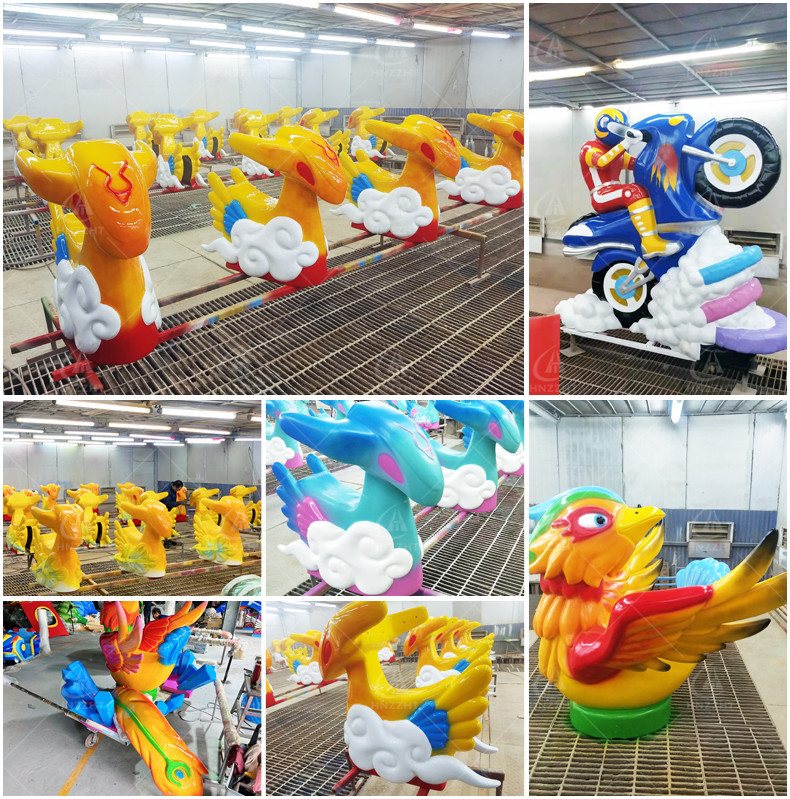
- Surface Finish: Automotive-grade high-temperature baking paint and hand-painted detailing produce vivid colors, strong three-dimensional effect, and long-term color fastness
- Seat Design: Ergonomic integrated seats with anti-slip footrests for comfortable and stable riding posture. All decorative details are smoothly polished with no burrs
Electrical & Control Systems
Core Electrical Configuration
- PLC Control: Premium equipment uses well-known brands such as Siemens, Mitsubishi, or Omron, with clear program logic and fault self-diagnosis capabilities. One-key automatic operation, timed operation, and speed adjustment are all program-controlled
- Variable Frequency Drive (VFD): A VFD controls the drive motor for smooth start and stop, avoiding passenger discomfort and structural impact from sudden starts/stops
- Safety Interlock Circuit: An independent safety interlock circuit includes bar position detection, platform safety confirmation, emergency stop circuit, travel limit, and overspeed protection. The equipment cannot start or stops immediately if any condition is not met
- Intelligent Linkage Protection: The equipment automatically alarms and stops during abnormal operation, with the UFO automatically resetting to the horizontal static position for safe passenger boarding and alighting
Electrical Safety Requirements
- Electrical cabinets and junction boxes must have a protection rating of no less than IP55, suitable for outdoor rain, snow, and high-temperature environments
- Use national-standard flame-retardant leak-proof cables and waterproof electrical boxes
- Motor insulation resistance must not be less than 1 MΩ, and protective earth resistance must not exceed 10 Ω
- Distribution cabinets are equipped with complete protection elements including leakage, overload, short circuit, and phase loss
- Control panels have clear labels and key switches to prevent unauthorized operation
Professional Advice: During procurement, require the manufacturer to provide electrical schematics, PLC program backups, and a bill of materials with brand and model for electrical components. This facilitates future troubleshooting and spare parts procurement, and prevents the manufacturer from charging high fees under the pretext of “program confidentiality.”
Site Requirements & Foundation
Site Requirements
- Footprint: The 20-seat model has an equipment footprint of approximately 27m × 11m. Adding safety fencing and queuing areas, the actual site requirement is approximately 30m × 14m. Buyers should request formal foundation drawings and site layout plans from the manufacturer
- Ground Bearing Capacity: The sliding motion generates significant reciprocating impact forces on the foundation. Foundation bearing capacity is typically required to be no less than 150-200 kPa. Soft soil foundations require reinforcement
- Overhead Clearance: No high-voltage power lines, building overhangs, trees, or other obstacles may exist above or within the swing range. The maximum operating height is approximately 8m, so sufficient overhead clearance must be ensured
- Drainage and Flood Prevention: The site should have proper drainage to avoid long-term foundation submersion
Foundation Construction
Flying UFOs typically use reinforced concrete strip foundations. The manufacturer provides detailed foundation construction drawings including:
- Foundation plan dimensions, depth, and concrete strength grade (typically not less than C30)
- Anchor bolt specifications, quantity, positioning dimensions, and embedding method
- Reinforcement arrangement drawings and grounding electrode requirements
- Foundation curing period and acceptance criteria
Foundation construction should be performed by a qualified civil engineering team. After completion, it must be inspected and accepted by the manufacturer’s technical personnel before equipment installation.
Power and Environmental Requirements
- Power supply: 3N+PE 380V/220V 50Hz three-phase five-wire system; the 20-seat model has a total power of approximately 50.5 kW
- Voltage fluctuation should not exceed ±10%, and frequency fluctuation should not exceed ±2%
- The equipment should have an independent distribution box separate from other electrical equipment
- Operating ambient temperature 0-40°C, relative humidity ≤90%, altitude ≤3000m; discontinue use when wind speed exceeds 15 m/s
- Night operation requires additional power for LED lighting and audio systems
Customization & Themed Packaging
Customizable Elements
- UFO Themed Styling: Classic sci-fi flying saucer, cartoon cute style, interstellar warship style, alien spaceship style, etc. The UFO top can be customized with iconic sculptures (such as aliens, planets, spacecraft logos, etc.)
- Color and Painting: Various color schemes including metallic silver, starry blue, flame red, rainbow colors, etc. The UFO shell can be printed with exclusive logos and themed patterns
- Lighting System: RGB full-color LED lights, with flowing light strips wrapping the supports and track, and ambient spotlights embedded in the UFO body. Supports multiple dynamic effects including steady on, gradient, rhythmic flashing, and synchronized flowing, with night lighting changing synchronously with sliding rhythm
- Audio System: High-fidelity surround sound with built-in sci-fi themed background music and space sound effects, with adjustable volume. Supports multi-language broadcast prompts and custom music import
- Seats and Interior: Seat color and material can be customized; some high-end models offer faux leather cushioning
Customization Considerations
- Customization increases production lead time and cost; custom content, delivery time, and fees must be clearly specified in the contract
- Request 3D renderings from the manufacturer for confirmation before production to avoid finished products not matching expectations
- Custom decorations must not compromise safety performance or maintenance access; all added components must undergo strength verification
- Customization involving IP imagery must ensure legal authorization to avoid infringement disputes
Total Cost of Ownership & ROI
Total Cost of Ownership Breakdown
| Cost Category | Specific Items | Notes |
|---|---|---|
| Initial Procurement | Equipment ex-factory price, customization fees | Largest share |
| Logistics and Shipping | Road transport or sea freight, insurance, loading/unloading | 3%-8% |
| Civil Foundation | Excavation, reinforced concrete, anchor bolts, grounding | 5%-10% |
| Installation and Commissioning | Manufacturer technician travel, installation labor, crane rental | 5%-8% |
| Inspection and Acceptance | Special equipment supervisory inspection fee, use registration fee | 1%-3% |
| Operating Energy | Electricity (by operating days and hours) | Accumulated yearly |
| Maintenance | Friction wheel replacement, bearings/seals, annual NDT, anti-corrosion touch-up | Accumulated yearly |
| Spare Parts Inventory | Motors, electrical components, bearings, LED lights, safety belts | Procured as needed |
| Labor Cost | Operators (requires 2), maintenance personnel | Accumulated yearly |
ROI Calculation Key Points
- Revenue Side: Hourly throughput × ticket price × daily operating hours × annual operating days. A 20-seat Flying UFO has a cycle of approximately 180 seconds, with an hourly throughput of approximately 360-400 passengers
- Cost Side: The above total cost of ownership allocated annually
- Payback Period: In a medium-sized park with stable visitor flow, a 20-seat Flying UFO typically has an investment payback period of 1-2 years; equipment design service life is 12-15+ years
- Sensitivity Analysis: Perform pessimistic/neutral/optimistic scenario analysis on visitor flow, ticket price, and operating days to avoid over-optimism
Cost Awareness: When requesting quotations, always ask the manufacturer to distinguish between “bare machine price” and “turnkey all-inclusive price,” and clarify whether foundation drawings, installation, and training incur additional fees — avoid endless add-on charges later. Ultra-low quotes often mean specification cuts, and ultimately the buyer pays the price.
After-Sales Service & Manufacturer Capability
Standard After-Sales Service Content
- Pre-Sales Survey: Quality manufacturers provide free site surveys, site layout planning, and foundation construction drawing guidance
- Installation and Commissioning: The manufacturer dispatches a professional technical team for on-site installation and commissioning, ensuring the equipment meets design performance and passes inspection
- Operator Training: Systematic training for operators and maintenance personnel covering equipment structure, operating procedures, safety precautions, daily checks, and common troubleshooting, with certificates issued upon completion
- Warranty Period: The industry standard whole-machine warranty is 12 months; some manufacturers offer extended warranties for core components
- Lifetime Maintenance: After the warranty period, paid lifetime maintenance is provided, including periodic inspections, fault repair, and technical upgrades
- Spare Parts Supply: The manufacturer guarantees original spare parts availability for at least 5-10 years after equipment discontinuation, with a free set of wearing parts provided at factory shipment
- Response Speed: 24-hour online technical support, simple faults resolved remotely within 2 hours, complex faults with engineers on-site within 48 hours
Maintenance Schedule Reference
| Frequency | Main Maintenance Tasks | Performed By |
|---|---|---|
| Daily | Pre-start check of restraint bars, seat belts, emergency stop button; check sliding contact line channel for foreign objects; run 2 no-load cycles to confirm no abnormal noise; power off, clean, and inspect fasteners after operation | Operator |
| Weekly | Maintain restraint bar mechanism, clean moving parts; check friction wheel wear; inspect track connecting bolts | Maintenance Staff |
| Monthly | Check motor insulation resistance and grounding resistance; inspect slewing bearing lubrication; test safety interlock circuit | Maintenance Staff |
| Quarterly | Friction wheel wear detection, replace if necessary; visual inspection of important welds; check high-strength bolt preload | Maintenance Staff |
| Annually | Inspect connection points of load-bearing metal structural components and perform anti-corrosion maintenance; NDT re-inspection of important welds; grounding resistance test before rainy season; cooperate with inspection agency annual inspection | Manufacturer / Inspection Agency |
Manufacturer Capability Assessment
The technical complexity and safety risks of the Flying UFO place high demands on a manufacturer’s R&D capability, production processes, and service system. Buyers should focus on: whether the company has an independent team of structural and electrical engineers, whether it has complete production lines including CNC cutting, welding, shot blasting, and painting, whether it possesses NDT equipment and capabilities, whether it has its own installation team, similar equipment installation cases from the past 3 years, export experience, and international certification capabilities. When possible, always arrange an on-site inspection to confirm it is not a private-label assembling trading company.
Conclusion
Flying UFO procurement is a systematic process. The core principle is “compliance first, quality as foundation, contract as evidence.” Buyers are advised to conduct thorough research before deciding, prioritize certified manufacturers with proven track records and reliable after-sales support, and never choose based solely on price. A well-built Flying UFO can operate reliably for over 12-15 years, serving as a dependable revenue-generating and crowd-attracting attraction in any amusement venue.
This guide is for procurement reference only. Specific technical parameters and commercial terms are subject to the actual contract and formal documents provided by the manufacturer.
Reference Standards and Sources:
- GB 8408-2018 Safety Code for Large-Scale Amusement Rides
- GB/T 18159-2019 General Technical Conditions for Sliding Amusement Rides
- TSG 71-2023 Safety Technical Specifications for Large-Scale Amusement Facilities
- GB 50017-2017 Standard for Design of Steel Structures
- EN 13814 (European Amusement Ride Safety Standard)
- ASTM F24 / F2291 (US Amusement Ride Standards)
- Special Equipment Safety Law of the People’s Republic of China