Designing the Iconic Ferris Wheel
From structural mechanics to passenger comfort, every Ferris wheel project demands a meticulous balance of engineering, safety, and aesthetics. This article explores the critical factors that shape modern Ferris wheel design.
Introduction to Ferris Wheel Design
Designing a Ferris wheel is a multidisciplinary challenge that integrates civil engineering, mechanical systems, materials science, and human factors. Unlike static structures, a Ferris wheel operates under continuous dynamic loading while carrying dozens or even hundreds of passengers. The design process begins with a clear understanding of the intended site, capacity requirements, and operational goals. Engineers must consider not only the physical loads but also the psychological comfort of riders, the visual impact on the skyline, and the long-term maintainability of the structure. Each decision — from the choice of steel grade to the configuration of the drive system — influences the final performance, safety, and economic viability of the ride.
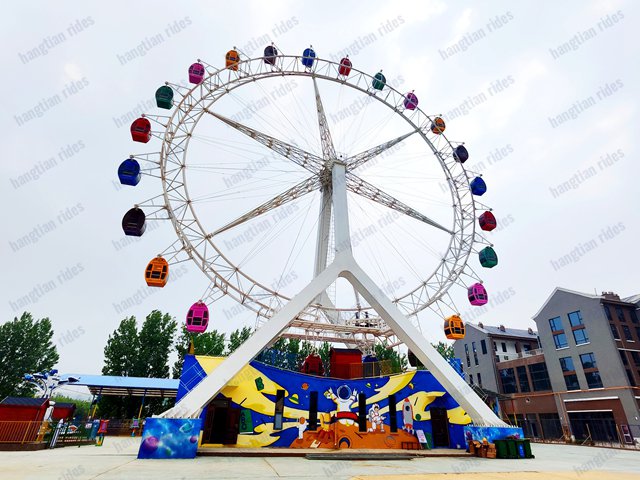
A well-designed Ferris wheel becomes a landmark, attracting visitors and generating revenue for decades. Therefore, the design phase must account for future operational scenarios, including peak tourist seasons, extreme weather events, and evolving safety regulations. Collaboration between architects, structural engineers, and ride specialists ensures that the final product is both visually striking and technically robust.
Structural Integrity and Load-Bearing Capacity
The structural framework of a Ferris wheel must withstand a complex combination of dead loads, live loads, wind pressures, and seismic forces. The primary support structure — typically an A-frame or lattice tower — transfers the weight of the wheel, cabins, and passengers to the foundation. Finite element analysis (FEA) is used to simulate stress distributions and identify critical points that require reinforcement. Material selection is equally crucial: high-strength low-alloy steel offers an excellent strength-to-weight ratio, while corrosion-resistant coatings protect against environmental degradation.
Load Analysis — Calculate static and dynamic loads including passenger weight, cabin mass, rotating components, and wind-induced oscillations. Safety factors typically range from 1.5 to 3.0 depending on the design code.
Material Selection — Choose steel grades (e.g., S355 or equivalent) with proven fatigue resistance. Welding procedures and inspection protocols are defined to ensure joint integrity and long-term durability.
Foundation Engineering — Design deep or shallow foundations based on soil bearing capacity and groundwater conditions. Pile foundations are common for large wheels to distribute loads evenly and prevent settlement.
Wind tunnel testing and computational fluid dynamics (CFD) simulations help predict aerodynamic behavior, particularly for wheels exceeding 100 meters in height. Engineers also incorporate tuned mass dampers or other passive control devices to mitigate vortex-induced vibrations, ensuring a smooth and stable ride experience even in gusty conditions.
Mechanical Systems and Drive Mechanisms
The mechanical heart of a Ferris wheel lies in its drive system, which provides controlled rotational motion while ensuring passenger safety and operational efficiency. Modern commercial Ferris wheels typically employ electric motors coupled with gearboxes and friction or pinion drives. The drive system must deliver sufficient torque to accelerate the wheel to its operating speed, maintain constant rotation, and bring it to a smooth stop. Redundancy is built into critical components — dual motors, backup generators, and emergency braking systems are standard features in contemporary designs.
Bearings and slew rings are precision-engineered to support radial and axial loads while allowing low-friction rotation. Lubrication systems are automated to reduce maintenance intervals and extend component life. In addition, sensors and programmable logic controllers (PLCs) monitor speed, position, and temperature in real time, enabling predictive maintenance and rapid fault detection. The integration of variable frequency drives (VFDs) allows for smooth acceleration and deceleration profiles, enhancing passenger comfort and reducing mechanical stress.
Passenger Experience and Safety Systems
The success of commercial ferris wheel rides depends largely on the quality of the passenger experience. Designers must consider cabin ergonomics, boarding and alighting efficiency, visibility, and climate control. Enclosed cabins with large panoramic windows offer all-weather comfort, while open gondolas provide a more thrilling, traditional feel. Interior lighting, audio systems, and interactive displays can enhance the ride, making it memorable for families, tourists, and event attendees.
Boarding Systems — Level boarding platforms, automatic doors, and assisted access for passengers with reduced mobility ensure smooth and inclusive operations.
Emergency Evacuation — Redundant egress routes, emergency descent systems, and communication links to control centers are mandatory for passenger safety.
Real-Time Monitoring — CCTV, load sensors, and intercoms allow operators to monitor cabin conditions and respond instantly to any incident.
Safety systems are designed to exceed international standards such as EN 13814 or ASTM F2291. Features include overspeed governors, anti-rollback devices, and dual-circuit hydraulic brakes. Regular inspections and non-destructive testing (NDT) of critical components are scheduled throughout the operational life of the ride. Comprehensive training for operators and maintenance staff is equally essential to uphold the highest safety culture.
Environmental Factors and Site Planning
Site-specific conditions profoundly influence Ferris wheel design. Wind climate, seismic zone, temperature range, and proximity to water bodies all dictate engineering choices. For coastal installations, salt spray corrosion resistance becomes a priority, requiring specialized coatings and stainless-steel fasteners. In seismic regions, base isolation or energy-dissipating devices are incorporated to protect the structure during earthquakes. The orientation of the wheel relative to prevailing winds can reduce aerodynamic drag and improve stability.
Urban planning considerations include visual impact, shadow studies, and integration with surrounding infrastructure. The wheel must not obstruct flight paths, traffic corridors, or neighboring buildings. Foundation design must account for underground utilities and existing structures. Environmental impact assessments (EIAs) are often required to evaluate noise, light pollution, and effects on local wildlife. Sustainable design practices — such as energy-efficient motors, regenerative braking, and solar-powered lighting — are increasingly adopted to reduce the operational carbon footprint.
Manufacturing, Supply, and Operational Economics
The successful delivery of a Ferris wheel project relies on a robust supply chain and manufacturing strategy. A reputable ferris wheel factory employs advanced fabrication techniques — including robotic welding, CNC machining, and pre-assembly testing — to ensure precision and quality control. Modular construction allows components to be manufactured off-site and transported efficiently, reducing on-site erection time and minimizing disruption to the surrounding area.
Selecting the right ferris wheel supplier is a strategic decision that affects project cost, timeline, and long-term support. Experienced suppliers offer comprehensive services ranging from conceptual design and engineering validation to installation supervision and after-sales maintenance. They provide detailed documentation, including structural calculations, operation manuals, and spare parts catalogs, enabling the operator to manage the asset effectively throughout its lifecycle.
Economic viability hinges on accurate cost estimation and revenue forecasting. Capital expenditure includes design fees, materials, fabrication, transportation, foundation works, and erection. Operational costs cover energy consumption, routine maintenance, insurance, and staffing. Revenue streams typically come from ticket sales, VIP experiences, event rentals, and sponsorship opportunities. A well-executed project can achieve a return on investment within 5 to 10 years, making it an attractive venture for theme parks, tourist destinations, and urban regeneration projects.
Ultimately, the design of a Ferris wheel is a holistic process that merges technical excellence with creative vision. By addressing structural, mechanical, safety, environmental, and economic factors in a balanced manner, engineers and developers create iconic landmarks that delight millions of riders worldwide.