
Break Dance Amusement Rides Buying Guide for 24 Seat Projects
Preface for buyers and operators
A Break Dance ride earns its place in an amusement park when the rotating-car experience fits the guests, the plot and the operating team. For a buyer, the useful question is how the quoted machine will behave on a real trading day: which cabins move together, which cabins spin independently, how families board, and what has to be checked between dispatches. Those details affect the layout, staffing, acceptance plan and ownership cost long before a colour scheme is selected.
This guide examines the 24-passenger self-rotating car ride identified as Break Dance in the product workbook. The described arrangement combines three main arms, nine arm-mounted two-seat cabins and three additional two-seat cabins. Its public-facing appeal comes from car-shaped seating, combined rotation, selectable movement modes and lighting. Its purchasing requirements come from that same complexity: a buyer needs configuration-specific evidence for the moving assemblies, restraint systems and controls, rather than relying on a generic spinning-ride photograph.
The ten questions below connect the product description to practical decisions about specifications, site preparation, inspection, contracts and maintenance. The specification table deliberately preserves an ambiguous speed entry instead of silently correcting it. Read the guide alongside a supplier quotation and mark each unresolved item with an owner and a due date. That turns a search for a break dance ride for sale into a project brief that engineering, procurement and operations can review together.
What are the design, material and movement highlights, and who does the ride suit?
Understand the two cabin arrangements
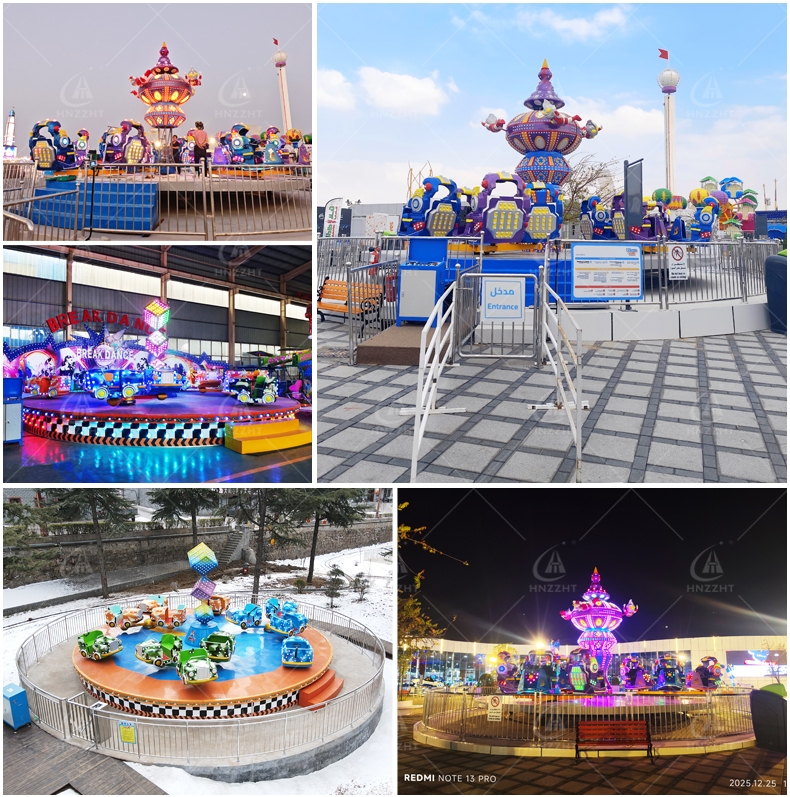
The distinguishing feature is the combination of arm-mounted cars and separate cars within one attraction. According to the source description, three arms each carry three two-seat cabins, while three further cabins add six seats. The arithmetic supports the stated 24-person capacity. Ask for a labelled plan identifying each position, because the words independent cabin do not establish a separate dispatch system or permission to run with an arm isolated. The car-shaped seats and visible rotation can help visitors understand the activity from the queue. Use photographs to discuss appearance, then use drawings to settle cabin count, boarding positions and the exact model being priced.
Separate visible finishes from structural evidence
The workbook names Q235B steel for the main structure and fiberglass for the cabin and central-column surfaces, with painted finishes and decorative lights. These are useful specification starting points. They do not establish plate thickness, weld acceptance, coating durability or an approved repair method. Request a material schedule and a finish sample linked to the order. For fiberglass parts, inspect edges, mounting interfaces, access panels and surfaces that riders can touch. The supplied photographs show several themes and installed layouts, so treat them as appearance examples. A background wall, light columns, colour combination or platform trim shown in a photograph must be itemised if it is expected in the purchased package.
Match compound motion to the intended audience
Central revolution combined with cabin self-rotation creates changing orientation rather than the predictable forward view of a conventional carousel. The source also describes alternate-arm lifting, simultaneous lifting and three speed selections. That makes the intended experience a central purchasing decision for family amusement rides: which approved programme serves accompanied guests, and which serves riders seeking more dynamic movement? Do not translate family positioning into unrestricted eligibility. Ask for model-specific rider limits and a demonstration of the proposed programme. Assess spinning sensitivity, boarding confidence, the clarity of restraint checks and how the ride complements neighbouring amusement park rides before committing the site to the attraction.
Which specifications are confirmed, and what needs written clarification?
Use one purchasing baseline
The table records the supplied workbook, not a certified engineering schedule. It lists 24 passengers, 16.5 kW total power, 1.9 m operating height, Ø9.5 m × 5 m equipment dimensions and a Ø13 m floor reference. Put this baseline into the inquiry and ask the supplier to accept or mark each departure. A different seat arrangement, central decoration or lifting mechanism may affect drawings, utilities and handling even when the product name stays the same. Keep the agreed revision attached to the quotation. A brochure sent later should not silently replace the signed configuration, and a decorative redesign should trigger a review of any affected technical interfaces.
| Item | Source entry and confirmation boundary |
|---|---|
| Product identification | Self-rotating car ride / Break Dance; workbook sheet 016 |
| Passenger capacity | 24 people |
| Cabin arrangement described | 3 main arms × 3 cabins × 2 seats, plus 3 separate cabins × 2 seats; 12 cabins in total |
| Supply stated in workbook | 380 V / 220 V; actual circuit allocation, phase and frequency require confirmation |
| Total power stated | 16.5 kW; included loads require quotation confirmation |
| Operating height stated | 1.9 m; datum and moving-part reference require drawing confirmation |
| Equipment dimensions stated | Ø9.5 m × 5 m; approved general arrangement to define axes and projections |
| Floor-area reference | Ø13 m; not a complete queue, service or emergency-access allowance |
| Speed entry as written | 3r/rpm; ambiguous source notation requiring written clarification |
| Materials described | Q235B structural steel; fiberglass cabin and central-column surfaces; painted finish and decorative lighting |
| Motion features described | Central revolution and cabin self-rotation; alternate-arm and simultaneous lifting modes; three selectable speed settings; steering-wheel control described for separate cabins |
| Protection features described | Restraint bars and belts; further claims concerning five-point harnesses, braking, power-loss descent and guards require delivered-configuration evidence |
Resolve the speed and electrical ambiguities
The source speed is written as 3r/rpm. This is not a sufficiently clear engineering unit, so the guide does not convert it into revolutions per minute, linear speed, acceleration or cycle duration. Ask which assembly is being measured, the unit intended, the nominal value and the permitted operating settings. Likewise, 380 V / 220 V does not prove that the complete ride can run from either supply without modification. Confirm phase, frequency, control voltage, motor loads, starting behaviour and the boundary of the 16.5 kW figure with the responsible electrical designer. Do not order a feeder or generator from the headline power figure alone.
Control claims that need additional evidence
The detailed copy includes broad claims about safety testing, temperature range, continuous running and company credentials. Such wording should prompt a document request, not become an unconditional promise in the purchase order or visitor advertising. Match each material claim to its certificate or agreed acceptance record, each protective function to its design and test evidence, and each environmental limit to the delivered manual. Where the source merely says operating height, request the datum and the part to which it applies. A written clarification register should distinguish confirmed requirements, offered options, excluded items and unresolved claims. Close consequential gaps before foundation design or production release.
How much space is needed for the ride, queue and service access?
Build the site plan around movement and access
The Ø13 m floor reference should not be treated as a complete public operating plot. The plan needs to distinguish the equipment envelope, moving cabins, foundations, barriers, entry and exit, waiting guests and service access. Lifting arms and spinning cars create different clearances from a stationary platform outline. Ask the supplier to show those envelopes on an approved drawing and have the site designer integrate them with neighbouring attractions. Plot the control position early so that entry points and relevant boarding areas are observable. Where a background wall is selected, include its structure and its effect on visibility, circulation and access to equipment behind the ride.
Test a family boarding sequence on the drawing
Walk through the sequence of a group arriving, checking eligibility, waiting, entering, choosing an assigned car, receiving a restraint check and leaving. That sequence exposes conflicts that a circular equipment outline hides. Families may need time to coordinate seats, and a separate cabin may have different interaction instructions from an arm-mounted cabin. The queue should communicate those differences before visitors reach the loading platform. Provide an orderly place for belongings according to the operating rules. Plan how staff direct a guest who decides not to ride, without sending that person against the next boarding group or across the movement boundary.
Issue a site readiness checklist
Before civil work starts, the buyer should assemble a site package that the supplier and local designers can comment on together. Ground conditions, drainage and utility routes must be assessed for the actual location. Decorative paving should follow the functional layout so that drainage changes do not create awkward steps at gates. Confirm delivery and lifting access as carefully as the public entrance: an assembled platform section must be able to reach its installation position. Ask who supplies barriers, steps, lighting and any operator shelter, then put those boundaries in the quotation.
- Obtain the approved layout, movement envelope, foundation interface and installation access plan.
- Mark queue, exit, maintenance access, electrical isolation and emergency routes on the same revision.
- Assign responsibility for ground assessment, drainage, power design and delivery access; record the required completion dates.
How should controls, ride cycles and daily capacity be evaluated?
Define the operating modes before training
The workbook describes two lifting patterns, three speed choices and steering-wheel control for the separate cabins. Request a mode schedule showing which settings can be combined, when selection is permitted and which staff role has authority to select them. Passenger interaction should be explained precisely: which cabins have the wheel, what movement it influences and what limits remain under the control system. Do not infer that every passenger can change speed or that attendants can alter programmes during a cycle. Use the agreed schedule to develop briefings, queue signs and training scenarios so that the guest promise matches the installed controls.
Turn seats into a realistic operating forecast
Twenty-four seats describe capacity per fully occupied dispatch, not hourly attendance. A planning model can multiply available seats by dispatches per hour and average occupancy, then allow for operating availability. Each input needs site evidence or a clearly labelled assumption. Measure the complete cycle from one boarding opportunity to the next, including unloading, restraint checks, briefing and normal delays. Avoid calculating dispatches from the ambiguous source speed. Compare weekday and peak-period scenarios separately. Revenue also depends on the ticket arrangement, discounts and whether admission bundles include the ride; none of those commercial inputs are supplied in the workbook.
Observe the tasks that govern dispatch
During a demonstration, time the work as well as the motion. Record how attendants assign two-seat cars, manage mixed groups, check restraints and communicate with the operator. Confirm whether all relevant areas are visible from the proposed console and how staff communicate when sound effects are active. A dispatch target must leave room for the approved checks and for a rider to change their mind. Agree an initial operating review after real use: compare queue behaviour, incomplete loads, comfort feedback and interruptions against the forecast. This gives the operator a defensible basis for improving guest flow without improvising the approved movement or protection settings.
How should the buyer verify safety, compliance and foreseeable risks?
Match documents to the delivered machine and destination
Ask the supplier and a competent local adviser to identify the applicable route for the installation country, equipment classification and intended use. Obtain documents that name the manufacturer, model and relevant configuration, rather than accepting a collection of unrelated logos. Check the scope, issuer, revision and validity of any certificate offered. The workbook is not proof that a particular delivered unit has obtained approval for a destination. UK HSE guidance, for example, addresses inspection, maintenance and competent personnel within its own jurisdiction; it is a useful management reference, not a universal licence for an export ride. Record local review milestones in the procurement schedule.
Specify evidence for restraints and stopping behaviour
The source describes restraint bars and belts and later refers to five-point harnesses, emergency braking, power-loss descent and anti-pinch protection. Those statements need reconciliation with the exact seat design and operating manual. Ask for evidence showing the fitted arrangement and the approved checks; do not assume that all pictured cars carry the same system. Require the supplier to explain the intended response to a normal stop, emergency stop, power interruption and relevant fault. Stopping rotation, lowering an arm and releasing a restraint are different functions. Demonstrations must follow an approved test procedure supervised by competent personnel, with no improvised fault trials involving guests.
Plan recovery and rider communication
A written response plan should allocate who stops the ride, controls the queue, communicates with riders, calls technical support and authorises a return to service. For this attraction, discuss how guests would be assisted if an arm or cabin did not return to its normal boarding position. The method requires the delivered design and site arrangements, so a generic instruction to release the belt is not an acceptable substitute. Provide staff with approved eligibility information and an explanation of the spinning experience. Record incidents and significant abnormal behaviour with the operating mode and cabin position so the supplier can investigate the actual configuration.
What should factory acceptance reveal about structure, finish and function?
Inspect the configuration before the demonstration
Prepare a factory acceptance schedule before the machine is ready to ship. Count the cabins and seats, identify the three arms and separate positions, and match major components to the agreed list. Review material identification and the inspection evidence specified in the contract for relevant structures and joints. Painted surfaces cannot by themselves establish the condition of a concealed weld. Ask the supplier to identify any components that will be dismantled for transport and the records needed to verify reassembly. Photograph agreed identification points and number deviations so the record can follow the equipment from factory to site.
Examine finishes where appearance meets use
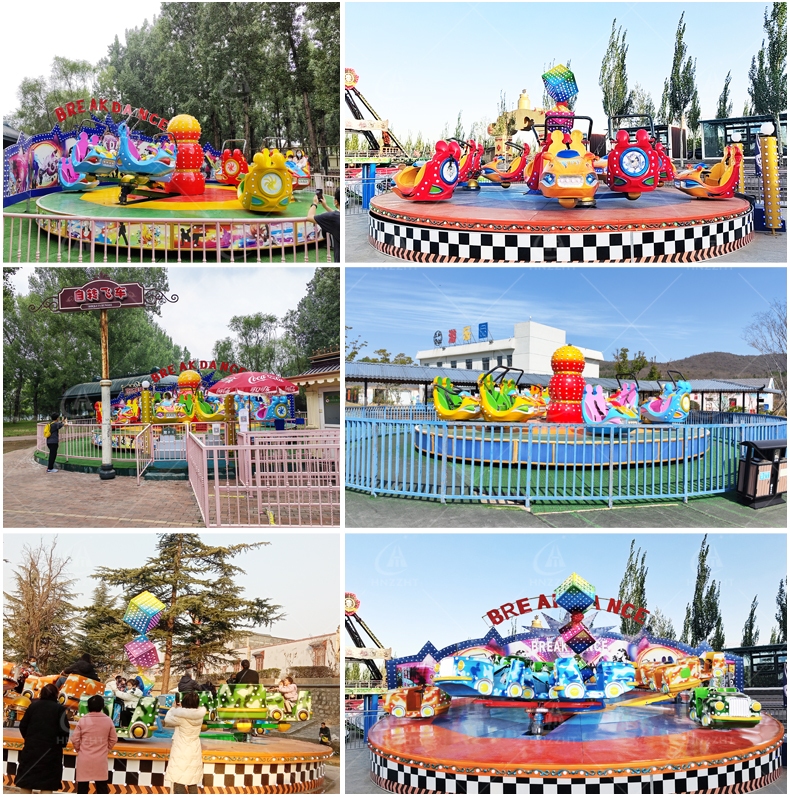
Inspect fiberglass edges, seat surfaces, hand-contact areas, panel fixing points and service openings. Look for damage, poor fit, exposed edges and inaccessible fasteners, and ask the supplier to resolve them against the agreed acceptance criteria. For coatings, compare colour and finish with the accepted sample under ordinary viewing conditions. Check the relationship between lights, their cables and moving parts. The workbook mentions background decoration, illuminated columns and platform trim, but these elements need their own packing and mounting scope. The second photo group illustrates varied configurations and perimeter treatments; it does not establish a particular barrier design or lighting package for the order.
Record a functional demonstration that can be repeated
Witness the approved operating modes and the functions included in the factory test plan. Record the model identity, programme selected, test conditions, observations and who signed the result. Where a relevant protective function cannot be demonstrated at the factory, identify the reason and the required site test instead of leaving the item untracked. Do not accept a short promotional video as equivalent to the agreed inspection. Separate cosmetic corrections from functional or documentary gaps, assign a closure date to each, and connect shipment release to the agreed evidence. Retain records that the installation team can use when checking the same assemblies after transport.
What should a quotation and purchase contract include?
Compare the complete opening cost
A useful Break Dance ride price comparison separates the machine price from the cost of getting the attraction into service. Ask each amusement equipment manufacturer to quote the same 24-seat arrangement, agreed modes and appearance scope. List packing, transport, insurance, customs responsibilities, unloading, lifting, foundations, electrical works, installation support, training and local inspection separately. Add initial spares and the cost of a support visit where these are relevant. The workbook provides no verified selling price, freight rate, energy bill or payback period. Present a quotation-based range for the actual project once inputs exist, rather than borrowing a price from a differently sized ride online.
Tie payments to identifiable deliverables
Agree payment events that can be evidenced, such as approval of drawings, completion of the agreed factory review, shipment documents and the contracted site handover. The percentages and remedies belong in the negotiated contract, not in an assumed industry rule. Specify the currency, named delivery location, trade term and allocation of taxes and charges. Define how a change to car shape, lighting, background wall or controls affects price and schedule. If remote installation assistance is offered, clarify language, working hours, required site skills and what happens when the issue needs a physical visit. A low equipment subtotal can conceal a much larger coordination burden.
Write a configuration and support annex
The contract annex should let a different employee understand what was purchased without reconstructing weeks of messages. Identify drawings and manuals by revision and establish how later changes are approved. Define warranty commencement, scope, exclusions and the evidence needed for a claim. Ask for a spare-part identification method and an escalation contact, without assuming a response time that the supplier has not committed to. Before signing, check that the sales summary, technical annex and acceptance schedule describe the same ride.
- Specify 24 seats, the accepted cabin layout, movement programmes, restraint configuration and electrical interface.
- List included decoration, platform components, barriers, control equipment, packaging, training and initial spares, with explicit exclusions.
- Name factory and site acceptance records, drawing deadlines, support arrangements, change approval and responsibility for unresolved items.
How should delivery, installation and site acceptance be organised?
Release shipment against site readiness
Coordinate delivery with foundations, power availability, lifting access and the installation team. Request packing dimensions and weights for the actual shipment rather than estimating from the assembled dimensions. Check where crates and delicate decorative parts will be stored if weather or site work delays assembly. On arrival, compare packages with the packing list and photograph damage before components are moved or fitted. Establish a contact route for shortages. A container reaching the park does not mean the ride can be installed that day; the site schedule should include unloading, condition checks, assembly, commissioning, training and local review.
Use a controlled commissioning record
Installation should follow the supplier’s approved method and the locally required responsibilities. Keep the assembly record connected to the foundation acceptance, component identification and technical drawings. Before functional testing, confirm that the required mechanical and electrical inspections have been completed by the assigned competent personnel. For this ride, record cabin position references so observations about rotation, lifting or restraint operation can be traced to the relevant assembly. Commissioning tests must use the approved procedure and acceptance criteria. If a correction changes the delivered configuration, update the drawings and operating documents as well as the physical machine.
Separate completion from permission to receive guests
Site acceptance should close the agreed installation tests, outstanding delivery items and training requirements. Hand over the operating and maintenance manuals, spare-part references, relevant inspection records, contact details and the local documents needed for use. Demonstrate that the operating team can perform the approved opening checks and explain each permitted mode. Establish a named person to decide whether all required conditions for opening have been met. A visually complete attraction may still lack a document, test or local permission that matters. Record those gaps explicitly and do not present a supplier’s installation sign-off as a substitute for the destination’s required approval process.
How should maintenance, spares and lifetime cost be planned?
Organise maintenance around the moving assemblies
Create a component map linking the central drive, arms, cabin rotation assemblies, restraints, controls and decorative electrical circuits to the manual and parts list. Use the delivered instructions for intervals, methods and acceptance limits; the catalogue does not supply those values. The practical issue for a compound-motion ride is traceability: a note saying unusual noise is less useful than a record naming the cabin, arm, mode and point in the cycle. Provide a consistent way to report wear, loosening, rubbing, damaged cables or restraint concerns. Abnormal findings need competent assessment and a documented decision before the affected equipment returns to use.
Buy spares by configuration and consequence
Ask for recommended start-up spares with part numbers, quantities, lead times, storage needs and any revision dependencies. Distinguish an appearance item from a component that can affect a protective function or stop the attraction from operating. Stock decisions should consider how quickly the specific part can reach the park and who can fit and verify it. A similar-looking belt, sensor or electrical component is not automatically interchangeable. Agree the route for approving substitutes and for identifying superseded parts. Keep a photographic and serial-number record of relevant assemblies so remote support can discuss the installed hardware rather than a catalogue variation.
Budget for ownership using measured use
The stated 16.5 kW figure does not reveal annual electricity consumption or total maintenance expense. Build the ownership budget from operating hours, measured demand, local tariffs, staffing, inspection, consumables, spare logistics and the contracted support scope. Record downtime and its cause so repeated interruptions become visible. Review cleaning and coating care against the actual environment and the manufacturer’s instructions, particularly where dust, rain or salt exposure is relevant. The source’s broad environmental marketing language should not be treated as a weather-operating limit. Seasonal closure, reopening and any change in operating intensity should be discussed with the responsible technical team and reflected in the maintenance plan.
What must be settled before ordering and before opening?
Complete the purchasing decision record
Bring commercial, site and operating staff together around the same configuration. The decision should explain the attraction’s role among existing amusement rides, the intended audience, the realistic plot and the supplier’s evidence package. Record assumptions about occupancy and dispatch separately from verified product data so financial optimism does not become a technical specification. Resolve the ambiguous speed entry and the electrical interface before they drive other purchases. A reliable amusement ride supplier should be able to identify what is included, what requires engineering confirmation and when the outstanding information will be issued.
- Confirm the 12-cabin, 24-seat layout and the exact programme and restraint configuration to be delivered.
- Approve the site interfaces and complete the quotation comparison, including exclusions and support costs.
- Agree the document register, acceptance schedule, change process and responsibilities for local approvals.
Close the recurring buyer questions
Can the ride operate from 220 V? The workbook’s dual-voltage entry is insufficient to decide; obtain the delivered electrical schedule. Does Ø13 m include a queue? The source does not say so, and the public layout needs a separate review. Is it a track-based spinning coaster? The described product is a central-axis, car-cabin ride, so search aliases should not redefine its mechanism. Can every cabin be controlled by a steering wheel? The source assigns that interaction to separate cabins and the delivered layout must identify them. Is 24 passengers an hourly figure? It is a per-dispatch seat capacity; a service forecast also needs measured cycle and loading assumptions.
Make the opening decision and request a comparable quote
Before receiving guests, close the commissioning record, required local reviews, staff training and approved operating information. Check the actual entrance, cabin allocation, control position and emergency access against the final plan. Confirm that the team knows whom to contact and what records to provide when a problem occurs. Break Dance amusement rides can offer a recognisable rotating-car experience, but the purchase becomes practical when configuration, site work, guest handling and support are agreed together. For a comparable proposal, send the supplier your destination, available plot, guest profile, intended opening period and requested 24-seat arrangement. Final engineering, foundations, electrical design, compliance, safety, rider restrictions and operating conditions require the delivered model’s approved documents, competent professional review and local confirmation.
Source note
Product facts: 2025 product-copy workbook, sheet 016 自转飞车, parameter and description rows, reviewed 5 September 2026. Photographs: supplied 37th product image set, self-rotating car folder, local copy of the provided materials. General management references: UK HSE guidance for ride controllers and fair organisers, linked below; its jurisdiction-specific duties must not be assumed to apply worldwide. Buyer checklists and commercial modelling suggestions are editorial recommendations, not delivered-model specifications. Public search results reviewed on 5 September 2026 support the relevance of Break Dance ride, ride for sale and manufacturer intent. No Google Keyword Planner or Search Console volume data was available, so no search-volume or ranking claim is made.
Further reading and related buying guides
For related categories, explore the carousel buying questions, Tagada product questions and self-control aircraft range. Compare each category using its own configuration and approved documentation.