Family Roller Coaster Buying Guide for 16 Passenger Amusement Parks
Preface for buyers and operators
A family roller coaster can give a park a recognisable track attraction without positioning the experience as a high-thrill coaster. Buyers still face a serious engineering and operating project. Track geometry, foundations, train clearance, drive behaviour, restraints, evacuation access and dispatch work must fit the proposed site. A colourful dragon train may attract families from the midway, but the purchasing decision should begin with the delivered configuration and the evidence needed to open it legally and operate it consistently.
This guide examines the Family Roller Coaster recorded in the supplied product workbook. The source lists a 16-passenger train, 125 m of track, a 4.9 m operating height, a 30 m by 18 m area reference, 15 kW total power and a 380 V or 220 V supply entry. It also describes a dragon-inspired train, two cooperating drive sections, spiral track movement, sound and themed lighting. These entries form an inquiry baseline. They do not replace an approved general arrangement, foundation loads, electrical schedule, rider eligibility rules or destination approval.
Current commercial search results commonly use phrases such as family roller coaster for sale, small roller coaster ride, kids roller coaster and family coaster manufacturer. This article uses those terms where they help a buyer find relevant information, together with broader terms such as amusement rides and amusement park equipment. It does not claim search volume, ranking or indexing results. The ten questions below turn a product search into a controlled procurement plan covering the site, quotation, factory review, installation, operations and long-term support.
What makes this family roller coaster distinctive and does it suit the project audience?
Read the dragon theme as a design scope
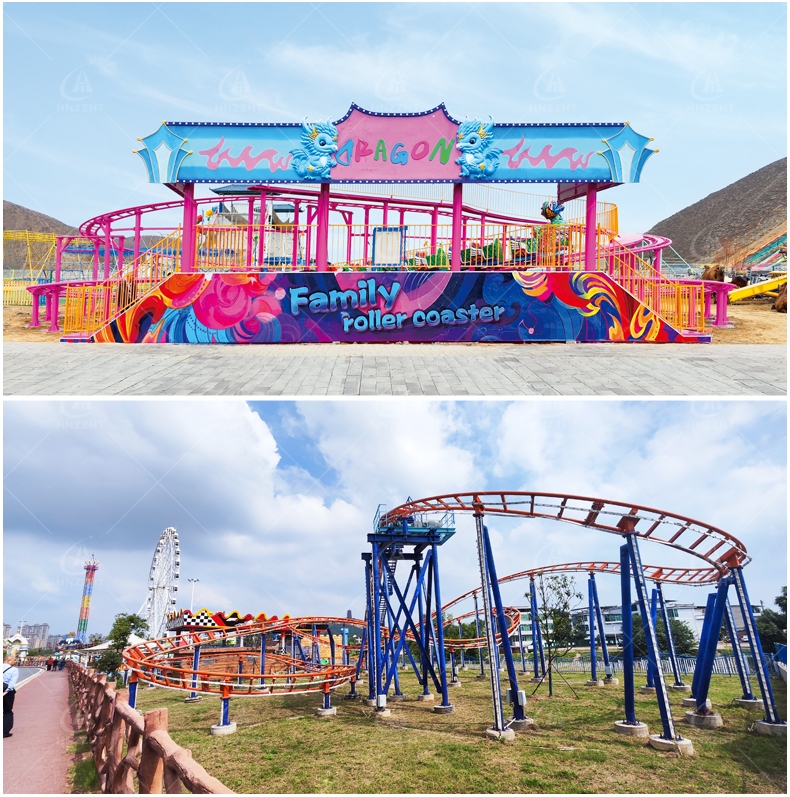
The source describes a streamlined dragon train with scales, horns, bright colour and lighting. This provides a clear family-facing visual identity, especially when the station and queue share the theme. A buyer should convert the description into an appearance schedule: approved renderings, paint references, train-car details, sign locations, lighting components and replacement access. Photographs help the team discuss style, but each photograph may show a different installation or finish. Ask the amusement equipment manufacturer to mark which decorative elements, station panels and lighting items are included. Theme changes should pass a technical review because added panels, cables or shapes can affect mass, clearance, maintenance access and wind exposure.
Match the ride experience to real guests
The workbook positions the equipment as a family-friendly roller coaster with moderate slopes and curves. That supports a planning conversation about accompanied children, mixed-age groups and guests moving up from gentle family rides. It does not establish unrestricted access for every age or body size. Request the delivered model’s rider restrictions, restraint fit information and operating programme before writing signs or marketing copy. Observe how the train enters curves, climbs and descends during an approved demonstration. Compare the experience with nearby amusement park rides, the park’s noise plan and the confidence level of the intended visitors. The project succeeds when the attraction fills a defined role in the ride mix and the operating team can explain that role accurately.
Which product specifications are verified and which details need written confirmation?
Use the workbook values as the inquiry baseline
The verified source entries are 16 passengers, 15 kW total power, a 4.9 m operating height, 125 m of track and a 30 m by 18 m area reference. Put these values in the request for quotation and require the supplier to confirm, revise or qualify each one. The table should stay attached to the offered model and drawing revision. Do not combine figures from another small roller coaster for sale, even when its train looks similar. Seat count, track routing, supports and drive sections work as a system. A change that appears cosmetic may alter delivery loads, foundations or electrical demand. The signed specification should identify the manufacturer, model, serialisation approach, drawing list and agreed options so that commercial and engineering documents describe the same equipment.
| Item | Source entry and confirmation boundary |
|---|---|
| Product identification | Family Roller Coaster; workbook sheet 017 |
| Passenger capacity | 16 people per fully occupied train; hourly throughput requires a measured dispatch cycle and operating assumptions |
| Power supply entry | 380 V / 220 V; phase, frequency, circuit allocation and compatibility with the delivered model require confirmation |
| Total power | 15 kW stated; confirm included motors, controls, lighting and auxiliary loads |
| Operating height | 4.9 m stated; confirm the datum, track elevation and highest moving or structural point on approved drawings |
| Track length | 125 m stated; confirm measured centreline, route geometry and final drawing revision |
| Area reference | 30 m × 18 m; does not establish the complete queue, exit, clearance, maintenance or emergency-access plot |
| Train and theme | Dragon-inspired train with decorative scales and horns described; final car count, seating layout, finishes and lighting scope require an order-specific schedule |
| Drive description | Two cooperating drive sections at the front and rear are described; drive type, control logic, redundancy and stopping behaviour require delivered-model evidence |
| Track experience | Intertwined spiral route, moderate slopes and curves are described; actual speed, acceleration, cycle and rider limits are not stated in the workbook |
| Passenger protection | Restraint bars and belts are mentioned in the appearance description; the installed restraint design and inspection method require configuration-specific approval |
| Sound and lighting | Themed sound and lighting are described; content, controls, power demand, weather rating and inclusion in the quotation require confirmation |
Close the missing engineering definitions
Several values need context before site design. The 4.9 m height requires a datum and confirmation of the highest track, train or structure point. The 30 m by 18 m figure needs axes, projections and separation from public areas. The 380 V or 220 V entry needs phase, frequency, control voltage and circuit allocation. The 15 kW figure needs a load schedule showing what it includes and what starting demand the site must support. Request track centreline geometry, support reactions, foundation interfaces, clearance envelopes, train mass, permitted operating conditions and the control narrative. Speed, acceleration, cycle duration and rider limits are absent from the workbook, so they must come from approved delivered-model documents rather than an online comparison.
How should the site layout, queue and access routes be planned?
Expand the equipment rectangle into an operating plot
The 30 m by 18 m reference is a starting envelope, not a complete site plan. The project drawing should show supports, foundations, train clearance, station, operator position, entry, exit, queue, fencing, drainage, electrical isolation and maintenance access. A roller coaster needs access along relevant track and support areas, not merely at the loading platform. Confirm how personnel reach inspection points and how tools or replacement components can be brought in without crossing uncontrolled public movement. Coordinate foundations with underground services and storm-water routes. Leave delivery and lifting access for long track sections and train components. The approved general arrangement should be reviewed against actual boundaries, neighbouring amusement rides, landscaping, lighting poles and future construction before civil work begins.
Test the family journey from arrival to exit
Draw the guest process on the same plan. Visitors need to see eligibility information before committing to the queue, organise family groups, secure belongings, receive seat assignments and leave without meeting incoming guests. The operator must see the loading area and the controls needed for dispatch. Staff also need a route for a guest who declines to ride at the platform. Consider stroller parking and waiting companions according to site rules, while keeping emergency and maintenance access clear. Queue capacity should reflect measured demand rather than filling every available gap. Review handrails, gates, walking surfaces and drainage as part of the operating system. A visually attractive station cannot compensate for crossing flows, hidden platform areas or a service route blocked by the queue.
How should drive controls, ride cycles and daily operations be evaluated?
Ask for a control narrative for the two drive sections
The workbook says two drive sections cooperate at the front and rear. That statement should lead to a configuration-specific explanation of drive type, start sequence, speed supervision, stopping, fault response and permitted operating states. The buyer should not interpret two drive sections as automatic redundancy. Ask what happens when a sensor, drive unit, communication path or power circuit reports a fault, and which actions require maintenance authority. Identify the normal, inspection, manual and recovery controls provided with the delivered model. The operator interface should use clear indications that correspond to the manual and wiring drawings. Training needs to cover the meaning of alarms and the conditions for reset, with records of who may operate, inspect and release the attraction after an interruption.
Build throughput from observed dispatch work
Sixteen passengers describe a full train, not hourly capacity. Measure the interval from one loading opportunity to the next, including unloading, boarding, restraint checks, announcements and normal delays. Throughput can then be estimated from available seats, observed dispatches, average occupancy and operating availability. Keep every assumption visible. Family groups may leave unused seats because of party size or approved seating rules, and younger riders may need extra boarding time. The workbook gives no verified cycle duration, ticket price, attendance or availability percentage. Use several scenarios instead of a single payback claim. During trial operation, record incomplete loads, dispatch variation and stoppage reasons so staffing and queue communication can improve without shortening required checks or changing an approved ride programme.
How should safety, compliance and foreseeable operating risks be verified?
Map the delivered model to the destination rules
Applicable requirements depend on the installation country, jurisdiction, ride classification and intended operating arrangement. Ask a competent local adviser to identify the approval path, required submissions, inspections and responsible parties. ASTM F2291 provides design criteria for amusement rides, while other jurisdictions may use EN standards, national rules or additional local procedures. The contract should name the standards and editions accepted for the project after professional review. Check that every certificate, report and drawing refers to the offered manufacturer, model and configuration. A logo or generic certificate is not evidence for a particular train, track or restraint. Schedule document review early enough to resolve gaps before manufacture, foundations or shipment create expensive changes.
Verify restraints, clearances and recovery arrangements
The source mentions restraint bars and belts, but it does not define the installed geometry, interlocks, passenger limits or inspection criteria. Obtain drawings, instructions and test evidence for the delivered train. Confirm how staff check each occupied position, how the system indicates readiness and how a fault affects dispatch. Review clearance envelopes for riders, cars, track, structures and nearby objects with the approved drawings. Develop recovery and evacuation procedures for credible stopped positions; the method must reflect track access, height, site equipment and local emergency arrangements. UK HSE guidance emphasises competent inspection, prompt maintenance and controlled return to service. Use such guidance as a management reference within its scope, while following the destination’s legal requirements and the manufacturer’s approved instructions.
What should factory acceptance examine before shipment?
Inspect traceable track, supports and train components
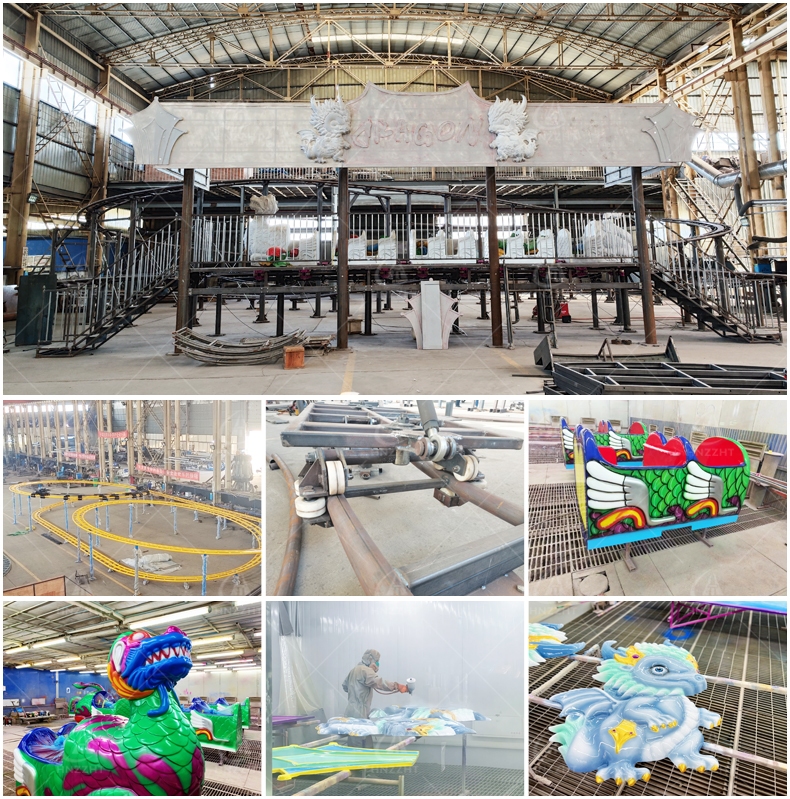
Prepare the factory acceptance plan before production finishes. Match track sections, supports, drive assemblies, train cars, restraints, control cabinets and fasteners to the agreed bill of materials and drawings. Review the contractually required material and fabrication records, identification marks and inspection results. Painted surfaces do not reveal the condition of concealed work, so the acceptance plan should identify evidence to review before coating or assembly when appropriate. Check fit-up points that will be separated for transport and record reference dimensions or alignment marks needed at site. The supplied manufacturing photograph shows work-in-progress track and themed components, which is useful for discussing inspection stages. It does not prove that every pictured component belongs to the purchased unit.
Witness functions and manage deviations
The factory demonstration should follow an agreed procedure and record the model, drawing revision, test conditions, loaded or simulated state, control mode and observations. Inspect train movement, stopping, indications, restraints, station interfaces, sound and lighting to the extent possible at the factory. Identify which checks must wait for completed site foundations and the final track assembly. Log each deviation with a description, evidence, responsible party, due date and closure requirement. Separate appearance corrections from engineering or documentation gaps. Shipment release should depend on the evidence agreed in the contract, rather than a short video or verbal assurance. Keep photographs and records organised by component identifier so the installation team can compare condition after transport.
What should the quotation, contract and purchasing schedule include?
Compare the complete cost to reach opening
A family roller coaster price comparison should use the same technical baseline and separate the equipment subtotal from project costs. Request line items for the train, track, supports, drive, controls, station elements, decoration, sound, lighting, restraints, packing, freight, insurance, customs responsibilities, unloading, lifting, installation support, training, initial spares and documentation. Foundations, site power, drainage, queue works, barriers and local inspection may sit outside the supplier’s package, but their interfaces still need definition. The workbook contains no selling price, freight estimate, energy use, maintenance cost or return period. Build a project budget from written quotations and local estimates. Record exclusions and assumptions beside each figure so a cheaper subtotal is not mistaken for a lower opening cost.
Link payment and schedule events to evidence
The contract should identify the exact configuration, drawing register, approval sequence, production milestones, factory acceptance, packing records, shipment documents, installation support and handover deliverables. Payment percentages and remedies are commercial terms for the parties to negotiate, but each event should be objectively verifiable. Define how design changes are requested, priced, reviewed and incorporated into drawings and manuals. State the delivery term, named place, currency, tax and insurance responsibilities. Clarify warranty scope, start date, exclusions, response route and evidence required for a claim. If remote support is included, specify language, hours and escalation. Keep open technical questions in a controlled register; do not let an unanswered message become an assumed contract promise.
How should transport, installation, commissioning and final acceptance proceed?
Coordinate foundations, access and shipment information
Foundation work should use approved loads, geometry, anchor details and local design review for the actual ground conditions. Confirm tolerances, survey references, drainage and earthing before equipment arrives. Request the packing list, package dimensions, weights, lifting points and storage requirements for the shipment. Long track sections and themed train parts may need planned turning space and protected laydown areas. On arrival, inspect packages against the list and record damage before assembly. Keep component identifiers visible through unloading and installation. The 30 m by 18 m product reference cannot be used to size cranes, trucks or storage. A coordinated logistics plan prevents completed landscaping, gates or overhead services from obstructing the approved installation sequence.
Commission in stages and hand over controlled records
Commissioning should proceed through documented mechanical completion, electrical checks, alignment, control verification, functional testing, required load tests, staff training and destination inspection. The exact sequence and acceptance values must come from approved project documents and competent personnel. Record corrections and repeat affected tests after changes. Operators should demonstrate normal start-up, restraint checks, dispatch, normal stopping, emergency actions and shutdown according to the manual. Maintenance staff need inspection points, lubrication or adjustment instructions, lockout arrangements and fault escalation contacts. Final handover should include as-built drawings, manuals, software or parameter records where applicable, parts lists, test results, training records and unresolved-item status. Engineering completion and permission to admit passengers are separate decisions.
How should maintenance, spare parts and lifecycle cost be planned?
Build the maintenance register around the actual route
Create an asset register for track sections, supports, fasteners, wheels or running assemblies, train connections, restraints, drive units, brakes, sensors, controls, cables, sound and lighting. Link each item to the delivered manual, inspection frequency, method, acceptance limit and responsible role. A record such as noise at track section T07 during the second circuit is more useful than a general note that the ride sounded different. Trend wear, alignment findings, restraint issues, faults and downtime by component and operating condition. Repairs that affect a safety function need competent review and the documentation required by the applicable rules. HSE guidance notes that rides degrade over time and that routine or extraordinary maintenance should be performed promptly by competent people.
Buy spares from failure impact and support time
Ask the amusement ride supplier for a recommended commissioning and operating spares list with part numbers, quantities, compatibility, shelf life, storage conditions and typical replenishment time. Distinguish appearance items from parts that affect dispatch or protection functions. Stock decisions should reflect local import time, the ability of site personnel to replace the item and the verification needed before return to service. Similar-looking sensors, restraints, wheels or electrical components are not automatically interchangeable. Annual ownership cost should combine measured energy use, staffing, inspections, consumables, planned work, corrective repairs, transport and contracted support. The 15 kW source value is a connected-load reference, not an annual consumption forecast. Update the budget with site records after opening.
What final decisions must be closed before ordering and before opening?
Use separate order and opening gates
Before ordering, confirm the 16-passenger configuration, 125 m track, 4.9 m height definition, 30 m by 18 m interface, electrical requirements, theme scope, applicable standards, drawing programme, acceptance plan, logistics, support and exclusions. Before opening, confirm installation records, completed tests, local approval, staff competence, operating documents, maintenance resources, emergency arrangements and closure of significant deviations. Keep commercial assumptions such as attendance and ticket price separate from technical acceptance. The buyer’s decision record should name the document revision and person responsible for each open matter.
- Approve a configuration schedule, site interface drawing and evidence register before production release.
- Confirm quotation scope, change control, factory acceptance, transport responsibilities and handover documents in the contract.
- Authorize public operation after required inspection, training, testing and destination approval are complete.
Send an inquiry that produces comparable answers
Tell prospective suppliers the destination, available plot, ground information, utility supply, target audience, operating calendar, expected opening date and required theme. Attach the verified baseline and ask them to identify every departure. Request a preliminary layout, technical schedule, foundation and electrical information plan, document list, production lead time, acceptance proposal, packing concept, installation responsibilities, training scope and initial spares. Ask how the proposed family coaster fits the stated riders without turning a marketing label into an eligibility rule. A useful response allows engineering, procurement and operations to review the same offer. Final engineering, foundations, electrical design, compliance, safety measures, passenger restrictions, operating conditions and local approvals must follow the approved documents for the delivered model, competent professional review and destination requirements.
Source note
Product-specific facts come from the 2025 product-copy workbook, sheet 017 Family Roller Coaster, reviewed on 6 September 2026. Images come from the supplied 37th product-image set, Family Roller Coaster folder. General procurement and safety-management guidance refers to the linked ASTM F2291 page and UK HSE guidance; their applicability and current edition require destination review. Public search results reviewed on 6 September 2026 support the relevance of family roller coaster for sale, small roller coaster ride, kids roller coaster and manufacturer wording, but no Google Keyword Planner or Search Console volume was available, so this guide makes no search-volume or ranking claim. Buyer checklists are editorial guidance, not delivered-model specifications.
Sources and related buying guides
For related categories, compare this family coaster with carousel, Tagada and self-control aircraft guides using each ride’s own approved configuration.