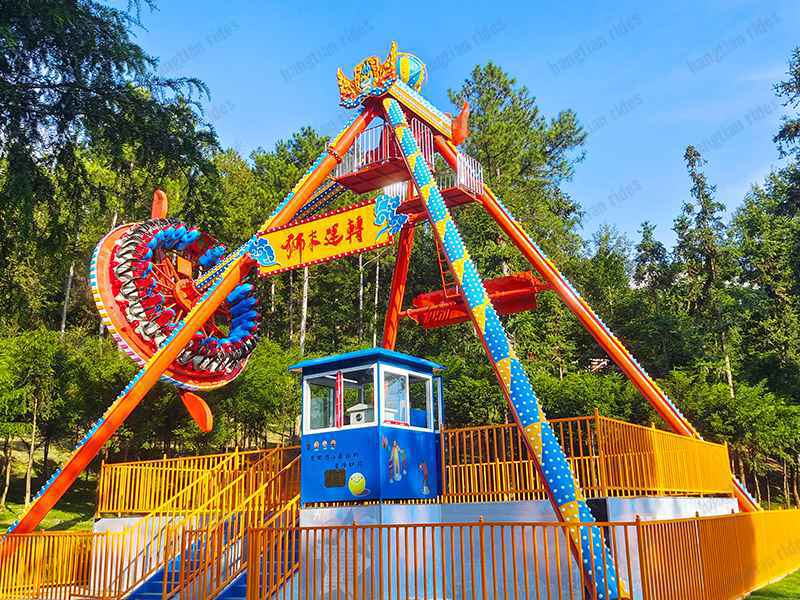
Pendulum rides captivate amusement park visitors with their hypnotic swinging motion and exhilarating drops. These attractions leverage fundamental physics principles to create gravity-defying experiences. Below, we break down their mechanics, types, and unique dynamics.
⚙️ Core Mechanics: The Science Behind the Swing
A classic
pendulum ride operates like a giant suspended pendulum. Key components include:
- Central Axis & Arm: A rigid arm rotates around a fixed central axis.
- Passenger Cabin: Mounted at the end of the arm, often with free-rotation capability.
- Drive System: Electric motors or hydraulic pumps initiate and sustain motion.
Physics in action:
- Potential → Kinetic Energy: The cabin is lifted to its highest point, storing gravitational potential energy.
- Arc Motion: As it swings downward, energy converts to kinetic energy, accelerating toward the lowest point.
- Centrifugal Force: At peak speeds, outward force pins riders to their seats during high arcs.
🔄 Three Thrilling Variations
1. Classic Pendulum Swing Ride
- Motion: Single-axis swinging in a fixed arc (e.g., 90°–120°).
- Experience: Predictable, family-friendly oscillations ideal for all ages.
- Safety: Mechanical brakes limit swing angles to prevent over-rotation.
2. Spinning Pendulum Ride
- Dual Motion: Combines swinging with independent cabin rotation.
- Dynamics: Centrifugal force amplifies as the cabin spins mid-swing, creating variable G-forces.
- Riders Feel: A disorienting “tumble” effect during peak rotation.
3. Pendulum Roller Coaster
- Hybrid Design: Integrates pendulum motion with coaster tracks (e.g., oscillating lifts followed by drops).
- Innovation: Uses swing momentum to propel trains through inversions without chain lifts.
🛠️ Engineering & Safety Innovations
- Redundant Braking Systems: Fail-safe electromagnetic brakes activate if swing angles exceed thresholds.
- Asymmetric Force Distribution: Counterweights balance load during erratic motions, minimizing structural stress.
- Chaotic Motion Control: Advanced sensors adjust motor torque in real time to manage unpredictable oscillations.
Critical Insight: Modern pendulum rides intentionally harness chaotic dynamics—like those in the Lorenz system.to generate unpredictable thrills while ensuring rider safety through algorithmic stabilization.
🌐 Why Pendulum Rides Dominate Theme Parks
- Space Efficiency: Vertical operation requires smaller footprints than traditional coasters.
- High Throughput: Rapid loading/unloading cycles accommodate large crowds.
- Versatility: Adaptable to themes (e.g., pirate ships, space capsules).
🔮 Future Evolution
Emerging trends include:
- AI-Driven Dynamics: Customizable swing patterns based on rider weight distribution.
- Regenerative Energy Systems: Converting kinetic energy into electricity to power park infrastructure.
- Enhanced Materials: Carbon-fiber arms enabling lighter, faster swings.
Conclusion: The Art of Controlled Chaos
From the rhythmic sway of a
pendulum swing ride to the hybrid intensity of a
pendulum roller coaster, these marvels blend Newtonian physics with cutting-edge engineering. By mastering principles like energy conversion, centrifugal force, and chaotic motion, designers create unforgettable thrills that push boundaries—all within rigorously calculated safety frameworks. As technology advances, expect pendulum rides to redefine aerial excitement while maintaining their timeless swinging allure.