Sky Bicycle Ride Procurement Guide: 10 Questions Buyers Should Resolve Before Ordering
Evaluate a 16-passenger pedal-controlled Sky Bicycle Ride using verified 13 kW specifications, site, motion, restraints, maintenance, contract and acceptance checks.
Buyer decision note: Final engineering parameters, passenger eligibility, restraints, pedal and control functions, inspection methods, compliance route, intellectual-property permissions and opening approval must be confirmed from the delivered model’s approved documents and competent local parties.
Preface: confirm the category before resolving the buying decision
Current search results reveal a naming problem that buyers must solve before comparing prices. Sky Bicycle Ride, Sky Bike, Air Bicycle Ride and Flying Bicycle can refer to very different products: a central rotating amusement ride with pedal-controlled passenger units, a suspended monorail bicycle, or a wire-rope sky-cycle attraction. This article concerns only the workbook-defined rotating ride. Its planning data are 16 passengers, 13 kW total power, 380 V/220 V supply, 2.9 m operating height, 2.9 m/s operating speed, Φ8.2 m × 5.3 m equipment dimensions and a referenced Φ11 m floor area.
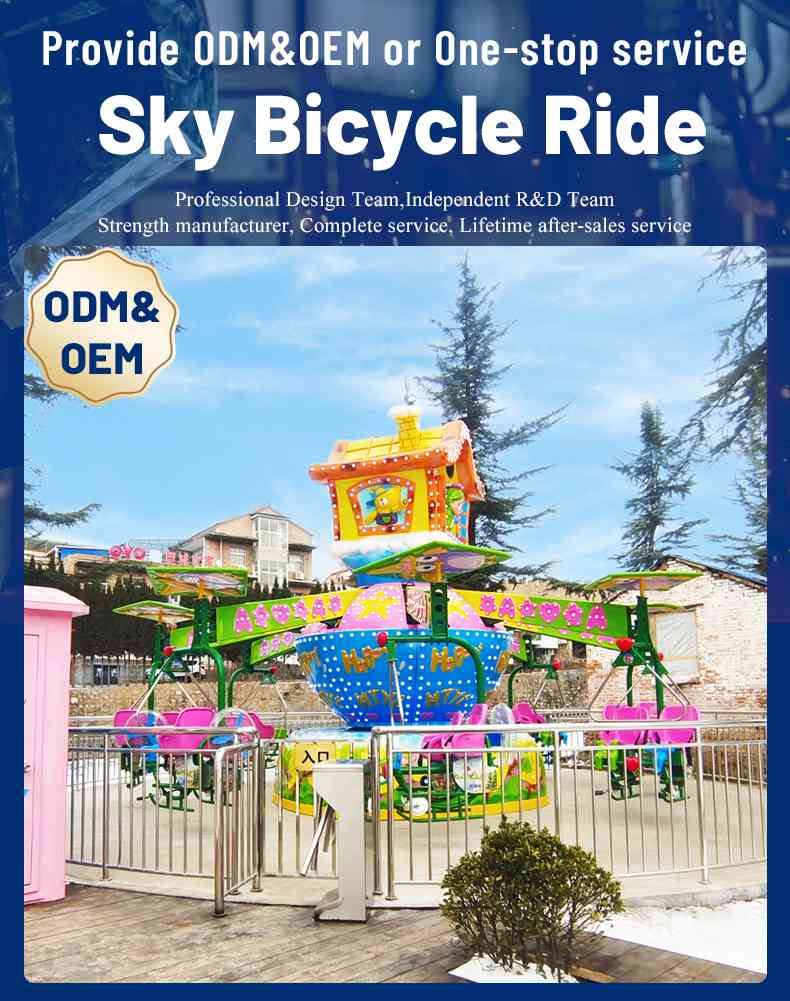
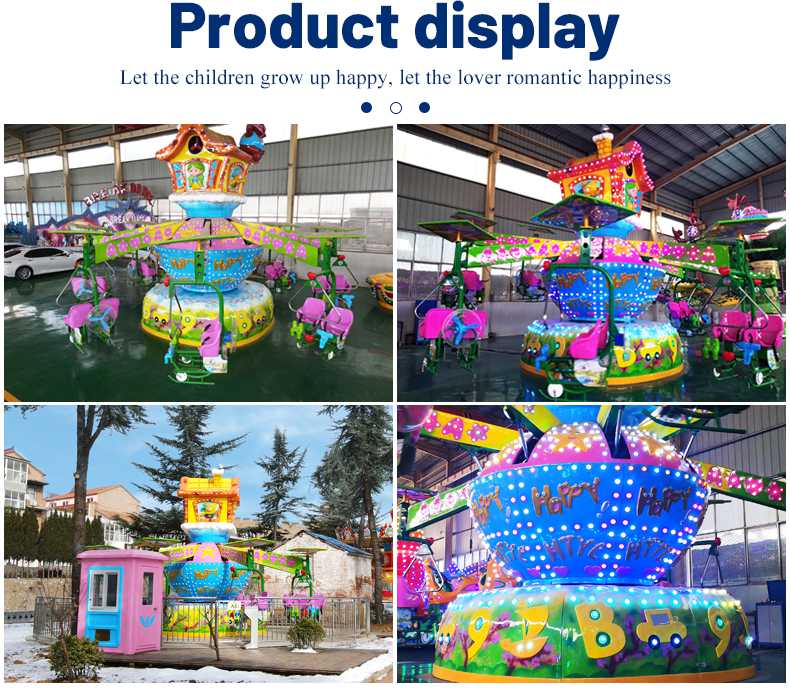
The workbook describes eight radial arms with two seats on each arm. Riders pedal to influence the height of their own passenger unit while the complete ride revolves around a central structure. Colourful fiberglass decoration, lights, music and rear fan-blade forms create the visual identity. The promotional text also refers to adjustable seat height, multiple motion modes, servo motors, intelligent diagnostics, emergency functions, certifications and inspiration from a well-known animated film. These statements should become RFQ evidence requests. They must not be treated as automatic delivered-model facts or licensed intellectual property.
This guide organises procurement around ten major buyer decisions and develops the detail through numbered subheadings. Search terms are used naturally to help relevant discovery, while model parameters remain restricted to the supplied workbook. General safety and operational principles are informed by CPSC and IAAPA sources. Final engineering, passenger eligibility, restraints, control functions, inspection criteria, applicable standards, intellectual-property permissions and opening approval must be confirmed from approved delivered-model documentation and competent local parties.
Verified product specification
| Product name | Sky Bicycle Ride / Ling Kong Man Bu |
|---|---|
| Power supply | 380 V / 220 V |
| Total power | 13 kW |
| Operating height | 2.9 m |
| Operating speed | 2.9 m/s |
| Equipment dimensions | Φ8.2 m × 5.3 m |
| Referenced floor area | Φ11 m |
| Passenger capacity | 16 persons |
| Workbook configuration description | Eight arms, two seats per arm, pedals beneath the seats and rear fan-blade decoration |
| Experience description | Central revolution with rider-pedalled ascent/descent, colourful GFRP decoration, lighting and audio |
| Buyer verification note | Confirm the meaning and measurement point of height/speed, final seat plan, pedal mechanism, movement envelope, restraints and control logic in approved delivered-model documents |
1. Is this the correct Sky Bicycle Ride category for the venue and target guests?
1.1 Separate the rotating ride from sky-cycle and monorail products
A buyer searching for a Sky Bicycle Ride may find central rotating rides, pedal cars suspended from overhead rails and bicycles travelling on tensioned cables. These products have different engineering, rescue, staffing, site and regulatory requirements. The RFQ should lead with the workbook profile: a 16-passenger central ride with eight described arms, two seats per arm and pedal-controlled rise or descent. Include photographs and a movement description, then require the supplier to confirm that every technical response applies to this category rather than another product that shares the keyword.
1.2 Define the commercial role before comparing quotations
This attraction can serve as an interactive family-zone anchor, a visually distinctive moderate-thrill ride or a romantic night-time feature supported by colour and music. Each role changes the specification. Family projects may prioritise accompaniment rules, low-pressure loading and caregiver visibility; shopping centres may focus on height, sound and fire interfaces; outdoor parks may emphasise drainage, weather and corrosion. State the target guests, venue type, indoor or outdoor condition, operating calendar, adjacent attractions, desired intensity and opening date before requesting price.
1.3 Translate audience claims into approved rider rules
The workbook positions the ride for families, friends, children and adults, but that language is not an eligibility schedule. Obtain approved height, age, accompaniment, health, mobility and passenger-combination rules. Confirm whether every pair of seats can accept an adult and child, how seat adjustment works, how operators screen riders and what happens when a party cannot be loaded safely. Website copy, ticket information, queue signs and operator scripts must use the same approved restrictions.
1.4 Build a buyer-intent keyword map without keyword stuffing
Use Sky Bicycle Ride for sale and Sky Bicycle Ride manufacturer for commercial discovery, with pedal flying ride, self-control flying ride and rotating lifting family ride as explanatory terms. Mention sky bike or air bicycle only when clarifying that this is not a cable or monorail product. A focused page should answer specification, site, interaction, capacity, maintenance, compliance and quotation questions rather than repeat synonyms. That structure improves relevance for serious buyers and reduces enquiries for the wrong category.
2. Which parameters and configuration details are verified?
2.1 Use the workbook values as the planning baseline
The verified parameter table lists 380 V/220 V, 13 kW, 2.9 m operating height, 2.9 m/s operating speed, Φ8.2 m × 5.3 m equipment dimensions, Φ11 m referenced floor area and 16 passengers. These values support preliminary site screening and RFQ comparison, not civil construction. The approved data sheet and general arrangement must define the measurement point and operating condition for 2.9 m and 2.9 m/s, the meaning of the 5.3 m dimension and how the Φ11 m area relates to the complete moving and safety envelope.
2.2 Confirm eight arms, two seats per arm and the final seat plan
The appearance and feature descriptions state eight arms around the central column, two seats on each arm and 16 passengers in total. This arithmetic is consistent, but the supplier should still issue an approved seating plan showing arm identification, seat positions, passenger space, entry paths, pedals, handholds, restraints and permitted passenger combinations. The quotation, drawing, nameplate, manuals, test records, inspection forms and spare-parts catalogue should use the same configuration and identifiers.
2.3 Freeze a model-specific configuration schedule
List the verified values plus central structure, arm and passenger-unit arrangement, pedal mechanism, powered movements, seat adjustment, restraints, platform, stairs, fence, gates, operator station, lighting, audio, decoration, controls, installation, commissioning, training, manuals and spares. Mark each item as included, optional, buyer-supplied or excluded. Reference drawing revisions and require written approval for substitutions. A catalogue rendering or statement that the ride is customisable cannot define the delivered equipment.
2.4 Convert promotional performance and certification claims into evidence
The workbook refers to multi-degree-of-freedom motion, servo motors, intelligent diagnostics, multiple protections, emergency stop, data logging, national certification and type testing. Ask for the actual component schedule, control description, test records, certificate identifiers, model scope, standards and validity. Do not publish highest-standard, certified, intelligent monitoring or similar claims until current model-specific evidence is received and checked against the project’s jurisdiction.
3. How should the pedal-controlled movement and ride experience be evaluated?
3.1 Map the relationship between revolution, pedalling and vertical movement
The source says the passenger units revolve around the centre while riders pedal to make their own unit rise or descend. Ask for a motion narrative and drawings that show each axis, range, speed, pedal input, transmission path, limits, start sequence, steady operation and stopping behaviour. Clarify whether pedalling directly supplies mechanical energy, commands a powered actuator or combines both, and what happens when riders stop pedalling. Video supports understanding but cannot replace approved engineering and control documentation.
3.2 Define rider control authority and system limits
The buyer should understand the permitted pedal force and cadence, the maximum and minimum passenger-unit height, operator override, equalisation or return-to-home behaviour, anti-reverse or freewheel functions, and fault response. Confirm whether unequal rider effort can create a significant height difference and how the design prevents unintended movement at loading or unloading. Rider interaction should create visible choice without weakening the operator’s authority or making dispatch criteria subjective.
3.3 Verify seat adjustment, pedal reach and passenger fit
The workbook states that seat height can be adjusted for riders of different heights. Obtain the exact adjustment range, locking method, inspection points, permitted adjustment timing and operator responsibility. Review foot reach, knee clearance, pedal surface, footwear rules, handholds, passenger separation and restraint fit. The site must not advertise universal adult-and-child suitability until the approved fit range and operating procedure have been tested on the delivered model.
3.4 Agree on intensity, cycle programme and show timing
The experience combines central rotation, individual height change, colour, light and music. Request approved modes, cycle duration, acceleration and deceleration, direction changes, speed settings, lighting and audio synchronisation and any locked parameters. Revenue planning should include rider explanation, seat adjustment, restraint checks and unloading rather than multiplying 16 passengers by an ideal cycle count. Operators must not shorten or intensify a programme outside approved limits.
4. What site, foundation, clearance and access information is required?
4.1 Separate equipment dimensions from the complete project footprint
The Φ8.2 m × 5.3 m equipment reference does not automatically include the rotating envelope, passenger reach, fence, queue, exit, operator station, electrical cabinet, maintenance approach, lifting space or emergency access. Ask for a scaled general arrangement that labels each boundary and its datum. Overlay it on the actual plot with columns, kerbs, landscaping, neighbouring rides and pedestrian routes. Indoor projects must also coordinate roof structure, sprinklers, lighting, signage and ventilation; outdoor projects should address grading, surface water, prevailing weather and protected maintenance access.
4.2 Obtain approved foundation and load information before concrete
The source describes a central steel column, heavy base and anchor connection, but civil work requires model-specific drawings and loads. Obtain support reactions, anchor layout, base-plate or embedded-item details, concrete requirements, tolerances, levelling and grouting method, drainage provisions and installation sequence. A locally competent civil or structural professional should review soil conditions, bearing capacity, groundwater, frost or settlement risk and local design obligations. Catalogue dimensions or photographs are not enough to place anchors. Survey the completed foundation and formally accept it before ride installation.
4.3 Plan queue, accessibility, service and weather interfaces
Map guest arrival, eligibility screening, waiting, loading, unloading and exit without crossing the operating or maintenance zones. Decide where caregivers wait, where loose items are stored and how mobility needs are assessed under the approved rules. Provide drainage and non-slip treatment around steps and platforms. For outdoor operation, obtain model-specific wind, rain, temperature and lightning limitations and define who orders a weather shutdown. For indoor operation, confirm sound, ceiling clearance, emergency lighting, fire interfaces and access for future component replacement. These interfaces can require more space than the ride itself.

5. How should electrical, drive, pedal and control systems be specified?
5.1 Turn 13 kW and 380 V/220 V into an approved load schedule
The final electrical package must state voltage, frequency, phases, connected load, starting current, motor and auxiliary loads, protective devices, isolation, earthing, cable entries and environmental ratings. Clarify whether 220 V is an alternative incoming supply, a control or lighting circuit, or both. Include lights, audio and every auxiliary. The buyer’s electrical designer should coordinate the approved single-line diagram and load list with the site distribution rather than sizing the supply from the marketing table alone.
5.2 Verify motors, transmissions and pedal mechanisms
Promotional text refers to servo motors and precision transmission, but the workbook does not identify the exact count, rating or architecture. Request a system description, component schedule, duty, cooling, lubrication, guarding, adjustment, inspection and replacement method. Obtain drawings for the central drive, arms, joints, passenger-unit lift, pedals, shafts, bearings, chains, belts, gears, cables or other actual elements. Components that are not used on the delivered model should be removed from the specification rather than left as ambiguous family-level claims.
5.3 Define interlocks, stops, monitoring and recovery
Obtain a cause-and-effect schedule covering dispatch permissives, loading position, seat or restraint confirmation if fitted, speed or position feedback, height limits, normal stop, emergency stop, power loss, overload, abnormal movement and reset authority. Identify emergency-stop locations and passenger recovery steps. Intelligent diagnostics and data logging are meaningful only when their sensors, recorded fields, alarms, test methods, retention and operator responses are documented.
5.4 Protect interaction from single-point operational confusion
The operator needs a clear indication that every passenger unit is in an acceptable state for dispatch and unloading. Specify how a jammed pedal, failed height sensor, unbalanced unit or communication fault is shown and whether it disables one unit or the complete ride. Recovery must not rely on improvised manual force. Include safe isolation, authorised intervention, post-maintenance test and return-to-service rules in the delivered manuals and training.
6. What passenger restraints, boarding features and emergency plans require proof?
6.1 Confirm the delivered restraint arrangement
The workbook explicitly mentions safety belts and other protective measures, while broader promotional text refers to high-strength belts and auxiliary safety cables. Obtain the approved seat and restraint drawing, locking and release method, secondary retention if applicable, fit range, operator verification, wear limits, inspection criteria and replacement parts. Do not add shoulder restraints or other devices from a different model merely because a competitor page shows them. Public copy should describe only the documented delivered arrangement.
6.2 Evaluate boarding geometry and pedal-related hazards
Review platform levels, step heights, anti-slip surfaces, handholds, seat adjustment, pedal position, pinch points, clothing or footwear entanglement, passenger separation, gate location and operator sightlines. Confirm how passenger units are stabilised or positioned for loading. The approved design should explain guarding and clearances around pedals, fan-blade decoration and moving joints. Operators need a repeatable visual and functional check before every dispatch.
6.3 Create a site-specific evacuation and abnormal-condition plan
Ask how passengers are brought to a safe unloading position after power loss, drive fault, pedal-mechanism fault or an elevated-unit stop. Define authorised manual recovery, access equipment, communication, supervision, first aid and local emergency-service interfaces. The plan must match the installed layout, approved manual and local requirements. Test it through drills without overriding manufacturer limitations, and update the SOP when the site configuration or equipment changes.
7. How do materials, theming, intellectual property, lighting and audio affect lifecycle value?
7.1 Separate load-bearing structure from decorative fiberglass claims
The workbook mentions high-strength alloy steel for the main structure and GFRP composite materials for passenger units and exterior forms, while another sentence broadly describes the main structure as GFRP. Require a material schedule that clearly separates load-bearing steel, non-structural shells, fasteners, joints, coatings and decorative parts. Obtain material certificates, fabrication controls, weld records where applicable, inspection access and approved repair methods. Attractive fiberglass must never obscure safety-critical connections.
7.2 Resolve third-party theme and licensing risk
The source says the design was inspired by a famous animated film and refers to a house-shaped centre. Inspiration is not permission to use protected names, characters, artwork or trade dress. The buyer should either obtain documented licensing rights or commission an original sky, cloud, house or travel theme that avoids confusing similarity. Put artwork approval, ownership, permitted territories, future reproduction and responsibility for infringement into the contract before production.
7.3 Procure lighting and audio as maintainable systems
Define fixture locations, programmes, brightness controls, audio sources, amplifier and speaker layout, content format, volume limits and operator controls. Request wiring diagrams, part numbers, spare modules and replacement access. For outdoor use, confirm enclosure ratings, cable routing, drainage, sealing and condensation management. The show package has lifecycle value only if the local team can diagnose and repair it without dismantling unrelated safety-critical assemblies.
7.4 Plan coatings, weather protection and cosmetic renewal
Obtain surface preparation, coating layers, colour codes, cleaning agents and touch-up methods for the actual environment. Verify ultraviolet, rain, humidity, salt or temperature exposure requirements as relevant. Distinguish cosmetic wear from corrosion, cracking or water ingress that triggers technical inspection. Budget periodic lighting replacement, audio service, fiberglass repair and repainting so the ride remains visually credible throughout its operating life.
8. What inspection, maintenance, spare-parts and record systems are needed?
8.1 Separate pre-opening, operating and periodic inspection
The delivered manual must define inspection frequency, method and acceptance criteria. Build a programme that distinguishes pre-opening checks, observations during operation, periodic technical inspection, scheduled servicing, seasonal shutdown work and condition-based corrective action. Confirm inspection points for anchors, central column, arms, cabin connections, seats, restraints, gates, passenger controls, drive, reducers, motors, wiring, protective devices, lights, sound and surrounding barriers. Do not copy intervals from another Sky Bicycle Ride model; similar appearance does not prove identical components, loads or inspection needs.
8.2 Make maintenance records decision-ready
Each record should identify the ride and cabin, date, operating hours or cycles if required, task, finding, measurement, technician, parts used, post-work test and return-to-service authorisation. Define who may adjust controls, replace restraint parts, repair fiberglass, work on structural connections or clear a fault. Vague entries such as ‘checked OK’ provide little trend information. Structured records support recurring-defect analysis, warranty communication, independent inspection and future resale due diligence. Retain superseded procedures and modification approvals so the configuration history remains traceable.
8.3 Purchase a model-specific initial spares package
Group spares by operational consequence: parts that stop the entire ride, parts that disable one cabin or interactive function, routine consumables, restraint-related items, electrical components, sensors, lights, audio parts, fasteners, approved lubricants and cosmetic repair materials. Require part numbers, drawing references, recommended quantities, lead times, shelf-life or storage conditions, substitution rules and installation authority. Ask which tools and diagnostic access are included. A low purchase price can become expensive when a small proprietary part has a long international lead time.

9. What inspection, maintenance, spares and records are essential?
9.1 Build inspection points around the actual movement system
The delivered manual must define frequency, method and acceptance criteria for foundations, anchors, central structure, arms, joints, passenger-unit connections, seats, adjustments, pedals, shafts, bearings, lift mechanisms, guards, restraints, gates, drive, motors, transmissions, wiring, sensors, limit devices, lights, audio, platform and barriers. Separate pre-opening checks, observations during operation, periodic technical inspection, scheduled servicing, seasonal work and condition-based corrective action. Do not copy intervals from a cable sky bike or another rotating model.
9.2 Make records specific enough to support decisions
Each record should identify the ride, arm, passenger unit and seat, date, hours or cycles where required, task, finding, measurement, technician, parts, post-work test and return-to-service authorisation. Define who may adjust seats, repair pedals, replace restraints, work on lift systems, change controls, repair fiberglass or weld structural components. Avoid vague checked OK entries. Structured records support trend analysis, warranty communication, inspection and configuration history.
9.3 Purchase model-specific spares and tools
Group spares by consequence: items that stop the entire ride, items that disable one arm or passenger unit, routine consumables, restraint parts, pedal and lift components, bearings, sensors, electrical devices, drive parts, lights, audio modules, approved lubricants, fasteners and cosmetic repair materials. Require part numbers, drawing references, quantities, lead times, storage, substitution rules and installation authority. Confirm special tools, lifting fixtures and diagnostic access.
9.4 Use condition information without overstating automation
IAAPA’s discussion of condition monitoring shows why structured sensor information can support maintenance decisions, but it does not prove this model includes predictive technology. If the supplier offers monitoring, define the measured variables, thresholds, alarm ownership, data access, calibration, retention and response workflow. Whether monitoring is automated or manual, qualified inspection and approved maintenance remain necessary.
10. How should factory acceptance, installation, site testing and handover be staged?
10.1 Approve configuration and evidence before shipment
Use staged gates. First approve the configuration schedule, drawings and document register. Before shipment, verify eight described arms, agreed occupancy information, restraint arrangement, passenger controls, drive and auxiliary equipment, lighting, sound, finish, identification, factory test records, packing and open deviations. Photograph agreed reference points and record serial or part identification where applicable. Factory acceptance does not replace site commissioning or regulatory inspection, but it reduces the risk of discovering configuration errors after international transport or after the foundations are complete.
10.2 Verify site readiness and controlled installation
Before installation, accept foundations, anchors, levels, drainage, access, incoming power and storage conditions against approved documents. Record installation steps, fastener controls, alignment, electrical tests, control checks and any site changes. Only authorised parties should approve deviations. Protect cabins and decorative surfaces during lifting and assembly without obscuring inspection points. The supplier and buyer should close a responsibility matrix for lifting equipment, temporary power, access, final connection, waste removal, testing loads, local inspectors and translation support.
10.3 Demonstrate operation, train staff and close handover
Site acceptance should demonstrate normal loading, approved passenger interaction, full operating sequence, normal stop, prescribed emergency functions, alarms, power-loss response, unloading and maintenance access. Train named operators and maintenance personnel, verify practical competence and issue site authorisation. Close punch-list items before final payment unless the contract defines secured exceptions. Final handover should include approved as-built documents, manuals, test and commissioning records, training records, warranty contacts, spares and unresolved limitations. A buyer-ready Sky Bicycle Ride is documented, inspectable, maintainable and supportable—not merely able to rotate on opening day.
Procurement, site, operations and contract checklist
| Product identity | Confirm this is the central rotating pedal-lift ride, not a cable sky cycle or suspended monorail product. |
|---|---|
| Verified parameters | Define 380 V/220 V, 13 kW, 2.9 m, 2.9 m/s, Φ8.2 m × 5.3 m, Φ11 m and 16 passengers on approved documents. |
| Configuration | Approve eight arms, two seats per arm, pedal mechanism, passenger-unit movement, seat adjustment, restraints, theme and options. |
| Site and civil | Approve the complete envelope, foundations, anchors, drainage, queue, exits, accessibility review, control point and maintenance access. |
| Electrical and controls | Approve load schedule, protection, earthing, motors, transmissions, pedal/lift logic, interlocks, emergency stops and recovery. |
| Passengers | Approve rider eligibility, pairing rules, seat adjustment, pedal reach, restraints, boarding and evacuation. |
| Materials and IP | Confirm steel/GFRP scope, coatings, inspection access, original or licensed artwork, lighting, audio and repair methods. |
| Operations | Approve staffing, dispatch, SOP, training, weather limits, abnormal response and realistic throughput assumptions. |
| Maintenance and documents | Receive inspection criteria, schedules, authorised repair limits, parts, tools, manuals, records and compliance evidence. |
| Acceptance | Link payments to configuration approval, factory evidence, site readiness, commissioning, training, punch-list closure and handover. |
Frequently asked buyer questions
Is this the same as a sky-cycle zipline?
No. This guide covers a central rotating amusement ride with rider-pedalled height interaction, not a bicycle travelling on a cable or overhead rail.
What is the verified capacity?
The workbook states 16 persons and describes eight arms with two seats per arm. Confirm the final seating plan in approved documents.
What does the pedal control?
The source says pedalling influences the height of the rider’s passenger unit. The actual mechanical or powered method, limits and fault response require model-specific documentation.
Is 2.9 m the total ride height?
The workbook labels it operating height. The supplier must define its measurement point and distinguish it from the 5.3 m dimension and complete envelope.
Is Φ11 m the complete site requirement?
No. Add moving and reach envelopes, barriers, queue, exits, operator station, electrical, maintenance and emergency access from the approved layout.
Can the theme copy a famous animated film?
Only with appropriate rights. Otherwise use an original sky, cloud, travel or house concept that avoids protected names, characters and confusingly similar artwork.
Which restraints are included?
The workbook mentions safety belts and other protection. Use only the approved delivered-seat arrangement and verify locking, checking, release, inspection and replacement.
Can this guide replace the operating manual?
No. Operation, inspection, maintenance, rider rules and emergencies must follow approved manuals and authorised site procedures.
Conclusion and compliance caveat
A reliable Sky Bicycle Ride order identifies the correct rotating category and closes a traceable loop around the 16-passenger configuration, pedal-controlled height interaction, site interfaces, rider rules, intellectual property, inspections, maintenance, documentary evidence, training and acceptance responsibility.
Source note
Product facts: user-supplied 2025产品文案(2025改).xlsx, sheet 014-凌空漫步. Photographs: supplied folder 9.凌空漫步. Search-language review dated 3 September 2026 considered ‘Sky Bicycle Ride for sale’, ‘Sky Bicycle Ride manufacturer’, ‘pedal flying ride’, ‘air bicycle ride’ and related terms; commercial results were used only to identify vocabulary and the risk of category confusion. General guidance: U.S. CPSC amusement-ride standards overview (https://www.cpsc.gov/Regulations-Laws–Standards/Voluntary-Standards/Amusement-Rides-Trampoline-Parks-and-Adventure-Attractions); IAAPA SOP guidance (https://iaapa.org/news-funworld/safety-ride-operations-standard-operating-procedures-manual); IAAPA Ride Safety Regulation principles (https://iaapa.org/safety/ride-safety-regulation); IAAPA condition-monitoring discussion (https://iaapa.org/news-funworld/safety-corner-ride-monitoring). These sources do not certify the delivered model.