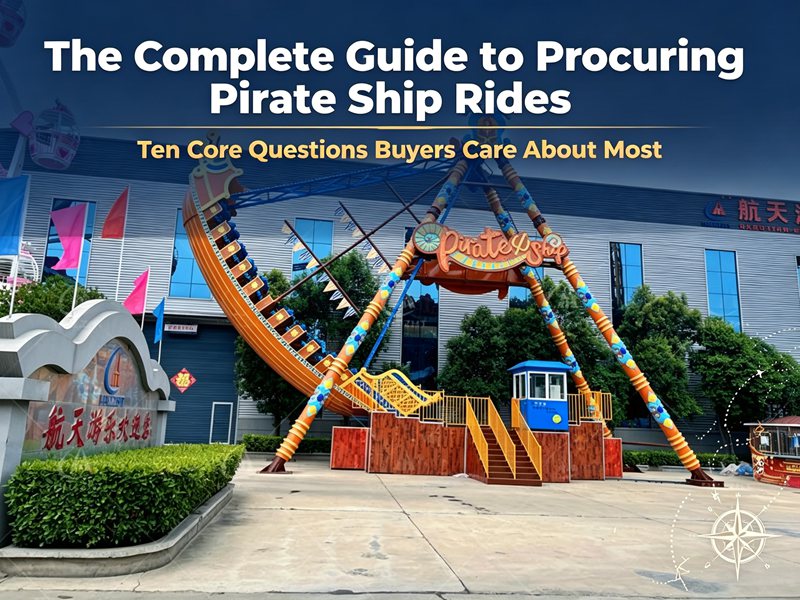
Ten Core Questions Buyers Care About Most
The Pirate Ship Ride (also known as pirate ship amusement ride or swinging galleon) is one of the most classic and widely popular categories among observation-type amusement facilities. The equipment simulates an ancient pirate ship tossing and turning on ocean waves, with the hull performing reciprocating swinging motion around a horizontal axis. Passengers are alternately pushed toward the crest of a wave and plunged into a trough, experiencing alternating sensations of weightlessness and hypergravity. From compact mini parent-child models in shopping mall atriums to 36-seat flagship models in 4A scenic areas, the pirate ship has become a “standard” attraction for all types of entertainment venues due to its strong thematic atmosphere, high throughput efficiency, and broad age appeal.
However, the pirate ship is classified as a large-scale amusement facility in the observation category under the national special equipment catalog. Its procurement decision involves multiple professional dimensions including equipment classification, certification compliance, drive systems, safety redundancy, civil foundations, and operating costs. A wrong selection can lead to inspection failure, low daily occupancy, high maintenance costs, or even hidden safety hazards.
This article systematically examines the ten core questions that buyers care about most when procuring pirate ship rides, drawing on national special equipment safety regulations, industry technical standards, and firsthand manufacturing and operational experience, to provide a verifiable and actionable decision reference for procurement professionals.
Safety Red Line:
Pirate ship rides are classified as large-scale amusement facilities in the observation category. Their design, manufacturing, installation, modification, and repair all require corresponding special equipment qualifications. Based on swing angle and passenger capacity, they are divided into Classes A, B, and C, each corresponding to different licensing requirements and inspection standards. Buyers must treat certification compliance as a non-negotiable veto item — no price advantage can substitute for safety licensing.
Certification Compliance and Equipment Classification
A/B/C Levels and Qualification Verification
The classification of a pirate ship directly determines the manufacturing license level, inspection requirements, and operational supervision intensity. It is the first issue buyers need to clarify.
Pirate Ship Classification Standards
| Class | Criteria | Common Models | License & Inspection |
|---|---|---|---|
| Class A | Single-side swing angle ≥90°, or passenger capacity ≥40 | 40+ seat large pirate ships | SAMR license, national-level inspection |
| Class B | 90° > swing angle ≥45°, and passengers <40 | 24-seat, 32-seat, 36-seat mainstream models | Provincial market regulation bureau license, provincial inspection |
| Class C | Single-side swing angle <45° | 12-seat mini parent-child pirate ships | Municipal-level license and inspection |
Buyers should select the appropriate class based on their venue positioning and target audience. It is important to note that equipment classification follows the “higher of the two” principle — if either the swing angle or passenger capacity meets a higher class criterion, the equipment is managed at that higher class.
Core Certifications to Verify
- Special Equipment Production License: The manufacturer must hold a production license covering the corresponding class of observation-type facilities. The permitted scope and validity period must be verified item by item.
- Type Test Certificate: Each specific model must pass type testing by a national or provincial special equipment inspection institute. One certificate per model is the core proof of equipment legality.
- Installation, Modification & Repair License: The installation unit must hold corresponding qualifications. After installation, the equipment must pass supervisory inspection before use registration can be processed.
- Supervisory Inspection Report: Mandatory inspection reports before factory shipment and after installation are essential documents for use registration and annual inspections.
- Export Target Market Certifications: CE and EN 13814 compliance for the EU, ASTM F24/F2291 for North America, TÜV for Germany, SABER for some Middle Eastern countries.
Pitfall Warning:
Some small factories may borrow another company’s qualifications or provide out-of-scope licenses. Buyers should verify certificate authenticity through the SAMR Special Equipment Public Information Query System, confirm that the production address matches the actual factory, and request the original type test report for the specific model.
Model Selection and Visitor Flow Matching
Choosing Between 12, 24, and 36 Seats
Model selection is the most perplexing issue for pirate ship buyers. More seats is not necessarily better — the key is precise matching with site area, daily visitor flow, and budget.
Comprehensive Comparison of Three Mainstream Specifications
| Comparison Item | 12-Seat Mini Parent-Child | 24-Seat Mid-Size Bestseller | 36-Seat Large Flagship |
|---|---|---|---|
| Equipment Class | Class C | Class B | Class B |
| Reference Ex-Factory Price | RMB 68,000–95,000 | approx. RMB 158,000 | RMB 450,000–520,000 |
| Footprint | approx. 8m × 6m | approx. 9.2m × 6.8m to 14m × 10m | approx. 18.5m × 8.5m (base 19m × 9m) |
| Equipment Height | approx. 5–6m | approx. 7.2–10m | approx. 15.2m |
| Max Swing Angle | <45° | ±45° | approx. 60° |
| Rated Power | approx. 5–8 kW | approx. 15–22 kW | approx. 30–45 kW |
| Cycle Duration | approx. 120–150 sec | approx. 180 sec | approx. 180–240 sec |
| Foundation Type | Simple concrete foundation | Reinforced concrete foundation | Reinforced raft foundation |
| Foundation Reference Cost | RMB 5,000–10,000 | RMB 18,000–25,000 | RMB 35,000–45,000 |
| Applicable Scenarios | Shopping mall atriums, indoor parent-child parks, community playgrounds | County parks, small-to-medium farms, county-level cultural tourism parks | 4A/5A scenic areas, large cultural tourism towns, comprehensive theme parks |
Note: The above prices and parameters are market reference values for qualified manufacturers in 2026; specific values are subject to each manufacturer’s official quotation and technical documentation.
Selection Decision Logic
- Choose 12 seats when: Site area is under 100㎡, target audience is children aged 3–12 with parent-child groups, budget is limited and testing the amusement project. Advantages: low entry threshold, small footprint, low power consumption. Disadvantages: weak throughput, insufficient visual impact, cannot serve as the park’s main landmark.
- Choose 24 seats (the cost-effective all-rounder): Medium daily visitor flow with weekend spikes, clear peak/off-season gaps, county-level parks and small-to-medium scenic areas. More than half of small-to-medium scenic areas ultimately choose 24-seat models because they balance all age groups, moderate investment, and stable payback periods.
- Choose 36 seats when: 4A/5A scenic areas, large cultural tourism towns, stable daily visitor flow with holiday surges. The 36-seat model offers grand scale, strong visual appeal, and naturally becomes a social media landmark with high revenue ceiling during peak season. However, it requires high upfront investment and strict foundation bearing capacity; if daily visitor flow is insufficient, low occupancy will extend the payback period.
Core Selection Principle:
Visitor flow determines everything. Forcing a 36-seat ship into a low-traffic venue means frequent under-occupancy, wasting electricity and depreciation. Using a small pirate ship during peak holiday crowds causes long queues and lost visitors. The right fit always matters more than bigger or more expensive.
Safety Performance
Restraint Systems, Braking Limits, and Multi-Layer Redundancy
Safety is the lifeline of a pirate ship. Because the equipment performs reciprocating swinging motion, passengers experience noticeable weightlessness at the highest point, placing extremely high demands on restraint systems and braking protection.
Passenger Restraint System
- Safety Restraint Bar: The mainstream configuration is a pneumatic safety bar or ratchet-and-pawl bar. Premium equipment uses thickened pneumatic bars that auto-lock when inflated and remain locked when air pressure is lost (fail-safe). Each seat’s bar should operate independently with position detection.
- Safety Belt: As secondary protection, made of high-strength polyester material with a special-tool-operated buckle. Some high-end models use five-point harnesses.
- Dual Confirmation: After the operator checks each bar and belt, the platform safety confirmation button must be pressed before the ride can start.
Braking and Limit Protection
- Swing Limit Device: Dual protection of mechanical limits and electrical limits prevents the swing angle from exceeding the design maximum.
- Hydraulic Overpressure Protection: Hydraulically driven pirate ships must be equipped with relief valves and pressure sensors that automatically relieve pressure when system pressure exceeds limits.
- Emergency Stop Button: Both the control console and platform are equipped with red mushroom-head emergency stop buttons to cut power and activate braking instantly.
- Power-Off Auto-Stop: In the event of a sudden power outage, the equipment should decelerate slowly and safely dock at the horizontal position, rather than swinging freely.
- Overload Protection: Motors and hydraulic systems are equipped with overload protection that automatically shuts down under abnormal loads.
Suspension and Structural Safety
The pirate ship hull is suspended from the support frame via suspension shafts and bearings — the most critical load-bearing components:
- Suspension Shaft Safety: Suspension shafts should be made of high-strength alloy steel, subjected to quenching and tempering and non-destructive testing, equipped with anti-disengagement retaining plates.
- Suspension Device Safety: Suspension bearing housings should be equipped with secondary safety wire ropes or safety pins to prevent hull detachment even if the main bearing fails.
- Secondary Safety Wire Rope: Some high-end models add secondary safety wire ropes between the hull and support frame, providing double insurance for extreme conditions.
- Buffer Device: Anti-collision buffer pads are installed at the hull docking position to reduce impact during docking.
According to GB 8408-2018, the maximum operating acceleration of pirate ship equipment must not exceed 3.5g, the main structure safety factor must not be less than 5.0, and the emergency braking response time must be controlled within 1.5 seconds. Buyers should require the manufacturer to provide strength calculation reports and critical weld inspection reports.
Drive Systems
Hydraulic Transmission vs. Friction Wheel Drive
The drive system is the core technical differentiator of pirate ships, directly affecting operational smoothness, maintenance costs, and service life. Currently, two main drive methods exist on the market.
Hydraulic Transmission Drive
Hydraulic transmission is the mainstream drive method for medium-to-large pirate ships, using hydraulic cylinders or motors to push the hull to swing back and forth along an arc track.
- Advantages: Smooth and linear power output, shock-free startup and stop, natural swinging rhythm that realistically simulates ocean waves; enables stepless speed regulation and precise swing angle control; strong load capacity, suitable for 24+ seat medium-to-large equipment.
- Disadvantages: Complex system with many hydraulic components (oil pump, cylinder, valve group, piping), risk of oil leakage; sensitive to hydraulic oil quality and temperature, requiring regular oil changes and maintenance; in low winter temperatures, increased hydraulic oil viscosity degrades startup performance.
- Procurement Focus: Hydraulic component brands (reputable brands recommended), whether the system has oil temperature and level monitoring, whether piping layout is standardized, and whether oil leakage collection devices are installed.
Friction Wheel Drive
Friction wheel drive uses a motor-driven friction wheel in contact with a friction track on the hull bottom, propelling the hull by friction force.
- Advantages: Relatively simple structure, no hydraulic oil leakage, low maintenance workload; lower cost, common in 12-seat small pirate ships and some 24-seat economy models.
- Disadvantages: Friction wheels and tracks wear out and require periodic replacement; slight impact may occur during startup and braking; power output is less smooth than hydraulic under high loads, not suitable for 36+ seat large equipment.
- Procurement Focus: Friction wheel material (wear-resistant polyurethane or rubber), replacement cycle and cost, and whether a pressing force adjustment device is provided.
Comparison Summary
| Comparison Dimension | Hydraulic Transmission | Friction Wheel Drive |
|---|---|---|
| Operational Smoothness | Excellent, stepless speed, no impact | Good, slight impact on start/stop |
| Load Capacity | Strong, for medium-to-large equipment | Moderate, for small equipment |
| Maintenance Complexity | Higher, regular oil changes and leak checks | Lower, mainly friction wheel replacement |
| Oil Leakage Risk | Exists, requires proper maintenance | None |
| Purchase Cost | Higher | Lower |
| Applicable Specifications | 24+ seats medium-to-large | 12 seats small and economy models |
Materials and Craftsmanship
Steel, Welding, Anti-Corrosion, and FRP
Materials and craftsmanship are the key differentiators between quality pirate ships and low-cost inferior products, directly determining service life, safety, and maintenance costs.
Structural Steel and Welding
- Steel Selection: Main support frames, arc tracks, and load-bearing bases should use Q345 low-alloy high-strength steel or equivalent, with thickened seamless steel pipes and integrally welded bases for improved impact resistance.
- Welding Process: Critical load-bearing welds use full penetration welding, followed by ultrasonic testing (UT) or magnetic particle testing (MPT) to eliminate weld cracks and incomplete fusion.
- Pin Shaft Heat Treatment: Key pin shafts such as suspension shafts undergo quenching and tempering with hardness test reports to ensure adequate strength and toughness.
- High-Strength Bolts: Hull-to-frame connections use Grade 8.8+ hot-dip galvanized high-strength bolts, anti-loosening and anti-rust, with alignment marks applied after installation for inspection.
Surface Anti-Corrosion Treatment
Pirate ships operate outdoors long-term, and anti-corrosion quality directly affects service life:
- Sandblasting/Shot Blasting: All steel components must undergo surface rust removal to Sa2.5 grade or above before painting, ensuring firm adhesion between the coating and steel substrate. Equipment without proper rust removal will show paint bubbling and internal corrosion within 1–2 years.
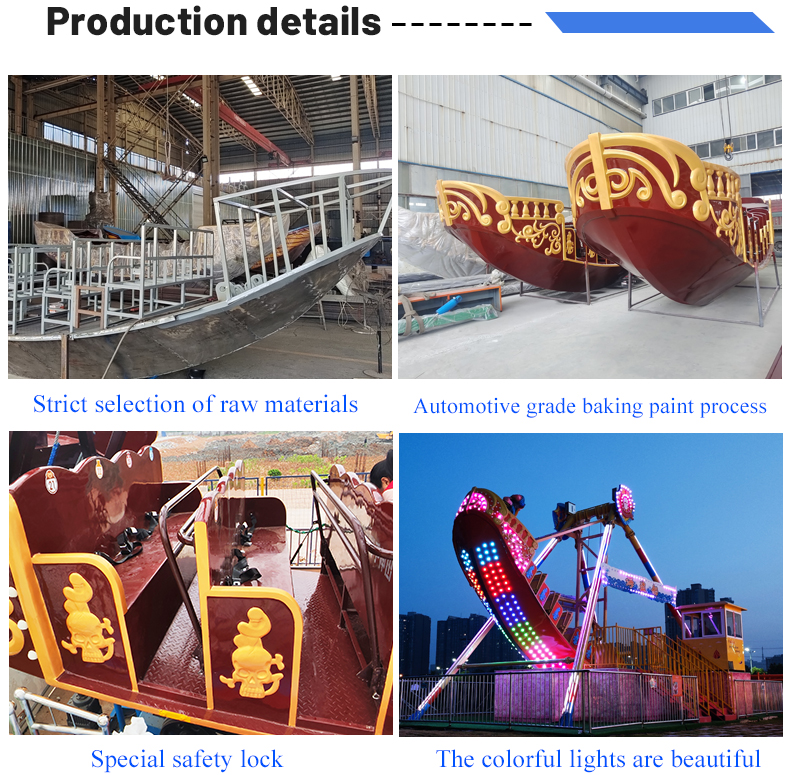
- Multi-Layer Coating System: Premium equipment uses a three-layer system of “epoxy zinc-rich primer + epoxy micaceous iron oxide intermediate coat + polyurethane topcoat,” with outdoor weathering life of 8–10+ years. Some manufacturers use automotive-grade high-temperature baking paint for a glossy, long-lasting finish.
- Annual Anti-Corrosion Maintenance: After commissioning, metal structures should be inspected annually for anti-corrosion, with paint damage promptly touched up.
Fiberglass Reinforced Plastic (FRP) Hull and Decorations
Pirate ships extensively use FRP components for the hull shell, bow/stern decorations, and seats:
- Material: High-density thickened FRP, environmentally friendly, non-toxic, impact-resistant, crack-resistant, and non-deformable. Load-bearing parts should be no less than 5mm thick.
- Layup Process: Quality FRP uses a chopped strand mat + multi-layer platinum cloth layup structure, with iron-cloth reinforcement at embedded metal fittings.
- Surface Finish: Automotive-grade high-temperature baking paint and hand-painted detailing produce vivid colors, strong three-dimensional effect, and long-term color fastness.
- Seat Design: Ergonomic integrated seats with anti-slip footrests for comfortable and stable riding posture. All decorative details are smoothly polished with no burrs.
Electrical and Control Systems
PLC VFD, Safety Interlocks, and Protection Ratings
The electrical control system is the “brain” of the pirate ship, and its reliability directly affects operational smoothness and failure rates.
Core Electrical Configuration
- PLC Control: Premium equipment uses well-known brands such as Siemens, Mitsubishi, or Omron, with clear program logic and fault self-diagnosis capabilities. One-key automatic operation, timed operation, and swing angle adjustment are all program-controlled.
- Variable Frequency Drive (VFD): A VFD controls the drive motor for smooth start and stop, avoiding passenger discomfort and structural impact from sudden starts/stops.
- Safety Interlock Circuit: An independent safety interlock circuit includes bar position detection, platform safety confirmation, emergency stop circuit, swing angle limit, and overload protection. The equipment cannot start or stops immediately if any condition is not met.
- Intelligent Linkage Protection: The equipment automatically alarms and stops during abnormal operation, with the hull automatically resetting to the horizontal static position for safe passenger boarding and alighting.
Electrical Safety Requirements
- Electrical cabinets and junction boxes must have a protection rating of no less than IP55, suitable for outdoor rain, snow, and high-temperature environments;
- Use national-standard flame-retardant leak-proof cables and waterproof electrical boxes;
- Motor insulation resistance must not be less than 1 MΩ, and protective earth resistance must not exceed 10 Ω;
- Distribution cabinets are equipped with complete protection elements including leakage, overload, and short circuit;
- Control panels have clear labels and key switches to prevent unauthorized operation.
Professional Advice:
During procurement, require the manufacturer to provide electrical schematics, PLC program backups, and a bill of materials with brand and model for electrical components. This facilitates future troubleshooting and spare parts procurement, and prevents the manufacturer from charging high fees under the pretext of “program confidentiality.”
Site Adaptation and Foundation Construction
Footprint, Foundation, and Power
The swinging characteristics of pirate ships impose special requirements on the site and foundation, which buyers should thoroughly assess before signing a contract.
Site Requirements
- Footprint: The actual space required is the equipment base dimensions plus surrounding safety clearance and fencing. For a 24-seat model with a base of approximately 9.2m × 6.8m, a site of approximately 14m × 10m is typically needed after adding safety clearance. Buyers should request formal foundation drawings and site layout plans from the manufacturer.
- Ground Bearing Capacity: The swinging motion generates significant reciprocating impact forces on the foundation. Foundation bearing capacity is typically required to be no less than 150–200 kPa, with higher requirements for 36-seat large equipment. Soft soil foundations require reinforcement.
- Headroom Requirements: No high-voltage power lines, buildings, trees, or other obstacles may exist above or within the swing range. The maximum swing height of a 36-seat model can exceed 15m, so sufficient overhead clearance must be ensured.
- Drainage and Flood Prevention: The site should have proper drainage to avoid long-term foundation submersion.
Foundation Construction
Foundation requirements vary significantly by pirate ship specification:
- 12 seats: Simple concrete foundation, easy construction, cost approx. RMB 5,000–10,000.
- 24 seats: Reinforced concrete foundation, with reinforcement and anchor bolt embedding per the manufacturer’s foundation drawing, cost approx. RMB 18,000–25,000.
- 36 seats: Reinforced raft foundation with strict bearing capacity and reinforcement requirements, cost approx. RMB 35,000–45,000.
Foundation construction should be performed by a qualified civil engineering team. The manufacturer provides foundation construction drawings (including plan dimensions, depth, concrete strength grade, anchor bolt positioning, reinforcement arrangement, and grounding requirements). After foundation completion, it must be inspected and accepted by the manufacturer’s technical personnel before equipment installation.
Power Supply and Ancillary Requirements
- Medium-to-large pirate ships typically require a 3N+PE 380V/220V 50Hz three-phase five-wire power supply, with 24-seat models at approx. 15–22 kW and 36-seat models at approx. 30–45 kW;
- Voltage fluctuation should not exceed ±10%, and frequency fluctuation should not exceed ±2%;
- The equipment should have an independent distribution box separate from other electrical equipment;
- Night operation requires additional power for LED lighting and audio systems.
Customization and Themed Packaging
Styling, Lighting, and Audio
In an increasingly homogeneous competitive market, the pirate ship’s themed packaging and visual effects directly affect visitor attraction and social media sharing rates.
Customizable Elements
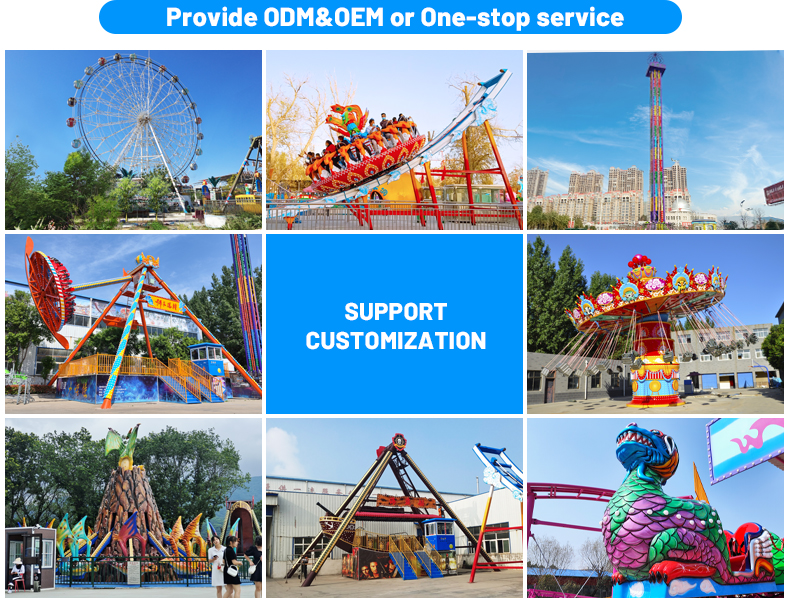
- Hull Themed Styling: Classic retro pirate style, cartoon cute style, ocean fantasy style, Viking dragon ship style, Chinese-style swinging dragon boat, etc. The bow can be customized with iconic sculptures such as skulls, dragon heads, or mermaids.
- Color and Painting: Various color schemes including retro wood tone, ocean blue, and carnival colors. The hull can be printed with exclusive logos, pirate patterns, and personalized graffiti.
- Lighting System: RGB full-color LED lights, with flowing light strips wrapping the support frame and arc track, and ambient spotlights embedded in the hull and sails. Supports multiple dynamic effects including steady on, gradient, rhythmic flashing, and synchronized flowing, with night lighting changing synchronously with swing angle.
- Audio System: High-fidelity surround sound with built-in pirate adventure themed background music and wave simulation sound effects, with adjustable volume. Supports multi-language broadcast prompts and custom music import.
- Seats and Interior: Seat color and material can be customized; some high-end models offer faux leather cushioning.
Customization Considerations
- Customization increases production lead time and cost; custom content, delivery time, and fees must be clearly specified in the contract;
- Request 3D renderings from the manufacturer for confirmation before production to avoid finished products not matching expectations;
- Custom decorations must not compromise safety performance or maintenance access; all added components must undergo strength verification;
- Customization involving IP imagery must ensure legal authorization to avoid infringement disputes.
Total Cost of Ownership and ROI
Hidden Expenses Beyond Purchase Price
Many buyers compare only ex-factory prices, overlooking the Total Cost of Ownership (TCO). A low-priced piece of equipment with a high failure rate may have far higher long-term operating costs than a quality unit.
Total Cost of Ownership Breakdown
| Cost Category | Specific Items | Notes |
|---|---|---|
| Initial Procurement | Equipment ex-factory price, customization fees | Largest share |
| Logistics and Shipping | Road transport or sea freight, insurance, loading/unloading. The 36-seat model is an oversized item, with freight and crane costs approximately double those of the 24-seat model | 3%–8% |
| Civil Foundation | Excavation, reinforced concrete, anchor bolts, grounding | 5%–10% |
| Installation and Commissioning | Manufacturer technician travel, installation labor, crane rental | 5%–8% |
| Inspection and Acceptance | Special equipment supervisory inspection fee, use registration fee | 1%–3% |
| Operating Energy | Electricity (by operating days and hours); the 36-seat model consumes significantly more than the 24-seat | Accumulated yearly |
| Maintenance | Hydraulic oil changes, consumables (friction wheels/bearings/seals), annual NDT, anti-corrosion touch-up | Accumulated yearly |
| Spare Parts Inventory | Motors, hydraulic components, bearings, electrical components, LED lights, safety belts | Procured as needed |
| Labor Cost | Operators (12-seat can be single-staffed, medium-to-large requires 2), maintenance personnel | Accumulated yearly |
ROI Calculation Key Points
- Revenue Side: Hourly throughput × ticket price × daily operating hours × annual operating days. A 24-seat pirate ship has an hourly throughput of approximately 400–480 passengers; a 36-seat model approximately 600–720.
- Cost Side: The above total cost of ownership allocated annually.
- Payback Period: In a medium-sized park with stable visitor flow, a 24-seat pirate ship typically has an investment payback period of 1–2 years; a 36-seat model approximately 2–3 years; equipment design service life is 12–15+ years.
- Sensitivity Analysis: Perform pessimistic/neutral/optimistic scenario analysis on visitor flow, ticket price, and operating days to avoid over-optimism.
Cost Awareness:
When requesting quotations, always ask the manufacturer to distinguish between “bare machine price” and “turnkey all-inclusive price,” and clarify whether foundation drawings, installation, and training incur additional fees — avoid endless add-on charges later. Ultra-low quotes often mean specification cuts, and ultimately the buyer pays the price.
After-Sales Service and Manufacturer Capability
Installation, Training, Warranty, Spare Parts, and R&D Capacity
With a service life of 12–15 years, a pirate ship requires ongoing technical support and spare parts supply. After-sales terms should be formalized in the contract before signing.
Standard After-Sales Service Content
- Pre-Sales Survey: Quality manufacturers provide free site surveys, site layout planning, and foundation construction drawing guidance.
- Installation and Commissioning: The manufacturer dispatches professional technicians for on-site installation and commissioning, ensuring the equipment meets design performance and passes inspection.
- Operator Training: Systematic training for operators and maintenance personnel covering equipment structure, operating procedures, safety precautions, daily checks, and common troubleshooting, with certificates issued upon completion.
- Warranty Period: The industry standard full-equipment warranty is 12 months; some manufacturers offer extended warranties of 3 years for the whole machine and 5 years for core components (hydraulic system, motor, reducer, transmission structure).
- Lifetime Maintenance: After the warranty period, paid lifetime maintenance is provided, including periodic inspections, fault repair, and technical upgrades.
- Spare Parts Supply: The manufacturer guarantees original spare parts availability for at least 5–10 years after equipment discontinuation, with a free set of wearing parts provided at factory shipment.
- Response Speed: Quality manufacturers commit to 24-hour online technical support, simple faults resolved remotely within 2 hours, and complex faults with engineers on-site within 48 hours.
Maintenance Schedule Reference
| Frequency | Main Maintenance Tasks | Performed By |
|---|---|---|
| Daily | Pre-start check of restraint bars, seat belts, emergency stop button; run 2 empty cycles to confirm no abnormal noise or vibration; power off, clean, and inspect fasteners after operation | Operator |
| Weekly | Check hydraulic system oil level and piping for leaks; inspect suspension shaft and bearing lubrication; check electrical terminal connections | Maintenance Staff |
| Monthly | Test motor insulation resistance (≥1 MΩ) and earth resistance (≤10 Ω); inspect suspension shaft wear and anti-disengagement devices; check friction wheel wear (friction wheel type) | Maintenance Staff |
| Quarterly | Check reducer oil level and top up as needed; inspect high-strength bolt preload and apply alignment marks; clean hydraulic system filter elements | Maintenance Staff |
| Annually | NDT re-inspection of main load-bearing parts and welds; hydraulic oil change; anti-corrosion inspection and touch-up of metal structures; comprehensive safety performance test; cooperate with inspection agency annual inspection | Manufacturer / Inspection Agency |
Manufacturer Capability Assessment
- R&D Capability: Does the company have an independent R&D team? Can it provide complete technical documentation including structural calculations and electrical schematics? Does it hold patents?
- Production Scale: Owned factory area, CNC machining equipment, sandblasting/shot blasting equipment, paint booths, and testing facilities. Manufacturers with complete production lines offer far greater quality controllability than trading companies that assemble from outsourced parts.
- Industry Standing: Is it a member or president unit of the industry association? Has it received provincial/municipal famous trademark, technology enterprise, or contract-honoring honors?
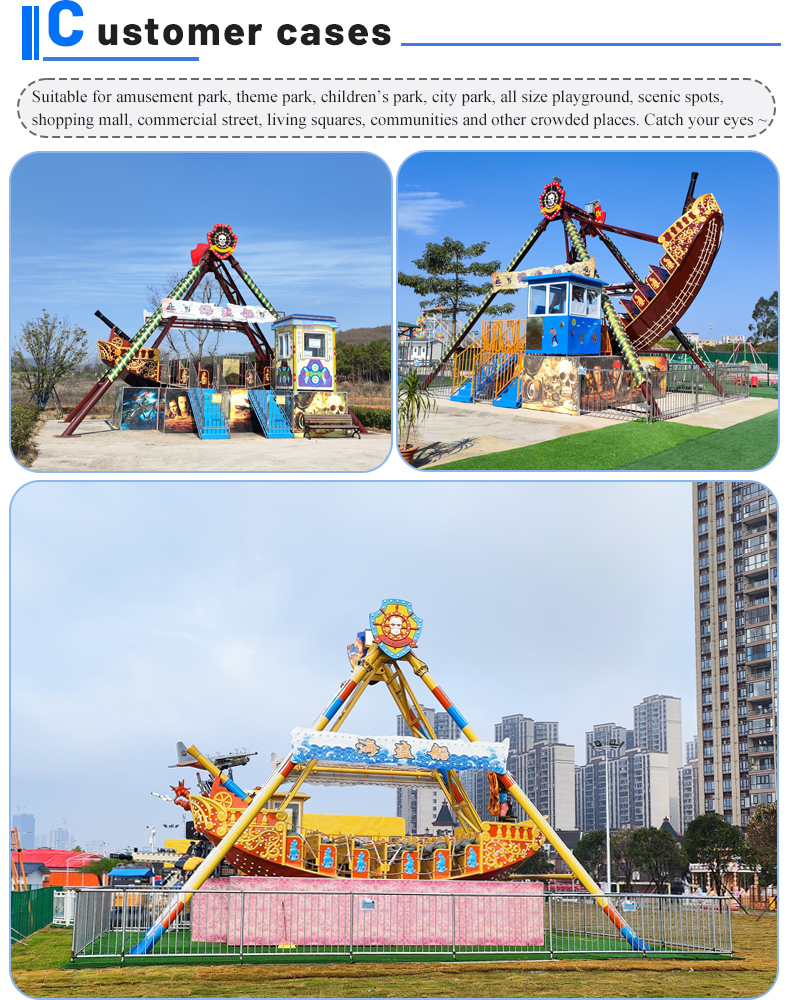
- Project Case Studies: Request a list of similar equipment installations from the past 3 years, and visit operating equipment when possible.
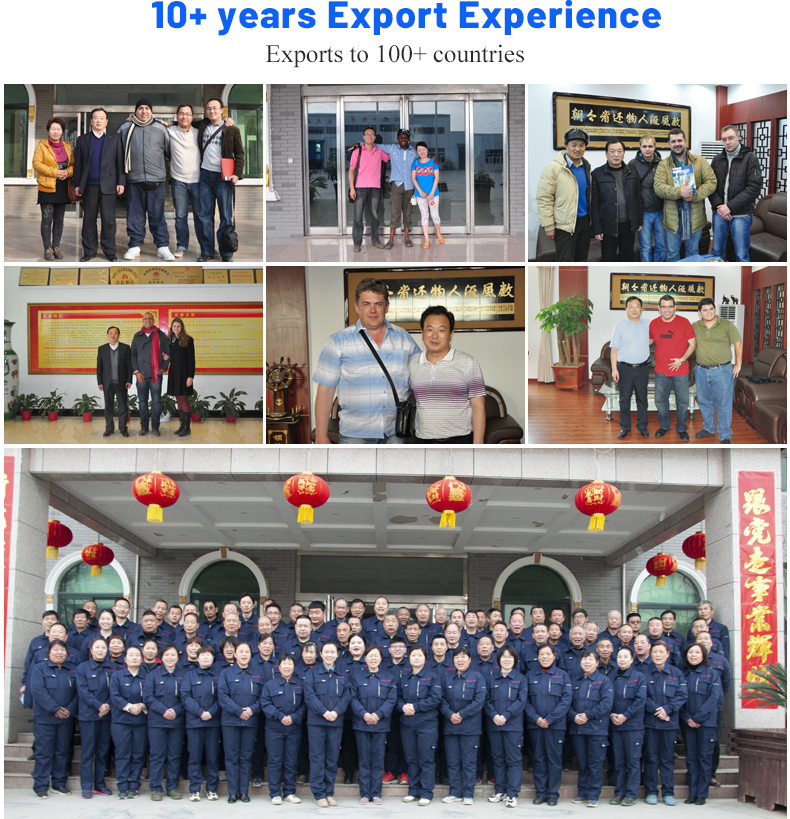
- Export Experience: Manufacturers with export experience are familiar with international certifications (CE, TÜV, ASTM), sea-freight packaging, and overseas installation processes, typically offering more reliable product adaptability.
- Financial Stability: Check business registration, legal risks, and operational anomalies through the National Enterprise Credit Information Publicity System.
Procurement Pitfall Guide
Common Traps and Preventive Measures
Drawing on industry experience, the following are the most common traps in pirate ship procurement and corresponding preventive measures:
Six Common Traps
- Specification Cuts After Low-Bid Award: Winning the bid at a low price, then cutting steel wall thickness, using no-name motors and hydraulic components, or reducing painting processes during production. Prevention: specify brand, specification, and material standards for major components in the contract, and conduct item-by-item acceptance upon delivery.
- Qualification Borrowing or Out-of-Scope Production: Small factories bid using large companies’ qualifications, while actual production is done by unqualified workshops. Prevention: verify that the production address matches the license address, and conduct on-site factory inspections.
- Blindly Pursuing Large Specifications: County-level scenic areas follow the trend and purchase 36-seat large ships, with daily occupancy below half, extending the payback period by 2–3 years. Prevention: select rationally based on daily visitor flow data, not “bigger is better.”
- Unfulfilled After-Sales Promises: “Lifetime free maintenance” promised before signing, then excuses or high fees charged afterward. Prevention: clearly specify warranty period, response time, spare parts pricing, and on-site service fees in the contract.
- Delivery Delays: Manufacturers delay delivery due to insufficient capacity or poor management, affecting project opening schedules. Prevention: specify delivery time and delay penalties in the contract, and follow up on production progress regularly.
- Inspection Failure: Equipment fails supervisory inspection due to design or manufacturing defects, making legal operation impossible. Prevention: select mature models with valid type test certificates, and promptly submit for inspection after installation.
Key Contract Clause Checklist
- Equipment model, class (A/B/C), technical parameters, and configuration list (as contract attachment);
- Material and component brand/specification detail sheet (steel, hydraulic components, electrical elements, FRP);
- Drive method clearly specified (hydraulic transmission / friction wheel drive);
- Delivery time, delivery location, transportation method, and cost bearing;
- Foundation drawing provision, installation/commissioning scope, and acceptance criteria;
- Warranty period, warranty scope, and after-sales service terms (including response time and on-site fees);
- Payment method and schedule (typically 30% deposit, 60% before shipment, 10% after acceptance);
- Liability for delayed delivery and quality issues;
- Intellectual property and confidentiality clauses;
- Dispute resolution method (recommend jurisdiction at the buyer’s location court).
Conclusion
Rational Selection for Long-Term Win-Win Partnership
Procuring a pirate ship ride is not a one-time transaction but a partnership lasting 12–15 years. Buyers should adhere to the principles of “safety first, proper specification, quality as foundation, service for the long term,” and on the premise of certification compliance, comprehensively evaluate equipment classification, model selection, drive method, material craftsmanship, electrical configuration, customization capability, total cost of ownership, and after-sales service system, selecting a quality manufacturer with genuine R&D and manufacturing capabilities.
A carefully selected pirate ship is not only an iconic attraction that draws visitors to the park, but also a reliable partner that continuously generates revenue and carries visitors’ joy. We hope the ten core questions examined in this article help buyers establish a clear evaluation framework amid abundant market information, and make rational decisions that meet both immediate needs and long-term value.
For further information on specific model technical parameters, customization options, or quotations, we recommend contacting directly a professional manufacturer holding a Special Equipment Production License and rich export experience for one-on-one project consultation.
Reference Standards and Sources:
- GB 8408-2018 Safety Code for Large-Scale Amusement Rides
- GB/T 18164-2020 General Technical Requirements for Observation-Type Amusement Facilities
- TSG 71-2023 Special Equipment Safety Technical Specifications
- EN 13814 (European Amusement Ride Safety Standard)
- ASTM F24 / F2291 (US Amusement Ride Standards)
- Special Equipment Safety Law of the People’s Republic of China