Key Factors to Consider Before Buying a Flying Chair Ride
A flying chair ride looks simple from the midway: seats hanging on chains, a hub that turns, guests lifting into the air. The engineering and the commercial decisions behind it are not simple at all. Size, foundation, capacity, restraint design, climate, local standards and after-sales support all shape the machine you receive. This article walks through the factors that matter most when you compare offers from a Chair Swing Ride Supplier, so the ride you order is one your park can run safely, maintain easily and profit from for many seasons.
Capacity, Rotation Speed and Guest Throughput
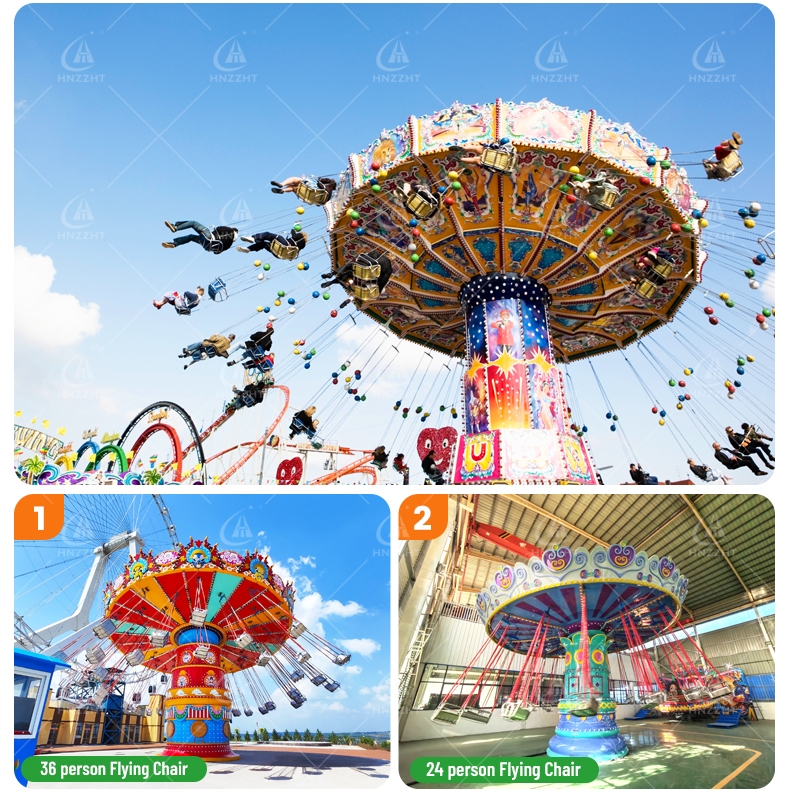
Capacity is measured in guests per hour, not in the number of chairs. The seat count, the boarding time and the length of one full lift cycle combine into the throughput figure that decides how long your queue will be on a holiday weekend.
Count the chairs and multiply by the seats in each one to get the guests carried per cycle.
Add the loading and unloading time to the lift cycle, then divide that into the operating hour for a realistic figure.
Compare the result with your peak visitor numbers and decide whether one unit is enough or a second will be needed later.
Rotation speed shapes the guest experience as much as the ride itself. Families with small children and older visitors usually prefer a slow, smooth lift that leaves time to look around, while a park aiming at teenagers may choose a faster cycle. A variable-speed drive lets one machine serve both audiences during different hours of the day.
Boarding position is another practical detail. When the ride stops with the chairs at platform level, children, older guests and visitors with limited mobility step on far more easily, and easier boarding directly shortens every cycle.
Site Space, Foundation and Swing Clearance
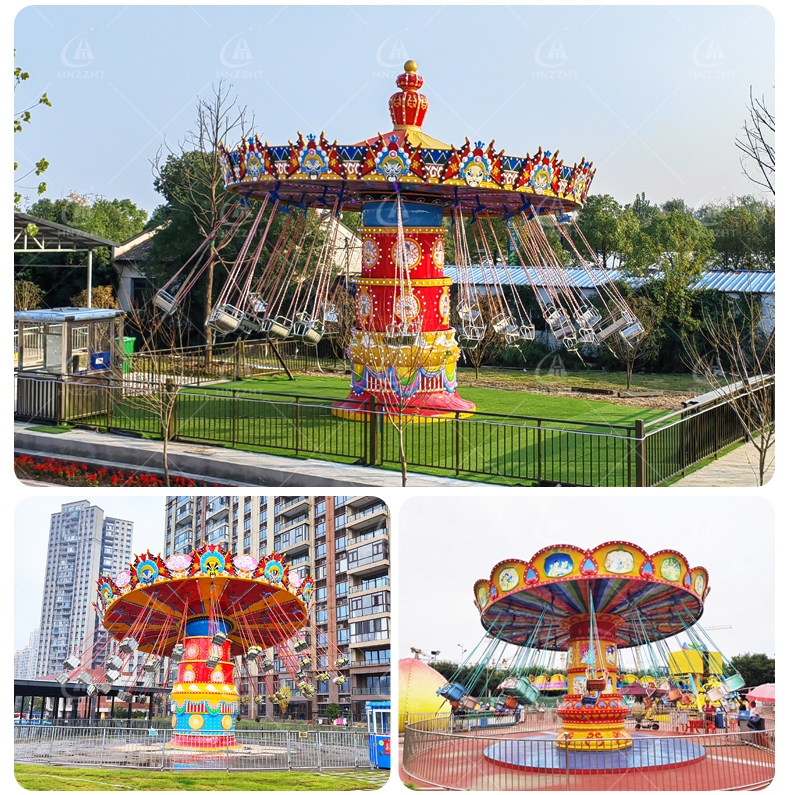
The first question is always where the machine will stand. A flying chair needs a level, load-bearing foundation, a clear safety envelope around the rotating hub, and enough open space for the chairs to swing outward at full speed without obstruction. Overhead power lines, tall trees, existing buildings and underground services all have to be surveyed before a diameter is chosen.
Ground conditions decide how much civil work is required. Soft or filled soil usually means a deeper, heavier foundation and a longer installation period, while a rocky site may need drilling and anchoring instead of a mass concrete base. Wind exposure matters too: an open coastal site puts far more load on the canopy and the hub than a sheltered valley, and that load has to be designed in from the start.
Access is part of the same calculation. Ask how the structure will arrive, whether the largest sections can be lifted by the crane available on site, and whether the biggest segment can pass through your gates and service roads. Confirm the required clearance radius in writing, because a ride that cannot swing freely on its own site is a problem no amount of design work will solve.
Safety Systems, Restraints and Local Standards
Safety equipment is where cheap designs show themselves first. A properly engineered machine includes a closed restraint on every seat, redundant braking, an emergency drive or manual release for power failure, limit switches that stop the rotation at the correct position, and a clear evacuation procedure for a stranded cycle.
Compliance is not optional. Ask which standard the design is built to, whether the structure can be certified by a third-party inspector in your country, and what documentation will be supplied: structural calculations, electrical diagrams, load test reports, operation manuals and maintenance schedules. Importers should also confirm voltage, frequency and plug standard for their market before production begins.
Lightning protection, earthing and emergency lighting are frequently overlooked items that inspectors will check. So is the wind operating limit. The manufacturer should state the maximum wind speed at which the ride may carry guests, and the procedure for parking the chairs when a storm approaches.
Structure, Materials and Weather Resistance
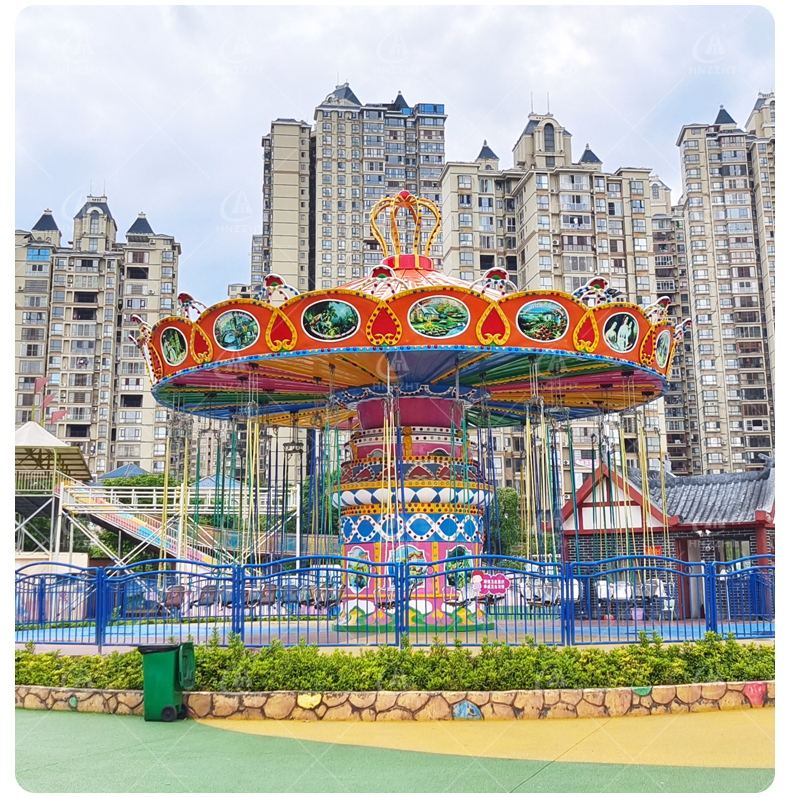
Most buyers compare a Flying Chair Amusement Ride on seat count and price, but the steel specification behind the paint matters just as much. Wall thickness, weld quality, galvanizing and the number of paint coats decide how the structure behaves after two or three seasons of rain, salt air and strong sunlight.
Hot-dip galvanizing followed by a marine-grade topcoat is the usual specification for coastal installations, while inland parks in dry regions may choose a heavy-duty paint system. Stainless fasteners, sealed bearings and quality chains cost more at the factory and save far more in maintenance later, because a machine that stands outside cannot avoid water, dust and temperature change.
Maintenance access belongs in this section as well. Inspection platforms and grease points should be part of the design, not an afterthought, because the team servicing the hub, the chains and the drive has to reach them safely. Ask the supplier to show exactly where an engineer stands when the bearings are greased.
Seat Design, Lighting and the Guest Experience
The seats are what guests remember. Bucket seats with individual restraints, themed canopies and colourful lighting each suit a different market, and the choice affects both the price and the operating rules. Wider seats and deeper backrests make boarding easier for children and older visitors, while a larger canopy gives better shade on hot days.
Lighting is both an attraction and an operating cost. Programmable RGB lighting turns the ride into a landmark at night and can be changed for holidays and sponsors, but the strips have to be weather-sealed and easy to replace when a section fails. Confirm who supplies spare lighting modules and how quickly they can be shipped.
For shopping centres, family entertainment centres and covered attractions, a compact unit is often the better fit. A Family Flying Chair Ride with a smaller footprint, a quieter drive and lower overall height can sit indoors and still carry a reasonable number of guests per cycle while keeping the whole family entertained.
Budget, Lead Time and Supplier Support
When the technical choices are clear, the commercial questions decide the order. A realistic budget covers the ride itself, the foundation and civil works, transport, insurance, installation supervision, commissioning, spare parts and staff training. Comparing only the factory price often hides the largest cost of the project.
Lead time should be written into the contract with a clear schedule for design approval, production, inspection, shipment and installation, along with the payment terms attached to each stage. Ask what happens if the ship is delayed, and confirm who is responsible for customs clearance and for the foundation drawings on site.
The last factor is support after delivery. A supplier who answers technical questions quickly, keeps fast-moving parts such as bearings, chains and restraints in stock, and can send an installation engineer to supervise commissioning will save the park far more than a small discount on the initial quotation.
Write down your site size, expected guest numbers, climate and budget, then send those details to the manufacturer and ask for a specification matched to them. A clear brief produces an accurate quotation, and an accurate quotation produces a ride that fits the park from the first day of operation.