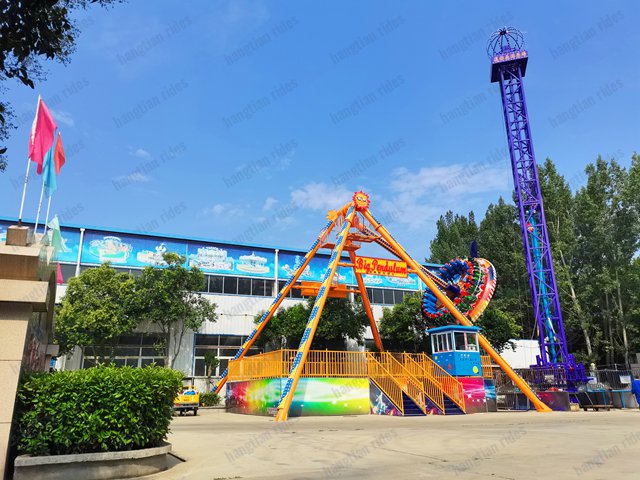
Pendulum rides—from the mesmerizing
360 pendulum ride to towering
giant pendulum ride installations—thrill amusement park guests through physics-defying arcs. Their seamless motion relies on sophisticated mechanical systems working in concert. Whether for a traveling
pendulum carnival ride or a permanent installation, understanding these core components reveals the engineering brilliance behind the adrenaline rush.
🏗️ 1. Structural Frame & Support System
The backbone of any pendulum ride is its structural frame, designed to withstand immense dynamic loads. Key elements include:
- Main Arm & Pivot Towers: Fabricated from high-strength steel, these support the entire swinging mechanism. For giant pendulum ride installations, towers often exceed 30 meters and require reinforced foundations to handle centrifugal forces.
- Base Platform: Anchors the ride to the ground via seismic-grade bolts, distributing operational stresses evenly. Corrosion-resistant coatings prevent environmental degradation.
- Counterweight Systems: Integrated into the arm’s design to balance passenger loads and reduce motor strain, especially crucial in high-capacity 360 pendulum ride variants.
⚙️ 2. Bearing & Pivot Systems
Smooth rotation hinges on precision bearings and pivots:
- Slewing Rings: Large-diameter rotational bearings (often exceeding 2 meters in giant pendulum ride models) enable fluid 360° motion. These incorporate hardened steel races and tapered rollers to manage combined radial and axial loads.
- Main Pivot Shaft: Connects the arm to the support tower. Journal bearings with self-lubricating polymers minimize friction during oscillation, while labyrinth seals protect against dust ingress.
🔋 3. Drive & Braking Mechanisms
Controlled acceleration and deceleration define the ride experience:
- Hydraulic/Pneumatic Actuators: Generate initial torque for swinging. In pendulum carnival ride setups, compact hydraulic systems offer rapid response for variable swing heights.
- Regenerative Brakes: Convert kinetic energy during deceleration into electrical energy, reducing net power consumption. Fail-safe friction brakes engage during emergencies.
- Variable-Frequency Drives (VFDs): Adjust motor speed to create programmable swing patterns—essential for achieving the signature inversion in 360 pendulum ride models.
🪑 4. Suspension & Passenger Units
Safety and comfort rely on these critical subsystems:
- Gimbal-Mounted Gondolas: Use spherical bearings to maintain cabin orientation during multi-axis swings. Reinforced polymer-composite joints absorb shock vibrations.
- Restraint Locking Systems: Electromechanical locks engage redundantly, with sensors confirming secure status before each cycle. Load cells monitor real-time weight distribution.
🖥️ 5. Control & Safety Systems
The operational brain ensures reliability:
- PLC-Based Controllers: Process sensor data (tilt angles, hydraulic pressure, motor temperature) to adjust operations dynamically. Encoders track arm position within 0.1° accuracy.
- Load Path Monitoring: Strain gauges on structural welds detect microfractures. Centralized dashboards alert operators to deviations in real time—critical for high-stress giant pendulum ride operations.
- Redundant Power Supplies: Backup batteries and hydraulic accumulators ensure graceful shutdowns during grid failures.
🔧 Maintenance & Longevity Considerations
- Modular Component Design: Allows swift replacement of wear-prone parts (e.g., bearing rings, seal kits) in pendulum carnival ride units traveling between sites.
- Predictive Analytics: Vibration sensors and oil-debris monitors forecast bearing fatigue or fluid contamination, scheduling maintenance before failures occur.
Conclusion: Precision Engineering Meets Thrilling Dynamics
The magic of pendulum rides—from the compact pendulum carnival ride to the awe-inspiring giant pendulum ride—stems from harmonized mechanical systems. Each component, meticulously engineered for durability and safety, transforms gravitational potential into exhilarating motion. As 360 pendulum ride technologies evolve with lighter composites and smarter controls, these marvels of physics will continue pushing the boundaries of aerial adventure. Partner with certified manufacturers prioritizing ASTM F2291/EN 13814 compliance to ensure your investment delivers decades of reliable thrills.
Pro Tip: Document component lifespans rigorously. Pivot bearings in high-use pendulum carnival ride setups typically require replacement every 12–18 months, while structural frames last 25+ years with proper corrosion management.