
How Is A Pirate Ship Ride Built And Tested?
A pirate ship rides project moves through five stages: engineering design, steel fabrication, in-house assembly and wiring, load and motion testing, and packing for shipment. Each stage produces something the buyer can check, which is why the process is worth understanding before you sign a contract rather than after the container arrives.
A swinging pirate ship looks simple from the queue line: a hull, two A-frames, a drive and a set of restraints. In the factory it is a sequence of controlled steps, and the quality of the finished ride is fixed long before the first guest boards. Buyers who know the sequence can ask the right questions at the right moment, and can tell a serious pirate ship ride manufacturer from a trader who only assembles other people’s parts.

Engineering Design Before Any Steel Is Cut
The process starts with a load case, not with a drawing of a ship. The designer fixes the hull size, the pendulum length, the maximum swing angle and the number of seats, then calculates the forces those choices put into the A-frames, the base and the ground. A 24-seat machine typically runs at 17 kW with a swing angle of 45 to 60 degrees and an overall height around 7.5 metres, while a 37 or 40-seat version steps up to about 28 kW and a structure above 10 metres. Those numbers come out of the design, and they decide the steel sections that follow.
The output of this stage is a drawing set: general arrangement, foundation plan, anchor layout, electrical schematic and a bill of materials. This is the moment to compare the proposal against your site. The footprint of a 24-seat unit is roughly 11 by 7 metres of equipment inside a 12 by 9 metre fenced area, and the larger machine needs around 20 by 10 metres. If your plot cannot carry that, the design stage is when it gets fixed, not the installation week.
Good practice at this stage also settles the restraint concept, the evacuation procedure and the fence line, because each of them changes the hull layout or the platform. A drawing set that arrives without them is incomplete.
Fabrication Of The Hull, Frame And Drive
Fabrication is where the design becomes steel. The A-frames and the base are cut, welded and then stress-relieved, because a welded structure that keeps its internal tension will move over time and put the bearing alignment out. Holes for the main shaft and the bearing housings are machined after welding rather than before, so that the centres stay true once the structure has settled.
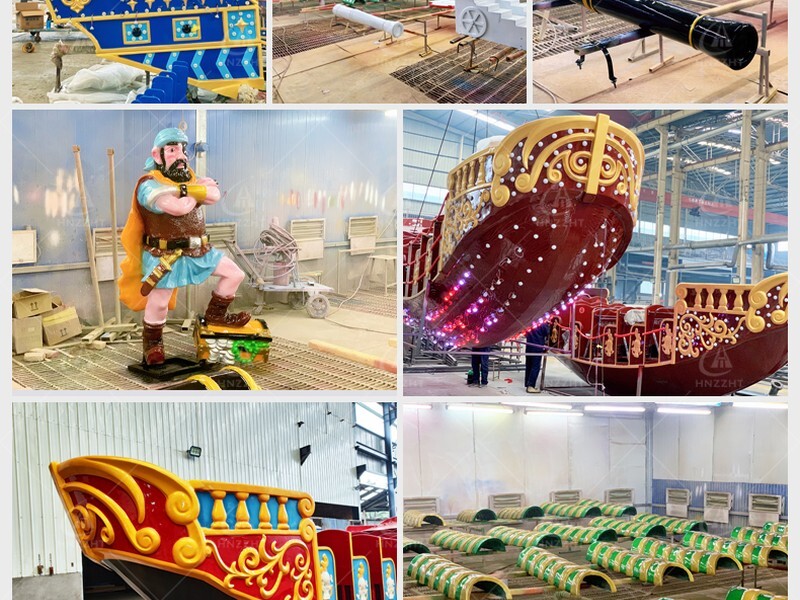
The hull is a glass-reinforced plastic shell over a steel sub-frame. The shell carries the look and the seating, the sub-frame carries the load. Inspecting the hull means checking the laminate thickness at the mounting points, the way the sub-frame is bonded and bolted into the shell, and whether the seat anchor plates are embedded rather than screwed onto the surface. These details never show from the outside once the ride is painted, and they are exactly what fails first after a few seasons of use.
The drive package is the third element. A swinging pirate ship is driven through a ring gear or a friction wheel acting on the pivot, with a motor, brake and, on larger machines, a variable-frequency drive. The gearbox and the brake are bought-in components, so the buyer should know the brand and the rating rather than only the kilowatt figure. Weld quality is checked visually and, on load-bearing joints, by non-destructive testing; a factory that cannot show those reports is telling you something about its process.
In-House Assembly And Electrical Work
Assembly happens in the factory rather than on site, and that is deliberate. The frames are erected, the pivot is aligned, the hull is hung and the drive is coupled while the machine is on a level floor with the tools and the crane close at hand. Mounting a hundred-tonne structure outdoors, in a different climate, with a local crew that has never seen the machine, is how alignment errors and damaged bearings happen.
Electrical work follows the mechanical build. The control cabinet, the motor starters, the variable-frequency drive where fitted, the emergency stop circuit and the lighting are wired and tagged before the machine is packed. Cables are routed through glands and marked with the drawing references, so that the site electrician connects to a labelled terminal rather than to a guess. A factory that tests the panel on a bench, with the actual motor connected, finds its wiring errors at home.
This is also when the safety devices are proven, not merely installed. The limit switches that stop the swing at the designed angle, the overspeed detection, the gate interlock and the emergency stop are checked one by one, and each result is recorded against the machine serial number. The record is what a third-party inspector will ask for later.
Load And Motion Testing Before Shipment
pirate ship rides manufacturing and testing is a single sequence, and the testing half is the part buyers most often take on trust. A proper programme has three stages: a no-load run, a rated-load run and a short overload check. The no-load run proves the drive, the brake and the limits. The rated-load run adds water weights or sandbags equal to a full complement of passengers and repeats the cycle, watching the structure, the bearings and the motor current.
The overload check, usually a modest percentage above rated capacity held for a defined number of cycles, is where weak points show. Bearing temperature, brake stopping distance, hull deflection and the behaviour of the limit switches are all recorded. A machine that passes on paper and fails here is far cheaper to fix in the factory than in a park with a queue at the gate.
Motion testing also covers the uncomfortable cases: a power failure at the top of the swing, a brake applied mid-cycle, an emergency stop pressed by a rider, and the recovery procedure afterwards. A swinging pirate ship that cannot be brought down safely after a fault is not a finished product, whatever its drawings say.
Documentation, Marking And Packing
The paperwork that travels with the machine is part of the manufacturing process, not an afterthought. A complete package includes the as-built drawings, the foundation and anchor plan, the electrical schematic, the component certificates for the gearbox, brake and wire ropes, the test records, the operating manual and the maintenance schedule. For export, the packing list has to match the crate markings, because a customs inspection that cannot reconcile the two stops the container.
Packing decisions are made with the installation in mind. The A-frames travel as matched pairs with their joint marks visible, the hull is braced so that it cannot distort in the container, and the pivot shaft and bearings are boxed separately with rust protection. Bolts, anchors and the small parts that are always missing on site go into a labelled crate that the installation foreman opens first.
The hull is the most fragile item in the shipment. It is a large glass-reinforced shell with a steel core, and it should travel on a cradle with the load taken at the sub-frame, never on the painted surface. A Viking ship ride that arrives with a cracked shell is a repair job before it is an attraction.
What A Buyer Should Witness At The Factory
Factory acceptance testing is worth the trip. Ask to see the machine running at rated load, watch the brake stop the swing from full amplitude, and press the emergency stop yourself. Ask for the weld reports, the component certificates and the test sheets, and check that the serial numbers on the paperwork match the plates on the machine.
- Weld and non-destructive test reports for the A-frames and the base.
- Component certificates for the gearbox, brake, motor and wire ropes.
- No-load, rated-load and overload test records with measured values.
- Limit switch, overspeed and gate interlock function checks.
- As-built drawings and a packing list that matches the crate marks.
A buyer who checks those five things is buying a machine, not a photograph. It also changes the conversation: a pirate ship rides supplier who can produce them on the day has a process, and one who promises to send them later usually does not.
Understanding the build sequence does not turn a buyer into an engineer, but it does show where the risk sits. Design decides whether the ride fits the site, fabrication decides whether it lasts, assembly decides whether it runs quietly, and testing decides whether it is safe. A manufacturer who can walk you through all four, with records, is the one worth ordering from.
Contact us today for a factory process sheet, a test record sample and a layout proposal for your pirate ship ride project.