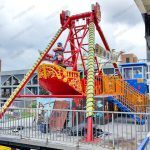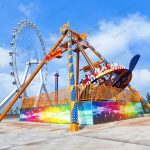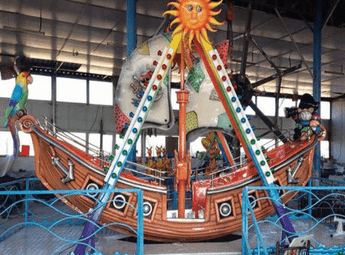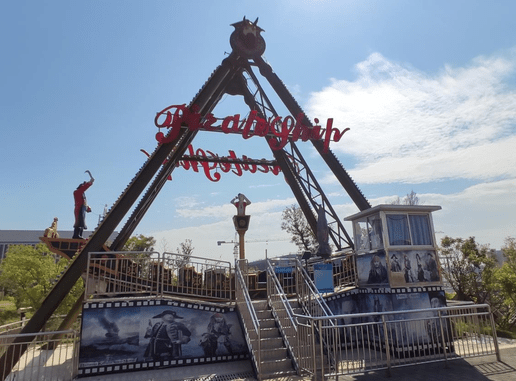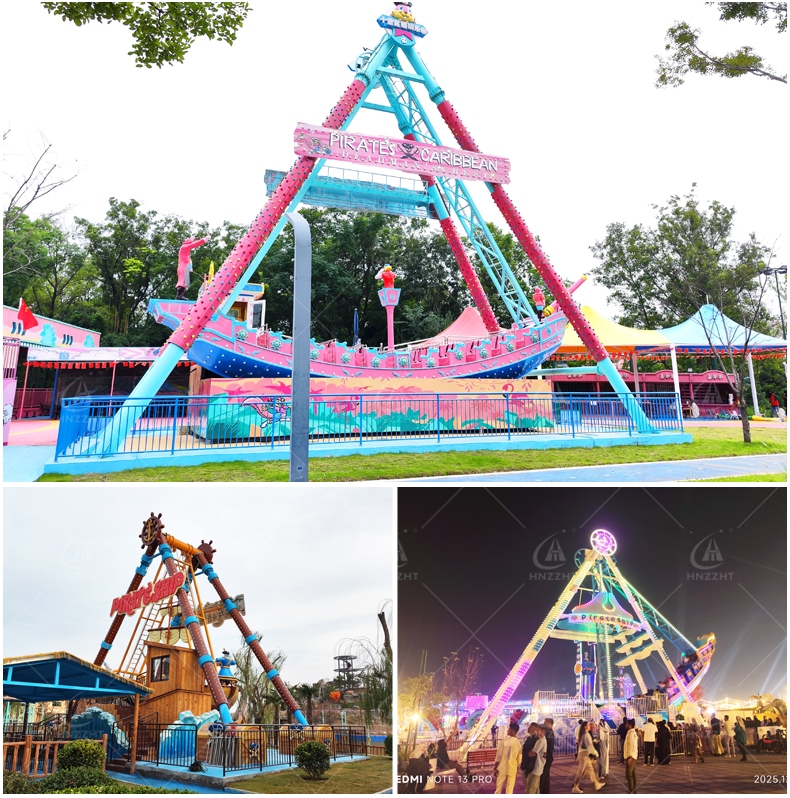
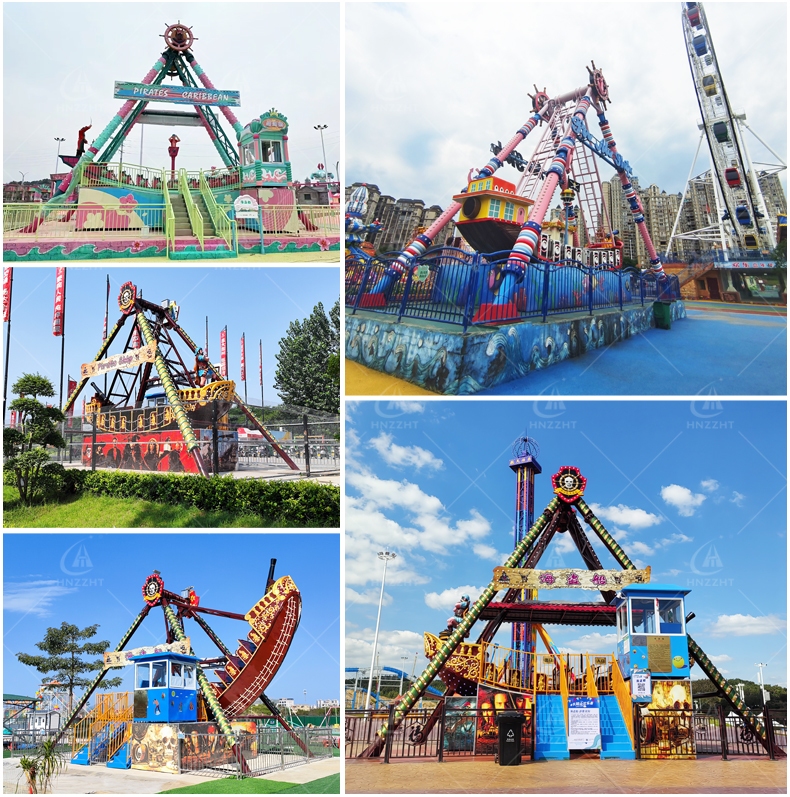
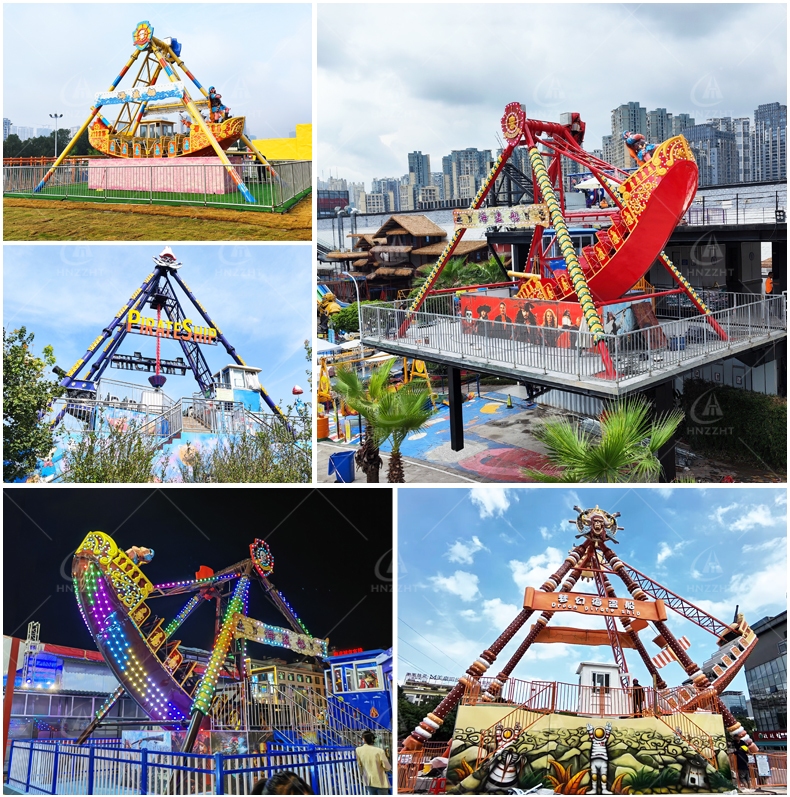
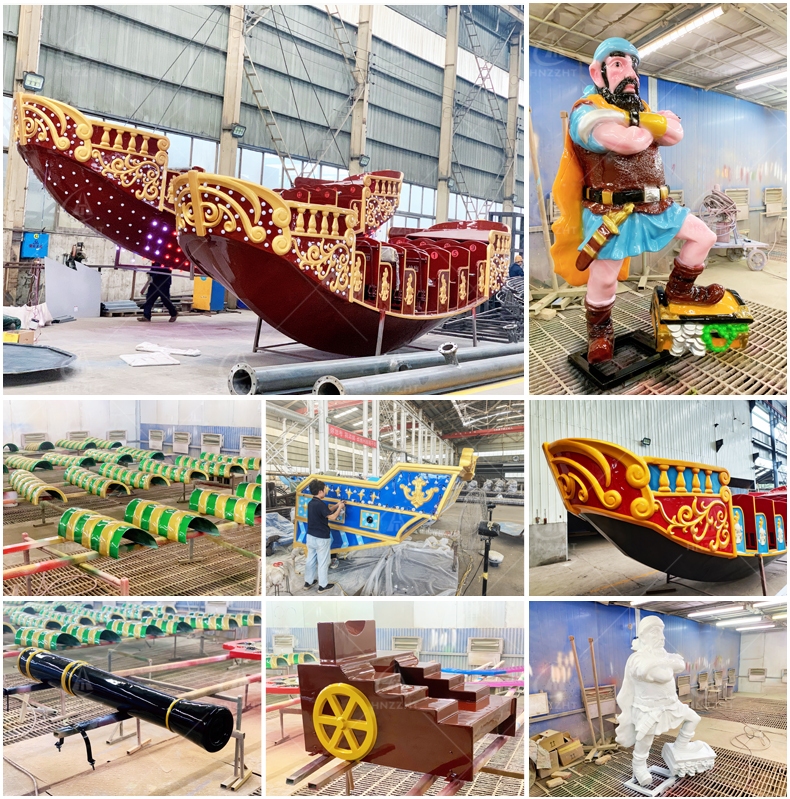
Pirate ship, just like the ancient pirate ship, is a horizontal axis swing repeatedly classic amusement equipment, it starts from slow swinging then slowly swing sharply, sit in the pirate ship, with slow to quick swing repeatedly, like on the waves of the sea, and sometimes on the crest, and sometimes fall off a cliff, adventure and thrilling. Pushing the limits that people can bear.
| Power | 16.5 KW |
| Voltage | 5N/380V/220V/50HZ |
| Area | Φ10.5m×7.5m |
| Equipment Size | 11.5m×7.5m×8m |
| Running Height | 9m |
| Capacity | 24 Persons |
A pirate ship is the easiest ride to sell to a park board and the easiest ride to get subtly wrong. This guide walks through what buyers actually need to check — footprint and capacity math, the steel behind the fibreglass, the eight safety points worth verifying at acceptance, the compliance passport for each market, and the three ledgers that decide whether the ride pays back.
Jump straight to the section you need — listed in reading order.

A pirate ship supplied by Hangtianrides, mounted on the elevated platform of a three-level stacked park and sharing the skyline with the Ferris wheel.
Positioning first — because the wrong positioning leads to the wrong size
A pirate ship is a medium-sized pendulum ride around a horizontal axis: a motor drives pusher tyres that push the hull higher and higher through friction, and once the drive cuts out the hull swings freely until a pair of brake tyres press onto the friction plate under the hull and bring it to rest on the level platform. Riders board from the platform, lock their restraint bars, and experience alternating weightlessness and hyper-gravity as the ship rises to the crest and drops into the trough.
It is not the most thrilling machine in the park. What a buyer is really purchasing is a visible crowd magnet that fills the experience gap around the coaster and the pendulum: families, couples and teenagers can all ride it, the queue fills itself because the motion is on display, and the ride cycles fast enough that throughput does not bottleneck the rest of the park.
From our side of the table, buyers rarely choose a pirate ship because it is the most extreme ride available. They choose it to complete a gradient of experiences with a controlled capital outlay. A coaster pulls visitors from a distance; a pirate ship keeps them in the same zone for another hour, and the screams from the platform do the marketing for the operator.
The ride also travels well across site types — county-level parks, the atrium of a commercial complex, scenic-area ride zones, resort entertainment clusters, and the middle tier of a multi-level stacked platform. The single test that matters is whether the site can accommodate the swing envelope plus the queue and circulation, not whether the plot looks big on a site plan.
The machine is built from seven assemblies: support frame, pendulum arm, hull, drive unit, braking unit, boarding platform and electrical system. The hull hangs from a suspension shaft that passes through a lifting ring and is locked with a pin; four welded square tubes form the load-bearing frame. The energy path is short and easy to audit — motor, pusher tyre, friction against the hull, hull swings to the set angle, drive cuts out, inertia carries the swing, brake tyres rise and press the friction plate, hull stops level.
Because the drive is friction-based rather than rigidly geared, the ride depends more on daily inspection than most equipment of its size. Drive tyre pressure, tread wear and the brake friction surface are all consumables. Understanding this is what stops a buyer from trading a spare set of tyres for a small discount at the negotiating table.
Eight out of ten quotation gaps are specification gaps, not configuration gaps
Going from an 8-seat hull to a 40-seat hull changes steel tonnage, foundation size, shipping volume and lifting requirements by multiples. So the order should be: fix the size from the site and the traffic, then compare structure and configuration within that size.
| Model | Riders | Dimensions (L×W×H) | Max swing angle | Total power | Footprint | Best-fit venue |
|---|---|---|---|---|---|---|
| Mini pirate ship | 8–12 | 5.1 × 2.7 × 3.6 m | Set per model | 4 kW | 7 × 5 m | Mall atriums, indoor family centres, community plazas |
| 24-seat | 24 | 9 × 12 × 7.5 m | 45° / 60° | 17 kW | 9 × 14 m | County-level parks, small and mid-sized parks, mixed-use developments |
| 37-seat | 37 | 10 × 17 × 10.2 m | 55° per side | 28 kW | 20 × 10 m | Regional parks, scenic-area ride zones |
| 40-seat | 40 | 9 × 16.6 × 14.5 m | 60° per side | 30 kW | 28 × 10 m | Destination theme parks, large cultural-tourism projects |
Reference values for standard configurations. Final dimensions, angles and counterweight follow the project's approved technical file. Note that "footprint" and "dimensions" are different numbers: the footprint already includes the swing envelope and the surrounding safety clearance, while the dimensions are only the hull projection. Buyers who measure a site against the hull projection usually discover at installation that the fence and queue line no longer fit.
The number buyers care about is riders per day, but the number suppliers quote is too often a theoretical hourly figure. Do it in two steps.
A 24-seat ship with a four-minute cycle gives 24 × 60 ÷ 4 = 360 riders per hour. In real operation, loading, per-seat restraint checks, dispatch waits, clearing the platform and shift handovers all consume time, so field practice applies a factor of 70% to 85%. At 80%, the practical figure is 288 riders per hour — that is the number that belongs in the plan.
The same formula explains why "bigger is better" is a common misjudgement. A 40-seat hull has higher theoretical capacity but needs a larger swing envelope, a heavier foundation and a longer boarding platform. If traffic cannot fill it, its real utilisation ends up below that of a fully loaded 24-seat ship.
The ride also has explicit environmental limits: ambient temperature 0–40 °C, relative humidity not exceeding 90% at 20 °C, altitude below 1,000 m (electrical derating above that). Operation must stop when wind speed exceeds 15 m/s, and during thunderstorms, heavy rain, dense fog, frost or snow. These clauses are not disclaimers — they are the basis for rostering and severe-weather procedure.
If the pad is in the 9 × 14 m range, daily traffic is in the hundreds, and the park wants to prove out a mid-size attraction, the 24-seat model is the safest choice: controlled investment, modest foundation demand, single-operator running, adequate turnover. Where the project is the gateway of a regional park — or one level of a stacked structure — 37- and 40-seat hulls deliver stronger visual impact and higher peak throughput, but require a heavier foundation, greater lifting capacity and a wider boarding platform. The mini model answers a different brief: indoor sites and family traffic, with gentle motion and a small pad.
Where quotations quietly differ from one another
The easiest place to misread a pirate ship is to judge it by its paintwork and hull sculpting. The decorative layer is fibreglass — replaceable and repaintable. The load-bearing steel and the suspension system are not. So read the equipment in this order.
Load-bearing structures use national-standard Q235 steel, with higher grades where the design calls for them; material certificates should be traceable. Critical pins are quenched and tempered with hardness reports, and connections use Grade 8.8 or higher bolts marked with witness lines after installation so loosening shows up during routine inspection.
Critical load-bearing welds are full-penetration, then inspected by magnetic particle (MT) or ultrasonic (UT) testing to remove cracks and lack of fusion. Records are archived with the machine. The whole hull structure is optimised through finite-element analysis to control stress concentration, vibration and noise.
Steel is shot-blasted to Sa2.5, then coated with an epoxy zinc-rich primer, intermediate coat and polyurethane topcoat. Fibreglass parts are oxidation-treated and finished with automotive-grade baking paint for UV and temperature resistance. Load-bearing steel requires an annual anti-corrosion service; rust, peeling or cracking is repaired as soon as it appears.
On a quotation these details usually collapse into one line reading "steel structure, sand-blasted and painted". Five to ten years later the difference is either touch-up painting during inspections, or structural repair and early retirement.
A pirate ship does not rely on one safeguard — it relies on layers
The following eight items are what a client should confirm on site, and they are the same items we sign off in factory inspection.
| Component | Condition to be met | How to verify on site |
|---|---|---|
| Restraint system | Independent restraint bar per seat, five-point seat belt, plus a reinforced safety rope as an additional layer | Press each seat and confirm full locking, including on empty seats; belt buckles require a dedicated tool to release |
| Swing limits | Mechanical and electrical limits in series; angle cannot exceed the certified maximum | Run unloaded and watch whether the limit position triggers the programmed deceleration |
| Braking | Normally-closed brake; decelerates and stops automatically on power loss or emergency stop; brake tyre contact is reliable | Carry out a power-cut test: the hull must settle onto the platform, never swing freely; if the brake fails to contact, a manual jack raises the brake wheel |
| Emergency stop | Red mushroom-head, manual-reset buttons at both console and platform; pressing cuts the main circuit at once; resetting does not restart the ride | Press and confirm main circuit isolation and brake engagement; after reset the ride stays stopped |
| Start interlock | No start if any restraint bar is unlocked, the platform confirmation button is not pressed, or the gate is open | Deliberately leave one condition unmet; the ride must refuse to start or stop immediately |
| Suspension and retention | Suspension shaft and bearing housings fitted with safety wire rope or retention plates; pins have anti-drop features | Check that retention parts are present, witness marks are drawn and bearing lubrication is correct |
| Off-centre loading | Passengers guided into a symmetrical pattern about the X and Y axes; no one-sided loading | Ticket gate limits each batch to the ride capacity; staff direct seating on the platform |
| Buffers and fencing | Docking buffers, stainless-steel handrails on boarding steps, complete perimeter fencing | Visually check buffer wear and settlement, and that handrails and fence sections are tight |
Safety configuration is only half of it; operating rules carry the rest. Rider restrictions must be enforced at the gate rather than reconstructed after an incident: nobody under 1.2 m or over 65 years, children between 1.2 m and 1.4 m only with an adult, nobody over 90 kg, and nobody whose body shape prevents a reliable restraint fit. Guests with hypertension, heart conditions, epilepsy, pregnancy, alcohol or impaired self-control are declined.
The most frequently overlooked detail is power loss and evacuation. The brake is normally closed, so a power cut or emergency stop decelerates and stops the hull automatically. If the brake does not contact the friction section, a manual jack raises the brake wheel for rapid braking; restraint bars are released through the manual button on the pneumatic solenoid, using residual air in the compressor receiver. On a low-level installation, full evacuation is planned within about 40 minutes — a figure that belongs in the park's emergency plan, and in its drills.
Standards and inspections are two different conversations
Compliance decides whether the machine can be accepted, opened and re-certified next year. It should be settled at the quotation stage, not after manufacturing has finished.
| Market | Main references | What the client must complete |
|---|---|---|
| China | GB 8408-2018 Safety Code for Large-Scale Amusement Rides; TSG 71-2023 Safety Technical Regulation for Large-Scale Amusement Facilities. Rides are classified by per-side swing angle and capacity; the 24-seat model is a Class B device inspected at provincial level. | Installation notification, supervisory inspection, use registration, annual inspection, certified operators |
| Europe | EN 13814-1 (design and manufacture), EN 13814-2 (operation, maintenance and use), EN 13814-3 (inspection requirements); CE marking. | Initial approval by a notified body, risk assessment file, device log book |
| North America | ASTM F2291 (design), F1193 (quality, manufacture and construction; current edition F1193-26), F770 (ownership, operation, maintenance and inspection). | State or provincial registration, annual inspection, operator training records |
The classic mismatch is a ride built to standard A being inspected against standard B. The purchase contract should state which framework the ride is designed and manufactured to, and list the documents supplied with it: general arrangement drawing, foundation and anchor-load drawing, structural calculations, electrical schematics, control-system description, risk assessment and the operation and maintenance manual. Anything that must be completed locally — notified-body approval, supervisory inspection, registration — should be named explicitly. Attaching that list to the contract works far better than arguing about it at acceptance.
What we deliver, and what the client has to have ready
Model and layout recommendation based on site dimensions, target traffic and budget, with a general arrangement and the footprint envelope. Client provides: surveyed site drawing, traffic forecast, power and lifting conditions.
Foundation drawing, anchor-bolt hole positions and load requirements. Client provides: civil works built to drawing, holes cleared, shim surfaces levelled.
Dimensional verification, weld appearance and NDT, electrical safety tests, and a 72-hour continuous no-load plus full-load pressure test before dispatch. Client provides: sign-off on paint scheme and lighting, confirmed shipping date.
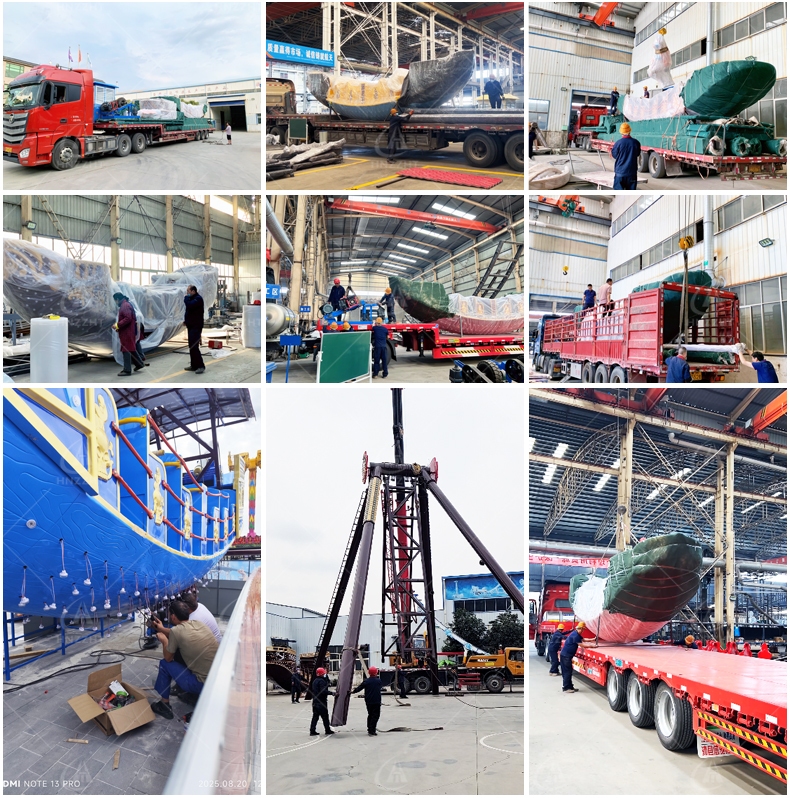
Component-wise packing with moisture and impact protection, documentation and packing list. Client provides: destination confirmation and customs paperwork.
Positioning, connection and wiring sequenced by platform level and lifting constraints. Client provides: lifting equipment, working area, temporary power.
At least 5 no-load runs; at least 80 simulated full-load runs with 72 kg per seat; at least 5 runs at half load off-centre; after an emergency stop the hull must come to rest within 5 minutes, tested three times consecutively. Client provides: staff to witness and record the data.
Joint acceptance; operator and maintenance training with assessment before duty. Client provides: trainees and a daily inspection record system.
The commissioning test counts are worth writing into the acceptance record: five no-load runs, eighty full-load runs and five off-centre runs cover the three load states that cause most problems. A five-minute stop after an emergency stop, repeated three times, is what proves the brake under inertia. Signing a one-line "operates normally" certificate throws all three verifications away.
What the quotation does not include, and what actually pays it back
Beyond the machine itself, budget for civil foundations, transport (these hulls ship in sections), lifting, installation and commissioning, inspection and registration, perimeter fencing and queue-area works, plus power distribution and lighting. In our experience most overruns on projects like this happen in the "supporting works" column, not in the equipment price.
The 24-seat model draws 17 kW. At eight effective operating hours a day and an average load factor of 0.8, daily consumption is roughly 109 kWh — and real consumption tracks operating hours and the number of starts, which in turn tracks traffic. One operator runs a 24-seat ship at normal traffic; with ticketing and platform guiding, two people cover a shift. Add consumables (drive tyres, brake tyres, drive belts, seals) and annual inspection and anti-corrosion work. Overall this is one of the cheaper machines in a park to keep running.
Using the 288 riders per hour derived earlier as a peak reference (24 seats, four-minute cycle, 0.8 operating factor), the daily figure depends on park traffic and where the ride sits on the circulation route. The table below is an arithmetic example only — every parameter is an assumption, not a quotation or a revenue guarantee.
| Line item | Example value and note |
|---|---|
| Ticket price per ride | USD 2 per rider (example; substitute your local pricing) |
| Effective daily riders | 300 riders (example; about a quarter of peak capacity, matching a park with moderate traffic) |
| Operating days per year | 250 days (example, allowing for peak and low season plus maintenance shutdowns) |
| Annual ride revenue | 2 × 300 × 250 ≈ USD 150,000 (example) |
| Annual direct cost | Electricity, consumables, inspection and servicing, staffing — entered at the scale of the example |
| Payback | Put total capital (equipment plus supporting works) into the denominator of the line above; in field practice a well-located mid-size ship typically recovers its investment within one to two operating seasons |
The value of this table is the method, not the numbers. Replace ticket price, daily riders and operating days with your own site data and the payback period falls out. Conversely, if a proposal shows a payback beyond three years, the problem is usually traffic density or site location rather than the machine.
Downtime costs more than the parts
A pirate ship is expensive to have standing still: a week of downtime on a flagship ride costs more than a week of tickets, because repeat visits and word of mouth go with it. Two things matter in the after-sales terms — can spare parts keep coming, and can the park diagnose a fault quickly.
In practice, what operators need is not a promise that nothing will break, but a clear "check this first" path. Insufficient drive tyre pressure, worn tyres, a shifted upper limit or a low-positioned proximity switch cover most of the cases where the hull will not reach its highest angle — and each has a short diagnostic route. Training the park's own maintenance staff on those four checks is faster than waiting for a technician to fly in.
Straight answers to the questions that sit behind most price negotiations
All the judgement above, applied to one machine
| Item | Specification |
|---|---|
| Power supply | 380V/220V, 50Hz (3N+PE); supply capacity not less than 60 kVA |
| Total power | 17 kW |
| Dimensions | 9 × 12 × 7.5 m (L × W × H) |
| Overall height | 7.5 m |
| Max swing angle | 45° / 60° |
| Footprint | 9 × 14 m, including swing envelope and safety clearance |
| Capacity | 24 riders |
| Cycle time | Adjustable from 3 to 10 minutes, to suit traffic and the intensity you want to run |
| Structure and materials | National-standard Q235 steel frame; high-strength fibreglass hull and trim; finite-element optimised; welds inspected by MT and UT |
| Safety configuration | Independent restraint bar and five-point belt per seat, reinforced safety rope; mechanical and electrical dual limits; normally-closed brake; emergency stop isolating the main circuit |
| Certification and testing | Whole-machine national special-equipment inspection; Class B provincial-inspected device; 72-hour continuous no-load and full-load pressure test before dispatch |
| Customisation | Paint scheme, hull sculpting, LED lighting and audio programme, platform theming — configurable to the park's own IP |
Around the machine we provide pre-project site and layout advice, foundation drawing and electrical-condition coordination, packing and transport, installation and commissioning, pre-duty training for operators, and warranty-period repair with spare-part supply. For multi-level platforms or constrained sites, the pirate ship can also be planned together with a Ferris wheel, big pendulum, Flying UFO and other rides as one circulation and zoning scheme.
The short versions, before you go into a technical meeting
24 × 60 ÷ 4 = 360 riders per hour is the theoretical figure at a four-minute cycle. Apply a 70–85% operating factor for loading, restraint checks, dispatch and clearing: at 80%, plan for 288 riders per hour.
For the 24-seat model, 9 × 14 m already covers the swing envelope and the surrounding safety distance. Add queue space and circulation on top of that — the ride's safety zone is not the queue zone.
3N+PE 380V/220V, 50Hz, sinusoidal supply, voltage fluctuation within ±10%, frequency within ±2%, capacity not less than 60 kVA. Confirm the transformer headroom before foundation works, because upgrading later is disruptive.
The brake is normally closed, so the hull decelerates and settles on the platform. If the brake does not contact the friction section, a manual jack raises the brake wheel; restraint bars are released using residual air from the receiver. On a low-level installation, full evacuation is planned within about 40 minutes.
General arrangement drawing, foundation and anchor-load drawing, structural calculations, electrical schematics, control-system description, risk assessment, operation and maintenance manual, product certificate, type-test certificate and packing list. Notified-body approval, supervisory inspection and use registration are completed locally.
Nobody under 1.2 m or over 65 years; children from 1.2 m to 1.4 m only with an adult; nobody over 90 kg or whose body shape prevents a reliable restraint fit; and guests with hypertension, heart conditions, epilepsy, pregnancy, alcohol or impaired self-control.
Who is answering these questions
Zhengzhou Hangtian Amusement Equipment Manufacturing Co., Ltd. (Hangtianrides) integrates research, manufacturing and sales in one company, operating two production bases. Its headquarters at No. 161 Gongye Road, Shangjie District, Zhengzhou covers 45 mu with 28,600 m² of floor area, employing a substantial team of ride-manufacturing and trade specialists.
The company holds Class A qualifications for the manufacture, installation, repair and modification of large-scale amusement facilities, with 3 invention patents and more than 30 utility-model and design patents. It is a member of the China Amusement Park Association and the first-council president unit of both the Henan and Zhengzhou amusement equipment associations, and has passed quality, environmental and occupational health and safety management system certification, holding a self-operated import and export licence together with EU CE certification.
Rides are sold throughout China and exported to Russia, the United States, France, Libya, Lebanon, Algeria, Pakistan, Kazakhstan, Kyrgyzstan, the UAE and other markets. Recent full-package deliveries include a three-level stacked amusement park (Ferris wheel, pirate ship, big pendulum, Flying UFO, self-control dinosaur and family roller coaster) and the site planning and ride package for MANAS PARK in Kyrgyzstan.