What Is The Working Mechanism Of Mega Bounce Rides?
Guests see a simple thing: a ring of seats that lifts them up, drops them into a gentle bounce and keeps the whole platform turning at the same time. Under the deck there is a compact machine doing three jobs at once, lifting, cushioning and rotating, all coordinated by a controller that reads position and speed many times per second. This article explains the working mechanism of Mega Bounce Rides from the base frame upwards, and what each part has to do for the bounce to stay smooth and safe all day.
The Basic Principle: Lifting Energy And Releasing It
Any bounce mechanism works on one idea. Energy is put into the seats by lifting them, and then released in a controlled way so that the guests fall, slow down and are caught again. A mega bounce ride lifts its seats with hydraulic cylinders, with a motor driving a crank or eccentric shaft, or, on some designs, with an air spring system that stores pressure. The important detail is that the fall is never free: the cylinder, the crank or the air spring keeps pulling against the movement, so the drop is a controlled bounce rather than a free fall.
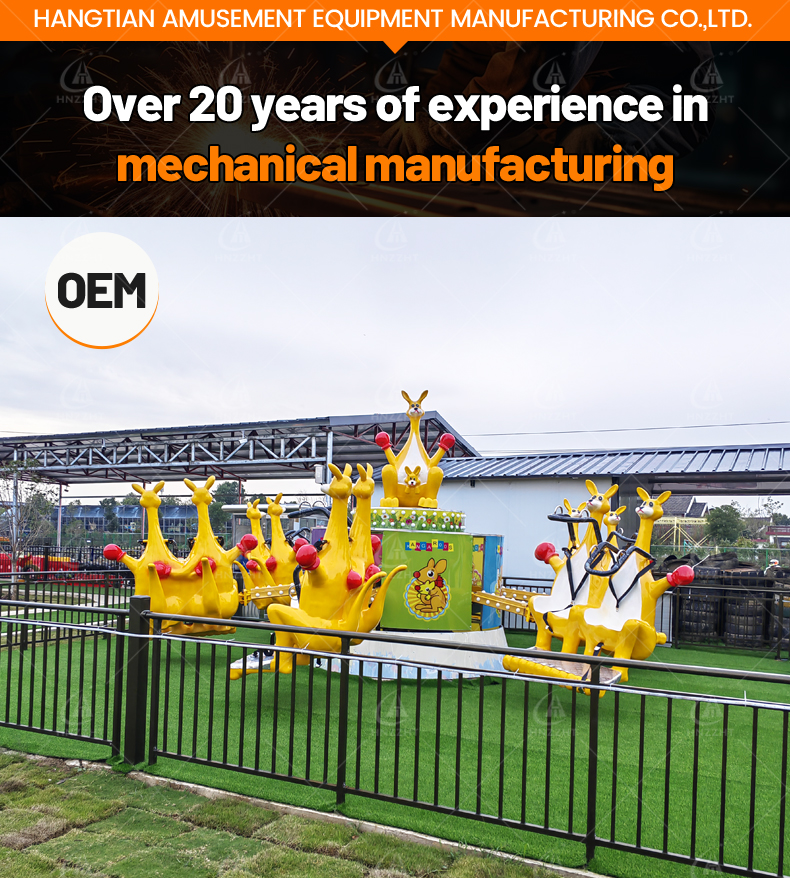
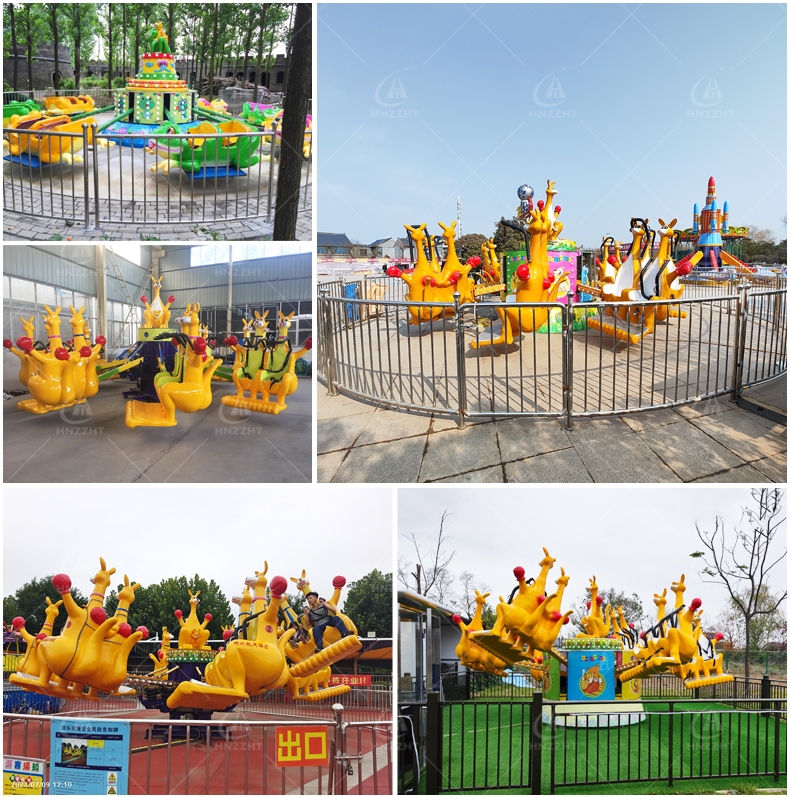
The height of the bounce and the speed of the movement are set by the machine, not by the guest. That means the whole ride is a fixed programme: the seats rise to a defined height, are held for a moment, drop with a defined rate and repeat, while the platform turns at a speed that is matched to the rhythm of the bounce. When an operator tells you a ride has a gentle or an aggressive bounce, this setting is what they are describing.
The Main Assemblies Of The Mechanism
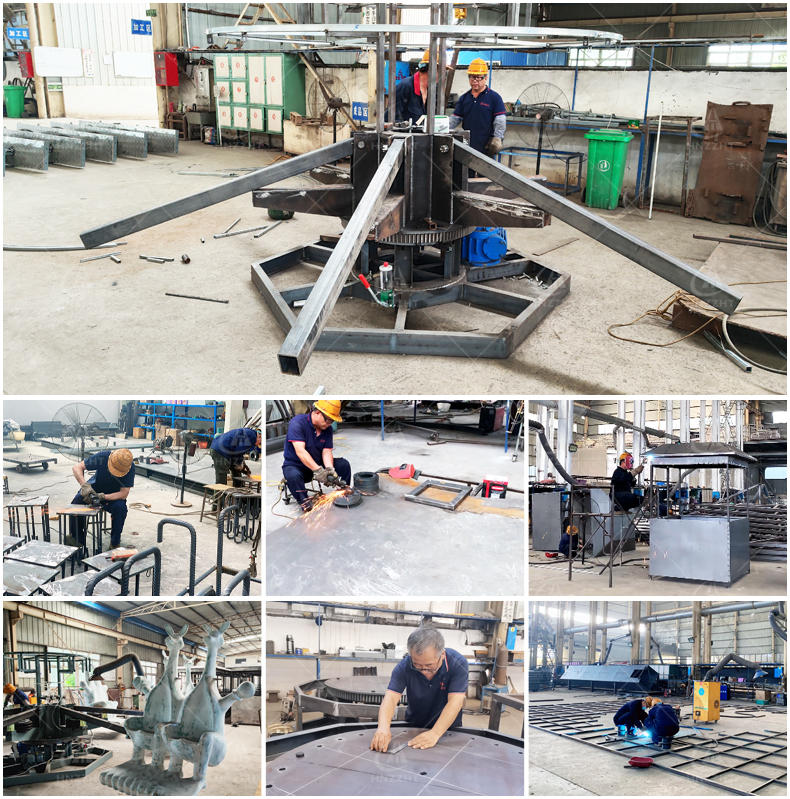
Under the deck, a bounce ride is built from a small number of large assemblies. The base frame is a welded steel structure that carries the weight of the moving parts and transfers every load into the foundation. Above it sits the rotation assembly, usually a slewing bearing with a driven gear ring, which allows the upper structure to turn continuously while carrying the bounce mechanism and the guests.
The lifting assembly is the heart of the machine. On a hydraulic design it is a set of cylinders with guide columns and a cross beam; on a mechanical design it is a shaft with a crank or an eccentric wheel and connecting rods that convert rotation into an up and down stroke. Seat arms are hinged or bolted to the moving frame, and each seat unit has its own restraint that locks before the ride is allowed to lift.
The cushioning elements deserve a mention of their own. Hydraulic circuits have an accumulator and a throttle valve that soften the bottom of the stroke; mechanical machines use rubber buffers or polyurethane stops; air systems use the compressibility of the air itself. This is the part of the mechanism that guests feel most directly, and it is also the part that wears first, which is why it belongs on every maintenance checklist.
How The Drive And Control System Work Together
The drive train starts with an electric motor and, on a modern machine, an inverter. The inverter ramps the motor up and down instead of switching it on and off, which keeps the current low, removes the jolt at the start of each cycle and allows the operator to set the speed of the rotation to match the bounce. On hydraulic machines the same motor drives a pump, and proportional valves control how quickly the cylinders extend and retract.
Above the drive sits the controller. A programmable logic controller reads inductive proximity sensors that detect the position of the lifting frame, the rotation of the platform and the state of every restraint. From those signals it decides when to lift, when to release, when the stroke has reached its limit and when the cycle can start again. If any reading is outside the expected range, for instance a seat that has not locked or a frame that has not returned to the bottom, the programme stops instead of starting a new cycle.
This is why the control cabinet contains more than a motor starter. You should expect a safety relay or a redundant stop channel, phase failure protection, surge protection, an emergency stop circuit that cannot be bypassed and, on the better machines, a small display that shows the fault code so a maintenance technician knows where to look. For anyone comparing a Bounce Ride For Sale, the depth of that control system is one of the clearest differences between a machine built to a standard and a machine assembled to a price.
What Happens During One Cycle
Once the restraints are locked and the operator starts the ride, the sequence follows the same pattern every time. The rotation drive accelerates the platform to its working speed. The lifting assembly then raises the seat frame to the upper position, holds it for a moment while the platform keeps turning, and releases it. The seats fall, are caught by the cushioning elements at the bottom of the stroke and rebound a little, then the cycle repeats for the number of times set in the controller.
Typical machines run a cycle of one and a half to three minutes including boarding, with a bounce frequency that feels lively without becoming uncomfortable for children. Rotation speed and bounce height are usually adjustable in steps, so an operator can set a gentler programme for family hours and a stronger one for evening sessions. Because the same motor drives both movements on many designs, the settings are stored as parameters rather than as mechanical adjustments, and a technician can change the character of the ride in a few minutes.
The Safety Mechanisms Built Into The Design
Safety on a bounce ride is mostly about preventing the mechanism from doing something it was not programmed to do. Upper and lower limit switches stop the lifting frame at the ends of its travel; a rotation sensor confirms that the platform is turning at the commanded speed; an overspeed check stops the drive if the platform or the stroke exceeds its limit; and the restraints are interlocked so the ride cannot start if one seat is not properly locked.
Mechanically, the design carries redundancy as well. Hydraulic circuits include a burst valve or a pilot operated check valve so a hose failure cannot let the frame drop freely, and mechanical drives use a brake that engages when the power is removed. Structurally, the base frame, the slewing bearing, the guide columns and the seat arm pins are sized with a defined safety factor, and those parts are inspected regularly for play, cracking and corrosion.
Guests are protected in three more ways: padded seat surrounds, a restraint that opens only with a tool or a key rather than by the passenger, and an evacuation procedure that lets the operator bring the seat frame down manually and release every restraint. Ask any supplier to demonstrate all three before you accept the machine, and ask what happens if the site loses power with the ride at the top of its stroke.
What The Mechanism Means For Buyers And Operators
Understanding the mechanism makes the buying decision much easier. A hydraulic machine gives a smooth, powerful bounce and a high lifting capacity, and it needs a well maintained oil circuit, clean oil and a competent technician. A mechanical crank drive is simpler and cheaper to service, with the trade off of a fixed stroke geometry and more mechanical wear points. A pneumatic design is light and works well for smaller units, but it depends on the quality of the air supply and the seals.
Whichever type you choose, the questions to ask are the same. Which components are used for the drive, the cylinder or the crank, and the slewing bearing? What is the rated load per seat and the safety factor on the lifting parts? Which parts wear fastest and how long do they last in a park running six days a week? Is the control programme adjustable, and who has the password? What spare parts should be kept on the shelf?
An Amusement Park Bounce Ride that is understood is a ride that is easy to run. The maintenance team knows which components to grease, which seals to change before the season and how to read the fault codes. The operator knows how to set the programme to suit the crowd in front of them. And the owner knows that the Kangaroo Jump Ride in the corner is drawing a queue every afternoon because the bounce feels right, the cycle is quick and the machine simply keeps working.