What is the Power Consumption of Viking Ship Ride?
Almost every operator planning a swinging ship asks the same question before signing a contract: how much electricity will the ride really draw once it is open every day? The honest answer is a range rather than one figure, because demand depends on the size of the gondola, the drive system, the swing angle and the way the ride is run. This guide explains how a Viking Ship Ride uses electrical energy, what the numbers on a motor nameplate actually mean, and how to size the supply so the machine never trips a breaker on a busy weekend.
How A Viking Ship Ride Uses Electrical Power
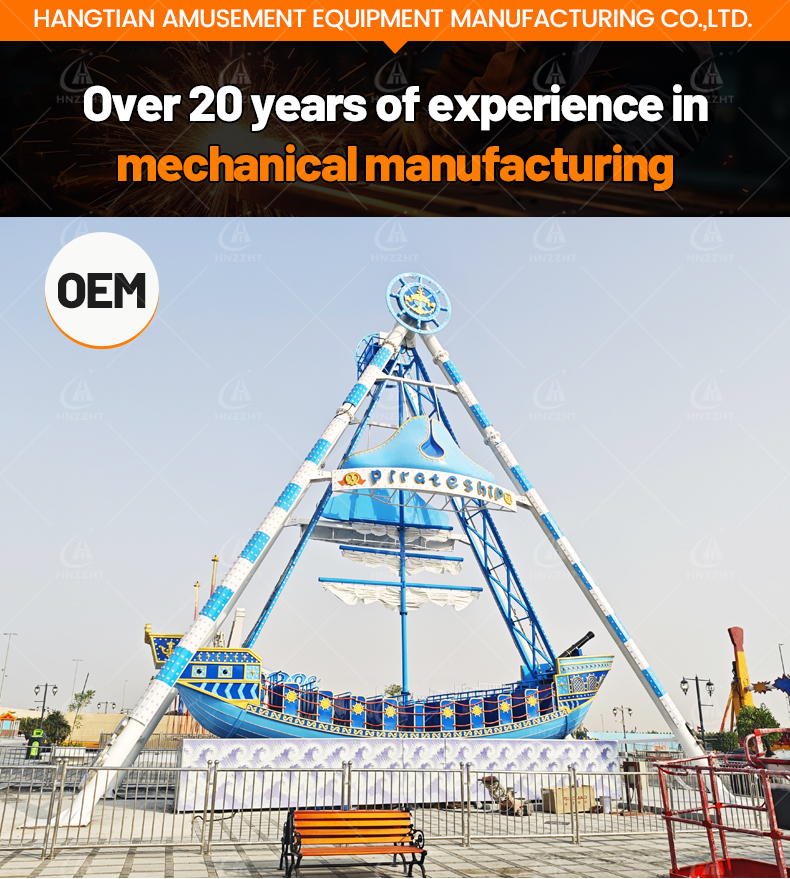
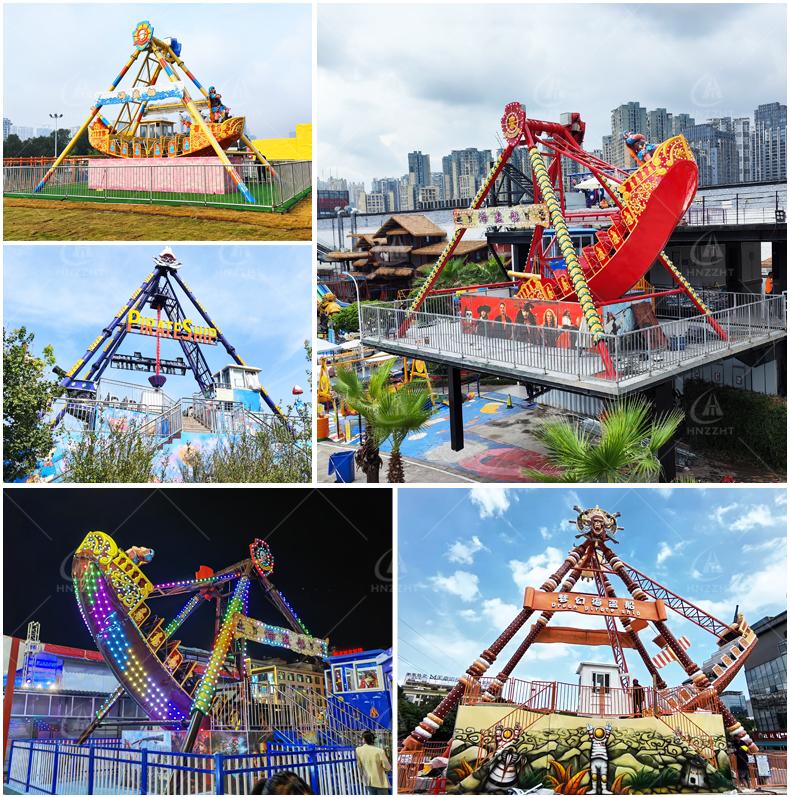
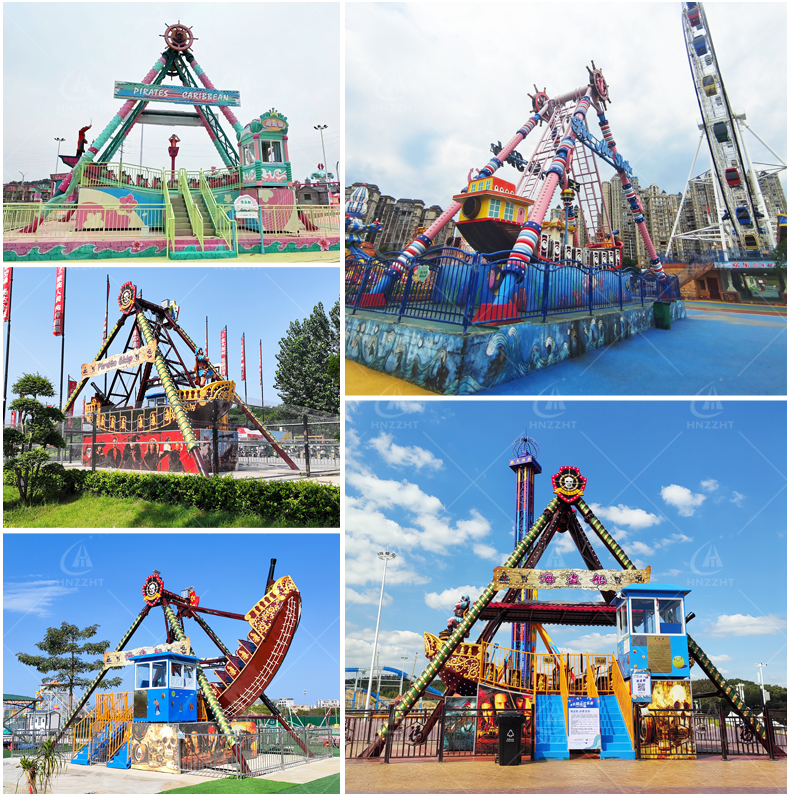
A swinging ship is a pendulum. The gondola hangs from one or two axles inside an A-frame, and the drive has only one physical job: to replace the energy the ride loses to friction and air resistance on every pass. That is why the electrical demand is not a steady load but a repeating pulse, highest as the ship accelerates away from the lowest point and lowest while the ship coasts upwards and slows down on its own.
Most ships are driven in one of two ways. A mechanical drive pairs an AC motor with a reducer and a crank or a friction wheel, and the motor alternates between drawing power to lift the gondola and being pushed by it on the way down. A hydraulic drive keeps a pump running against a pressure accumulator, so the motor load is smoother but the losses inside the hydraulic circuit are always present. In both cases the control cabinet holds the variable frequency drive or the pump starter, the contactors, the safety relay and the logic that reads the position sensors and releases the service brake.
Understanding that pulse is what makes the rest of the numbers useful. A 22 kW motor does not consume 22 kW for the whole afternoon, and a machine that is described as a 30 kW ride may well average less than half of that during normal operation. What the nameplate defines is the ceiling the supply must survive, not the bill the park will pay.
Typical Power Ratings For A Viking Ship Ride
Rated motor power grows with the mass of the gondola and the length of the arm. A compact twelve to sixteen seat ship usually carries a motor between about 5.5 kW and 11 kW. A standard twenty-four seat ship generally sits between 15 kW and 30 kW, while a large thirty to forty seat machine with a longer pendulum is normally specified between 30 kW and 55 kW, and the biggest hydraulic units can reach 75 kW at the pump motor.
Those figures assume a three phase supply, commonly 380 V, 400 V or 415 V at 50 Hz in Asia and Europe and 440 V or 480 V at 60 Hz in the Americas. Actual consumption during operation is far lower than the rating: a twenty-four seat ship typically averages between 35 and 60 percent of motor power while it is swinging, draws only one to three kilowatts while guests board, and adds half a kilowatt to two kilowatts for LED lighting and the control circuit.
The difference between a direct online start and a variable frequency drive matters as much as the rating itself. A direct start can pull four to six times the rated current for a fraction of a second, which is why the local breaker, the cable and the transformer have to be chosen with margin. A drive controlled ramp holds the starting current close to normal running current, which is friendlier to a weak rural supply and easier to run from a generator.
Measured energy is small compared with the machinery that moves it. A twenty-four seat ship with a mechanical drive uses roughly 0.05 to 0.15 kWh of electricity per cycle, so a busy day of three hundred cycles plus boarding time and lighting lands somewhere between thirty and seventy kilowatt hours. The only reliable way to know the figure for a particular machine is to clamp the incoming phases during a normal operating day and log the readings for a week.
What A Viking Ship Ride Project Needs From The Electrical Supply
Site planning starts with the transformer, not with the ride. As a working rule the supply should be able to deliver one and a half to two times the rated motor power without a significant voltage dip, so a 30 kW ship is best served by a transformer with at least 50 kVA of dedicated capacity. If the park shares one transformer with a coaster, a dark ride and a food court, the ride should have its own feeder and its own protection so that a fault in one attraction cannot stop the others.
Cable size follows the distance and the starting method. Voltage drop over a long run is often the real limit rather than current carrying capacity, and keeping the drop under about five percent protects both the motor and the drive. Armoured cable in a duct or a trench resists ultraviolet light, standing water and the occasional rodent, and an earthing conductor bonded to the steel structure gives the leakage protection something to work with.
Inside the cabinet, motor curve breakers, a phase failure relay, surge protection, an emergency stop circuit that cannot be bypassed and a clearly labelled isolation point keep the installation serviceable. For travelling shows, a diesel generator has to be sized for the starting method: a drive ramped machine can run from a generator that would stall under a direct start, and a machine that returns braking energy to the supply needs a drive that can also dissipate it through a resistor when the generator cannot absorb it.
How To Lower Energy Costs Without Losing The Swing
Most of the savings come from the way the ride is operated rather than from any single component. Ramping the drive gently, avoiding unnecessary stops between cycles on a busy day and keeping the pendulum angle matched to the audience all reduce the energy that has to be injected to keep the ship moving. Running the ride full rather than half empty improves the electricity used per guest, which matters more to the operating budget than the raw kilowatt hours.
Mechanical condition decides how much of the motor output reaches the gondola. A dry bearing, an axle that has drifted out of alignment, a worn friction wheel or a brake that drags even slightly all turn electrical energy into heat instead of motion. A short monthly routine that greps the axles, checks the brake clearance and listens to the gearbox will usually pay for itself many times over in reduced demand and longer component life.
On the electrical side, replacing old floodlights with LED fittings on a timer, setting the drive to a low power standby mode between sessions and keeping the control cabinet clean, dry and ventilated protect the components that would otherwise be replaced early. Logging the current of each phase every few months turns maintenance from guesswork into a trend: a slow rise on one phase with no change in the ride programme almost always points to a mechanical problem developing before the operator notices it.
What To Ask An Amusement Park Ride Supplier About Power
A serious supplier will answer electrical questions with documents rather than adjectives. Ask for the motor nameplate details, the duty rating, the insulation class and the protection rating of the cabinet, then ask for the single line diagram, the cable schedule, the protection settings and the parameter list of the drive. Those four documents tell you whether the machine was engineered for your network or simply adapted to it.
Confirm the voltage, frequency and phase rotation the ride will be built to test against, because a machine wound for 380 V at 50 Hz and installed on a 480 V at 60 Hz network will run fast, hot and short. Ask how the drive is commissioned, who sets the ramp times and the current limits, whether the parameters are documented and whether the supplier keeps a copy. Spare parts should be discussed at the same time: a spare drive, a set of relays and a brake rectifier in the store room can save a weekend of lost revenue.
Certification and testing complete the picture. A factory test report showing the motor running under load, the insulation resistance values before dispatch, the earth continuity result and the functional test of every safety circuit gives the local inspector a clear place to start, and it protects the operator if a question arises later about who set the machine up and how.
What An Outdoor Amusement Equipment Supplier Should Deliver On Site
Delivery is only the middle of the project. The installation team should set the foundation and the cable route, bring the supply to a labelled isolation point next to the cabinet, bond the steel structure to earth and leave the trench, the ducts and the drainage in a state the park can maintain. An enclosure rated for outdoor use, with a sun shield and a raised plinth, survives rain, dust and heat far better than a cabinet standing directly on wet concrete.
Commissioning should end with measurement rather than opinion. Ask the engineers to record the current and voltage on each phase through a full cycle, from boarding to the last swing, and to leave that sheet with the manual. Those first readings become the baseline for every future comparison, and they show immediately whether the machine is drawing what the specification promised.
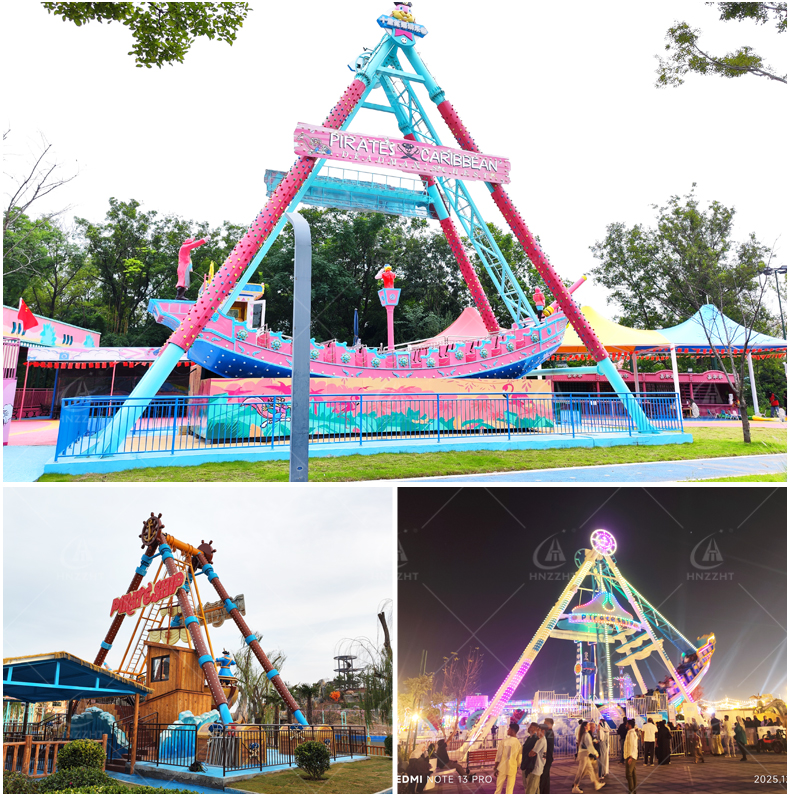
Training and after-sales support close the loop. Operators should know which breaker feeds what, how to isolate the ride safely, what the fault codes on the drive mean and who to call for a motor, a gearbox or a drive failure, with a stated response time and a spare parts commitment in writing. A ship that is maintained on schedule keeps its consumption stable for a decade, so compare options on drive system, electrical documentation and support as carefully as on the price of the structure itself.