How Many Kinds Of Tea Cup Ride Are There?
Almost every park has one, from a seaside pier to a shopping mall atrium, which is why buyers often assume there is only a single design behind the name. In practice a Tea Cup Ride is a family of machines that differ in floor type, cup size, drive arrangement and theme, and the version you choose decides the footprint, the guest mix and the installation cost. This article walks through the main kinds, explains how each one behaves on site, and shows what to compare when you order a set of cups for a new attraction.
The Classic Spinning Tea Cup Ride
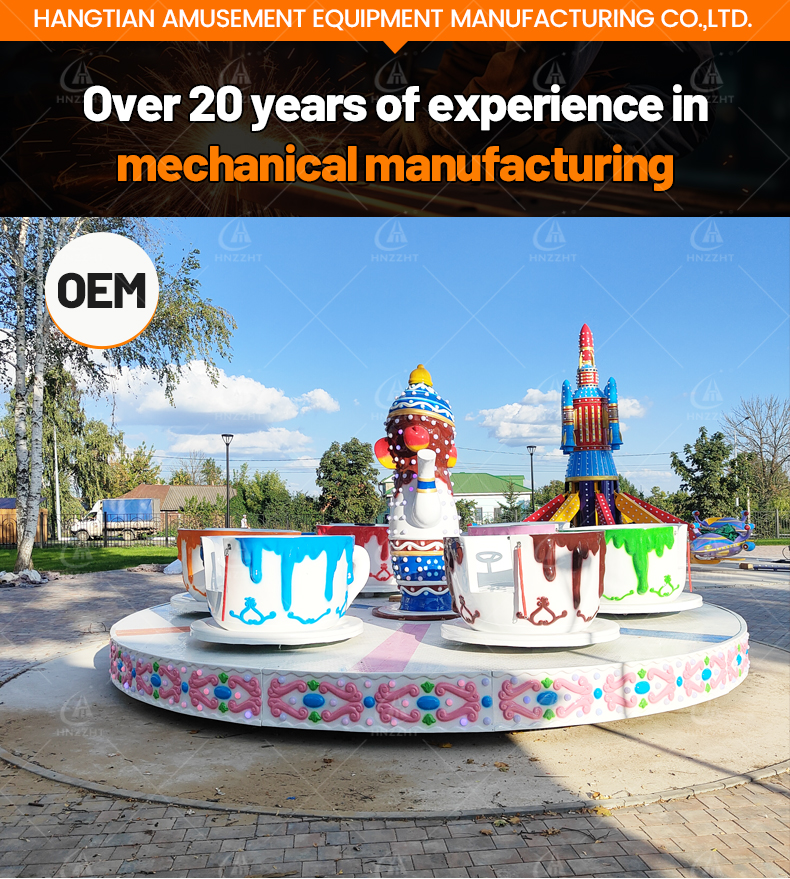
The classic machine is a rotating platform carrying a ring of cups, each mounted on its own small turntable. The platform turns in one direction while every cup can be spun by hand from the inside, so the ride gives two motions at once: a steady orbit and a much faster individual spin that the guests control themselves. That combination is the reason the ride stays popular with families included in a single ticket price, because a small child and a grandparent can share one cup and each still decide how fast it turns.
The floor of this type is normally a painted steel or fibreglass disc with the cups bolted on top, and the whole unit sits on a concrete base with the drive and the collector ring underneath. Diameters commonly run from six metres for a compact unit to twelve metres for a version that carries twenty-four or more guests, and the height rarely exceeds three metres, which makes the ride easy to fit under a canopy or inside a low building.
Cycle design matters as much as the styling. A machine that turns slowly for a long cycle suits older visitors and lets the operator run without an attendant inside the fence, while a faster cycle with a shorter boarding window is better on a busy midway where the queue never empties.
Tracked, Untracked And Tilting Floor Styles
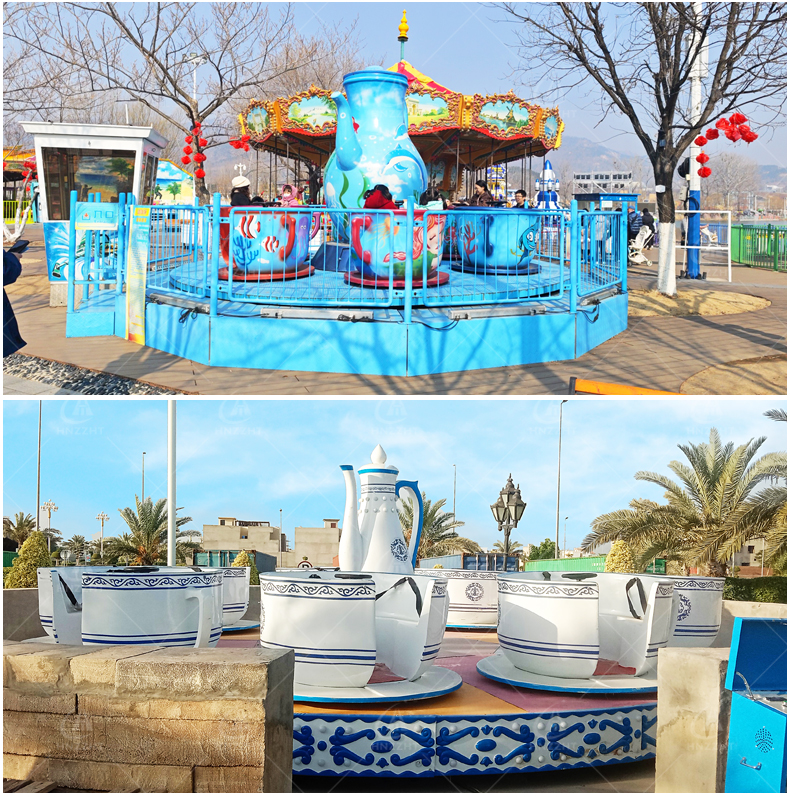
The second family splits by how the cups are guided. On an untracked machine the cups simply rotate with the platform and spin on their own bearings, which keeps the mechanism simple and the maintenance low. On a tracked version each cup follows a curved rail set into the floor, so the cup weaves in and out as the platform turns and the movement is more dramatic even at a modest speed.
A tilting floor adds a third movement. On these machines the outer part of the platform rises and falls slightly during the cycle, which lifts the cups in sequence and gives the ride a wave without the height of a coaster. The mechanism costs more and needs a firmer foundation, but it turns a small family attraction into something that looks different from the unit standing in the next park, and the extra motion is appreciated by guests who have already ridden the plain version.
Whatever the guide system, ask for the turning radius of the widest cup and the height of the fence line on the drawing. Tracked and tilting versions push the moving envelope outwards, and a plot that was measured around a plain platform can end up too tight once the cups swing beyond the disc.
Family, Kiddie And Double Deck Versions
Size separates the third family. A kiddie unit is built around a platform of four to six metres with three to six cups, a low fence and a gentle fixed speed, and it is usually placed indoors in a family entertainment centre or beside a playground where parents can watch from the edge. It needs very little power, fits on a reinforced slab rather than a deep foundation, and can be broken down for transport between fairs.
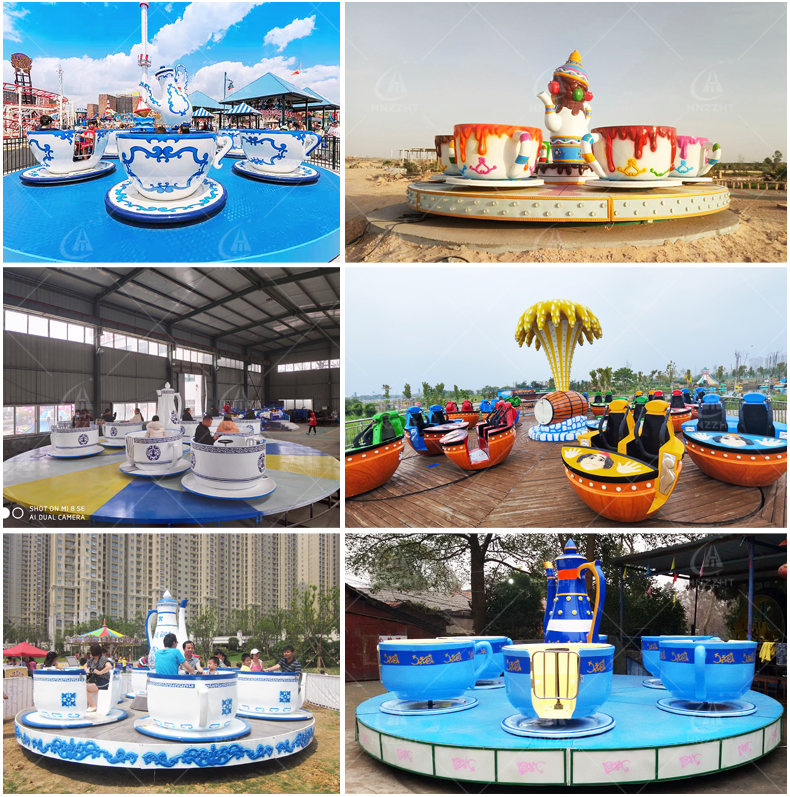
The family version sits in the middle, carrying two to four guests per cup with room for an adult beside a child, and it is the size most often bought for a park midway. A large unit goes further still, with bigger cups, a raised centre piece and sometimes two levels of decoration, and it is normally the centrepiece of a themed area rather than a filler attraction.
Choose the size by the queue you expect, not by the space you have left over. A machine that carries twelve guests per cycle and turns every ninety seconds clears fewer than five hundred guests an hour, so a busy park is usually better served by a larger model or by a second set of cups than by a small unit worked harder.
Themed And Custom Tea Cup Ride Designs
The last group is defined by appearance rather than by mechanics. A themed machine keeps the same platform and cups but changes the shell, so the cups become fruit, flowers, animals, balloons, mushrooms or vehicles, and the canopy and centre piece carry the same story. In a park with an existing theme this is often the cheapest way to make a standard ride look bespoke, since the drive and safety systems stay unchanged.
Full customisation goes deeper. Colours are matched to a brand palette, cup shapes are tooled for the design, the canopy is reshaped, lighting is added under the platform edge and along the cups, and music or a spoken commentary is wired into the control cabinet. A custom Spinning Tea Cup Ride built this way can be delivered as a recognisable attraction instead of a copy of the same machine in the park down the road.
When a theme is planned, agree the artwork file, the colour reference and the placement of logos before production starts. Changes made after the cups have been moulded are expensive, while changes made to a drawing cost almost nothing.
What Separates One Tea Cup Ride Manufacturer From Another
Two machines can look identical and still differ in the parts that decide how the next ten years go. The drive is the first: a geared motor with a well-matched reducer and a soft-start control gives a gentle pull-away and stops the platform without a jolt, which is easier on the cups, on the guests and on the fence line. Cheaper units save money here and show it in the ride quality.
Then look at the safety package. A rated chain or drive guard, a limit switch that stops the machine if a cup or a gate is disturbed, an emergency stop within reach of the operator, non-slip boarding steps and a fence that no child can climb are the basics. Ask for the electrical drawings, the load calculation for the base, the maintenance schedule and the spare parts list, and check that the machine is quoted against a recognised amusement ride standard rather than a general machinery rule.
Finally, check the factory rather than the catalogue. A serious Tea Cup Ride Manufacturer will show the welding on the platform frame, the paint process, the test run of a finished unit and the packing method that protects the cups on a long sea freight. Those four pictures tell you more about the machine than a page of specifications ever will.
Choosing The Right Kind Before You Order
Set the site first: the plot size, the clear height, the ground condition and the power available. Then match the type to the audience. A mall or an indoor centre wants a compact kiddie or family unit with a low noise level and a short cycle, a seaside park wants a mid-size machine that survives salt air and rain, and a themed area wants a custom shell with lighting that reads well after dark.
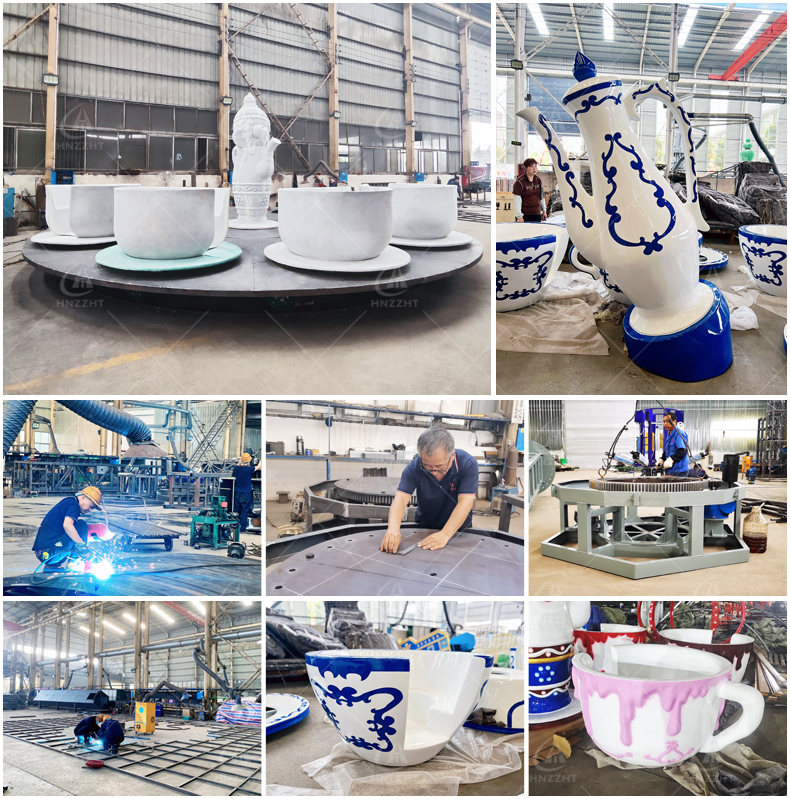
After the type is fixed, compare what each offer actually includes: the platform diameter, the number of cups and seats, the drive rating, the control system, the paint specification, the documentation, the installation support and the warranty. A quotation that lists all of these can be compared line by line, whereas a single price with no breakdown tells you nothing.
Most buyers end up choosing between three realistic options, and the choice is rarely about the machine alone. Compare the Tea Cup Rides for Sale that fit your plot on footprint, capacity, theme and service, and send the supplier a short brief with the plot drawing and the guest numbers. You will get a straight recommendation instead of a longer catalogue, and the Amusement Park Tea Cup Ride you finally install will suit the park you actually run.