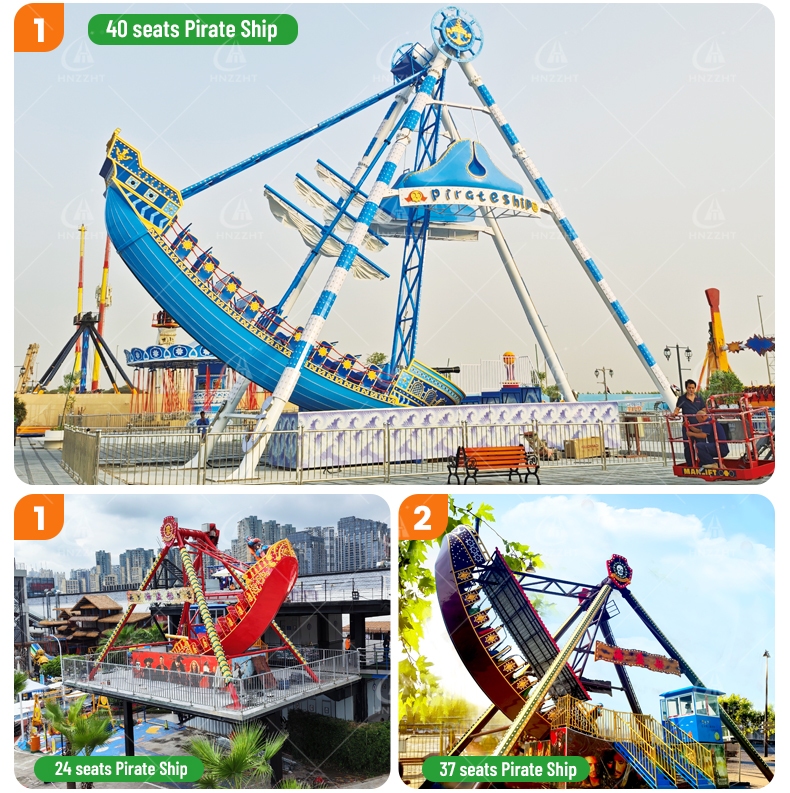
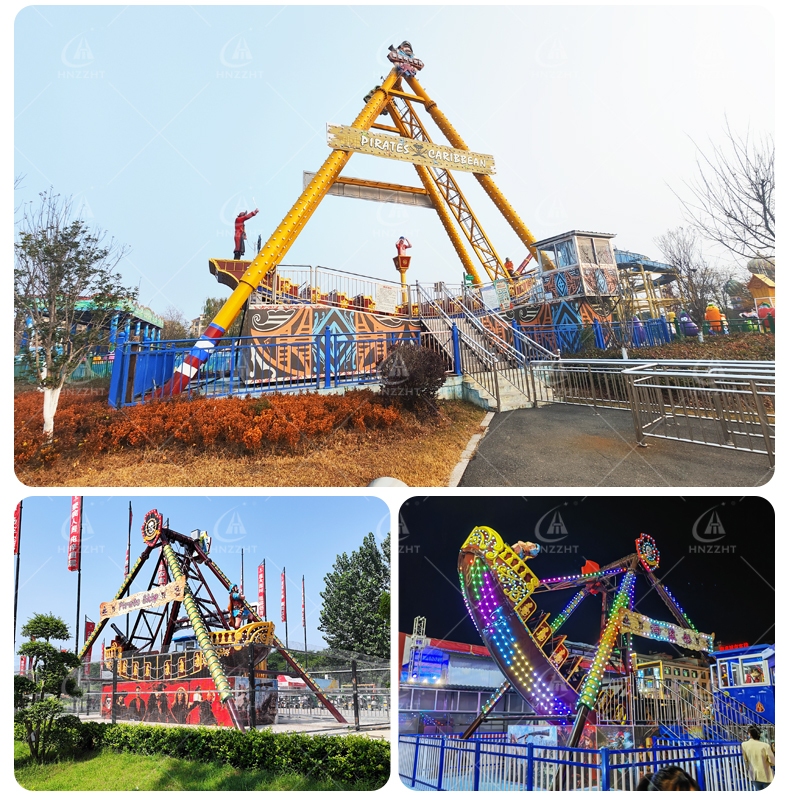
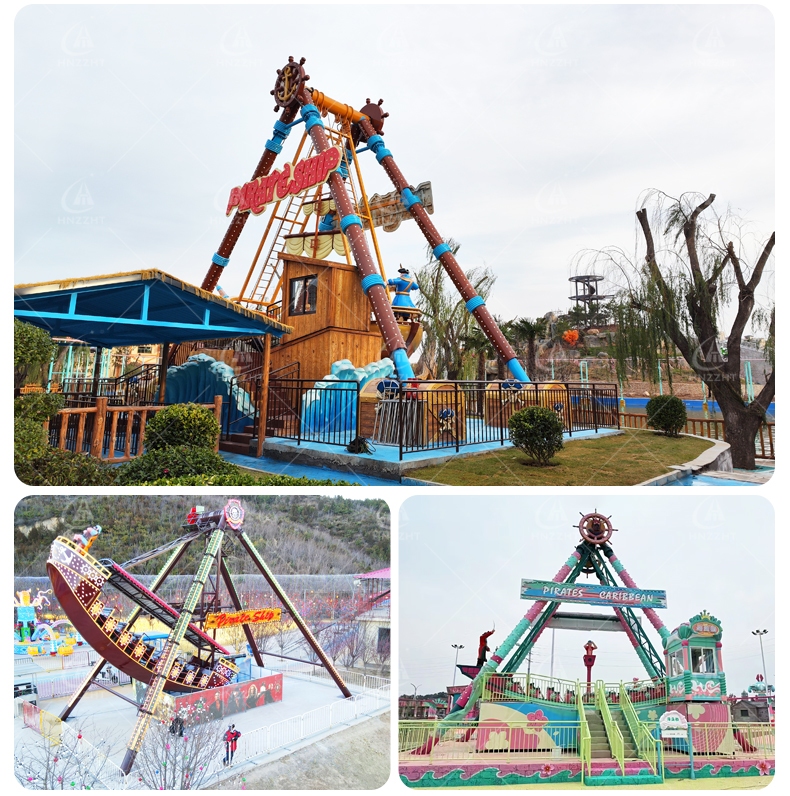
| Item | Specification |
|---|---|
| Capacity | 40 persons |
| Unilateral swing angle | 60°–70° |
| Equipment height | 14.6 m |
| Running height | 11.9 m |
| Device size (L × W) | 16.6 m × 9 m |
| Cover area (L × W) | 28 m × 10 m |
| Power | 37 kW |
| Voltage | 380V / 220V |
| Drive and control | Rubber tyre friction wheel, variable-frequency drive with PLC logic |
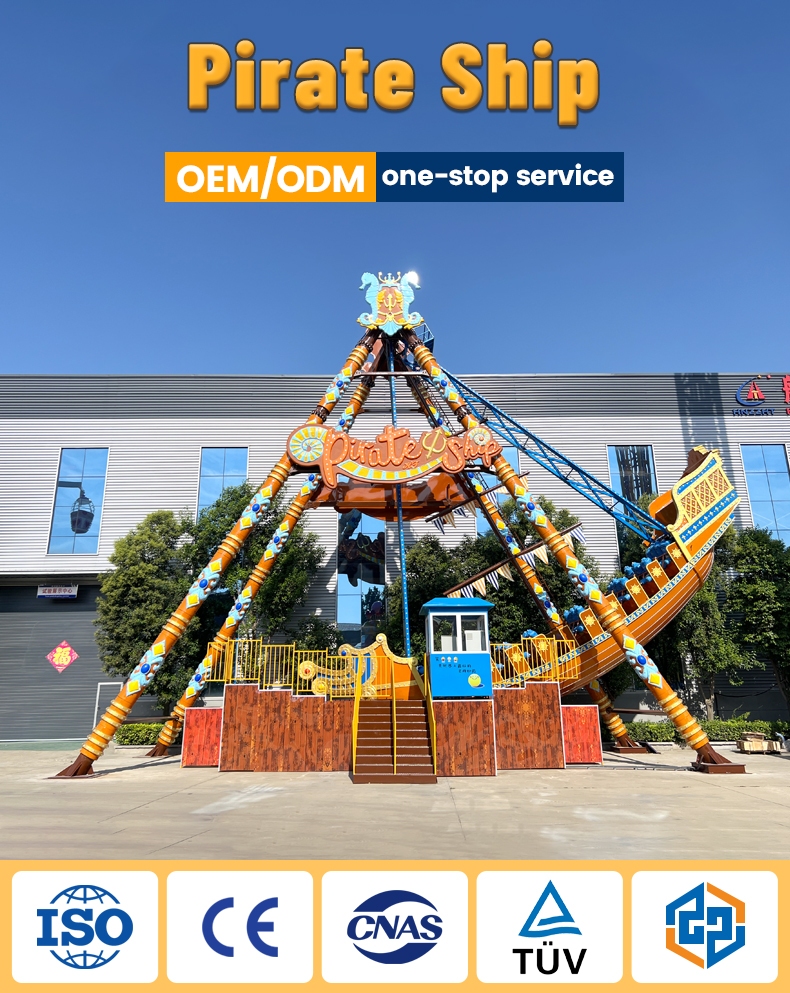
| Hull and theming | Welded steel structure with FRP figurehead and decoration, LED and audio package |
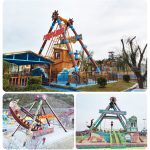
Manufacturer's parameters for the 40-seat pirate ship. The 16.6 × 9 m device size is the equipment; the 28 × 10 m cover area is what your site plan, fence line, queue and maintenance access must fit into. Confirm both on the drawing issued with your quotation.
In This Guide
Jump straight to the section you need — listed in reading order.
Who the 40-Seat Ship Is For
The flagship tier: a ride street anchor, not a corner attraction
Pirate ships — also sold as viking ships or swinging ships — come in three commercial tiers: compact 8–16 seat family boats, mid-size 24–32 seaters, and flagships from 36 seats upward. The 40-seat viking ship sits at the top of the standard range, and it solves a different problem from the smaller models.
A 24-seat ship fills a gap in a park's ride mix. A 40-seat ship changes the skyline: at 14.6 m of steel and a 16.6 × 9 m base it is visible from the far end of the park, audible from 50 m away, and carries 40 passengers per dispatch. That is what lets one machine absorb a family queue on a Saturday rather than merely decorating a plaza midweek.
The limitation is equally clear. The hull is long, the structure is heavy, and the machine needs a 28 × 10 m covered operating area plus a dedicated 37 kW service. If your plot cannot host that envelope, or your traffic peaks below about 1,500 daily admissions, a 24- or 32-seat ship earns a better return on the same money.
What 40 Seats Actually Buys
Capacity is the marketing number; cost per rider is the business number
Seat count alone tells you very little, because a bigger boat takes longer to load. What matters is riders per hour per dollar of capital, and how much of the family market the machine can serve.
| Comparison | 24-seat ship | 32-seat ship | 40-seat ship |
|---|---|---|---|
| Swing angle | 43°–60° per side | 55°–60° per side | 60°–70° per side |
| Structure height | 8–10 m | 13–14 m | 14.6 m |
| Installed power | 11–22 kW | 24–37 kW | 37 kW |
| Equipment footprint | approx. 9 × 12 m | 19 × 9 m | 16.6 × 9 m |
| Market price band (ex-works) | US$15,000–35,000 | US$30,000–50,000 | US$35,000–68,000 |
| Best fit | County parks, FEC outdoor plots | Regional parks, scenic areas | Flagship zones, high-traffic parks |
Bands compiled from current factory listings and published catalogues; the spread inside each tier reflects swing angle, hull material, drive specification and theming rather than seat count alone.
Three things genuinely change when you step up from 32 to 40 seats: the visual — a longer hull at up to 70° reads as a landmark, and landmarks are what guests photograph; throughput per dispatch, which shortens peak queues without extra staffing; and cost per rider, because the drive, cabinet, foundation and crew are broadly the same as on a smaller ship, so the running cost spreads over more paying guests. The offset is loading time: eight rows of five means a longer boarding wave, so plan five to six minutes per dispatch.
Decoding the Specification
Five numbers that decide whether the machine fits, and one that changes its legal class
60°–70° Unilateral swing angle
Sixty to seventy degrees on each side of vertical, so the hull travels between 120° and 140° across the arc. Always confirm whether a quotation quotes single-side or total travel: a "120°" machine may be the same ride, or a much wilder one. The distinction also sets the regulatory class in most markets, so it belongs on the drawing, not only in the brochure.
11.9 m Running height
The height to the passenger support surface at the top of the swing — 11.9 m on this ship. Above 8 m, the Eurasian technical regulation puts the machine in its highest biomechanical risk band — RB-1 — which requires certification rather than a declaration. That single figure can add weeks to your import plan.
28 × 10 m Cover area
The ground you must keep clear: swing envelope, fence line, queue and maintenance access. Compare this against your site plan rather than against the 16.6 × 9 m device size, because the cover area is what your fence and your access route have to live inside.
37 kW Power
Rated drive power on a 380V/220V supply. Treat it as a floor for this class: a 40-seat hull swinging up to 70° cannot be run on less. Listings advertising 30 kW or less for a "40-seat pirate ship" are usually describing a 45° machine with a shorter hull — a different ride with different forces, not a bargain version of this one.
40 Seats and the class boundary
Classification tables set the class by side-swing angle and by per-cabin passenger count, and the higher of the two governs. At 40 passengers, a ship normally reaches the threshold of the top class, which means the highest-tier manufacturing licence and national-level inspection in China, and a longer compliance lead time. Confirm the class in writing before you commit to a launch date.
380 / 220 V Voltage
Three-phase 380V is the normal service; 220V is offered where local supply demands it. Confirm what your site can deliver, and get the distribution board, cable route and earthing onto the civil drawings before the raft is poured.
Site, Foundations, Envelope
This is a civil project wearing a ride's clothes
A 40-seat ship with a 16.6 m hull and a 14.6 m frame puts reversing dynamic loads into the ground. Buyers who lose money here usually cleared the plot for the base area and then discovered the cage around it.
Fence the envelope, not the base
Fence the 28 × 10 m cover area and clear it to above the 14.6 m frame. Everything inside that volume must be free of paths, walls, ducts, staff routes and neighbouring ride structures. Keep queue, ticketing and the photo spot outside it, and agree the fence line from the drawing with your operations manager before civil works start.
Foundation and soil
A reinforced concrete raft with anchor bolts set to the manufacturer's bolt template, sized for impact and reversing thrust rather than static mass, and checked against local soil bearing capacity. Ask for the load cases and the bolt template; they are part of the machine, not an optional extra.
Crane and truck access
The A-frame legs, axle assembly and drive are heavy lifts, and the hull is an oversized piece. Confirm a crane can stand within working radius, a low-loader can reach the site, and the route is clear of overhead lines. Decide this with the civil contractor and crane operator before the shipment is booked.
Power, drainage, wind
A dedicated three-phase service in its own distribution board, outside the fenced area, with a lockable operator panel. Drainage that takes water away from the raft. And a published operating wind limit: on a hull this long, the sail area is real, and the crew must be trained to park and evacuate without debating it at the console.
Two items that get forgotten. Water, first: a long hull and a 14.6 m frame present a big sail area to a summer squall, and rainwater at the base fouls foundations. Second, evacuation — with passengers 11.9 m up, the inspection bodies expect a documented rescue plan and a trained crew. Buy the plan with the machine.
Throughput and the Money Maths
Dispatch interval, not seat count, decides what the machine earns
The formula every operator should keep in front of them:
Capacity formula
Theoretical riders per hour = riders per dispatch × 3600 ÷ dispatch interval in seconds.
Practical riders per hour = theoretical × seat utilisation × availability.
A 40-seat hull loads in waves: the interval covers the ride programme, individual restraint checks across 40 seats, gates, and the walk-down and boarding of two groups. Plan on 5–6 minutes, and treat any supplier who quotes 600–800 riders per hour as quoting a cycle with no loading in it.
| Dispatch interval | Dispatches / hour | Theoretical riders / hour | Practical, 40 seats |
|---|---|---|---|
| 5 min — three attendants, disciplined gate | 12 | 480 | approx. 380 (80%) |
| 6 min — normal park operation | 10 | 400 | approx. 300 (75%) |
| 7.5 min — single attendant, slow load | 8 | 320 | approx. 225 (70%) |
Illustrative. Measure your own dispatch interval in the first month — it is the single number that most affects revenue and the one suppliers never quote honestly.
| Planning item | Low case | Base case | Strong case |
|---|---|---|---|
| Equipment, ex-works | US$40,000 | US$48,000 | US$58,000 |
| Freight, insurance, port handling | US$3,500 | US$5,000 | US$7,000 |
| Foundation and civil works | US$6,000 | US$8,000 | US$10,000 |
| Erection, crane, commissioning | US$3,500 | US$4,500 | US$6,000 |
| Inspection, training | US$600 | US$1,000 | US$1,500 |
| Total in service | US$53,600 | US$66,500 | US$82,500 |
| Ticket per ride | US$2.50 | US$3.00 | US$4.00 |
| Paid riders per day | 80 | 150 | 250 |
| Monthly gross | US$5,200 | US$11,700 | US$26,000 |
| Energy, crew share, maintenance | US$2,600 | US$3,600 | US$6,000 |
| Monthly contribution | US$2,600 | US$8,100 | US$20,000 |
| Payback at ride level | approx. 21 months | approx. 8 months | approx. 4 months |
Illustrative model, 26 operating days per month, excluding land, park-level overhead, revenue share, tax and financing.
Be careful how you present that last row. Industry write-ups put a flagship ship's payback at roughly 18–24 months on a whole-park basis, and 14–22 months for mid-size units. The ride-level figures above look faster only because they exclude land, park overheads, seasonality and revenue share — all of which have to be carried by exactly this contribution. Show your board both, and model one scenario at half the assumed traffic.
Safety to Verify Before You Sign
Not the list of features — the behaviour of each one
The restraint chain
Forty seats means forty individual restraint checks per cycle. Each seat should carry a locking restraint bar plus a secondary belt, and the console must refuse to dispatch if any one of them is not properly engaged. Test this at the factory with a deliberately unfastened restraint — it is the single most important behaviour on a 40-seat hull.
Brake and power-loss behaviour
The brake must hold the loaded hull and bring it to a controlled stop if the supply is interrupted at full amplitude, then hold it level. Ask what happens on a power failure, and ask to see it.
Limits and over-speed protection
Amplitude capped mechanically as well as in software, over-speed protection on the drive, and protection against the hull contacting the frame or the platform. Point to the mechanical limit on the drawing, not just in the manual.
Welds and inspection records
The axle, the A-frame joints, the arc track and the base plate carry the whole dynamic load. Demand the weld list with its classes, the welder qualification, and the non-destructive testing reports for the load-bearing joints. Ultrasound or radiography, with acceptance levels stated.
Factory test and commissioning evidence
Ask for the running record for your serial number: no-load and full-load cycles, restraint and interlock demonstrations, brake and emergency-stop tests, plus measured acceleration and clearance checks. On a first order, ask for video of that specific machine running.
Structure, Hull and Theming
Two ships can photograph identically and last three years apart
01 Frame and axle
Welded carbon or low-alloy structural steel A-frame, axle assembly, arc track and base plate, with the hull supported on brackets at both ends. Defined design lives for the machine and for the load-bearing parts, with materials and weld classes named on the drawing.
02 Hull
Steel frame clad and decorated in FRP, typically 3–5 mm laminate with gelcoat and hand-finished painting. On a passenger boat, check laminate thickness, edge finishing and seat pitch rather than the colour scheme; FRP is also what makes a damaged hull repairable in place.
03 Coating
Sandblast to a defined cleanliness grade, primer, intermediate coat, then a UV-stable topcoat with dry-film thickness specified per coat. For coastal or humid sites, name the corrosion class in the specification and confirm the coating is rated for it. Fifteen years outdoors is decided here.
04 Drive and cabinet
Rubber tyre friction drive with VFD control and PLC logic, in an IP-rated cabinet on a dedicated circuit. Ask for component brands, enclosure rating, schematic, and thermal margin for a fully loaded hull on a hot afternoon.
05 Light and sound
LED packages along frame and hull plus an audio system are what make the ride legible after dark — and on a flagship, night presence is half the marketing. Specify sealed, IP-rated fittings on a separate lighting circuit so a lamp fault never touches the drive.
06 Theming
Viking dragon-head, classic Caribbean pirate, or a theme matched to your park's existing IP. Theming is where budgets quietly double, so fix the scope — figurehead, sails, banner arch, paint scheme, lighting — as a written line item before the deposit.
Compliance by Market
Which framework applies, and who signs each document
| Market | Framework | Documents to require |
|---|---|---|
| China | GB 8408 series and TSG 71-2023, covering design, manufacture, installation, use and inspection. Class is set by side-swing angle and per-cabin capacity, higher of the two governs; at 40 passengers this size normally reaches the top class. | Production licence covering that class, design document review certificate, type test report, quality certificate, weld and material records, installation supervision inspection report, then use registration and periodic inspection. |
| EU and UK | EN 13814-1:2019+A1:2024 for design and manufacture, EN 13814-2 for operation and maintenance, EN 13814-3 for inspection by a Type A body accredited to EN ISO/IEC 17020. | CE marking with technical file, design risk assessment, structural calculations and the amusement device log book; the inspection body's initial approval report. |
| US and Canada | ASTM F2291 for design, F1193 for quality and manufacture, F770 for ownership, operation, maintenance and inspection, plus state or provincial rules. | F2291 calculations, documented quality programme, F770 inspection and maintenance procedures, third-party pre-shipment inspection on a first order. |
| EAEU | TR EAEU 038/2016: above 8 m lift or drop, or above 20 m/s, is risk class RB-1, which requires mandatory certification rather than a declaration. A 40-seat ship with 11.9 m running height lands in RB-1. | 038/2016 certificate, attraction formulary, electrical declarations under TR CU 004/2011 and 020/2011 plus TR EAEU 037/2016, EAC marking, and on-site technical inspection at least every 12 months. |
Frameworks as published by the standards bodies and the Eurasian Commission; national implementing rules differ. Confirm the current list with your importer or inspection body, and name the responsible party for each document in the contract.
Investment, Operation and Traps
What to budget, how to run it, and five questions worth asking
Beyond the equipment price, budget for freight and oversized handling, the reinforced raft, crane time and technicians, inspection and registration, the first set of wear parts, and commissioning power. A practical rule at this size is to add 30–45% to the ex-works figure before the machine earns anything.
Operation is a discipline, not a routine. Two to three attendants, one on the gate and one at the console; one published height policy measured with a fixed gauge; daily checks of restraints, brake, emergency stop and start interlock; weekly checks of tyre wear, torque and enclosure condition; a wind limit and a rehearsed evacuation. Log all of it — the log book is the first thing an inspector asks for.
Is the angle single-side or total?
60° per side is 120° of travel. Suppliers quoting "120°" may be describing the same ride or a wilder one, and the answer changes both the ride experience and its legal class. Get it on the drawing.
Is the footprint the base or the envelope?
A 16.6 × 9 m device sits inside a 28 × 10 m cover area. Compare total operating area against your site plan, not the brochure rectangle — "it will not fit" is almost always discovered after the deposit.
Whose licence is on the certificate?
A trading company can show a licence it does not own. Match the manufacturer named on the production licence and type test to the entity issuing your invoice, and verify it in the public register.
What is the power really?
A 40-seat hull swinging up to 70° is rated at 37 kW. A listing quoting 30 kW or single-digit kilowatts is a different machine with a shorter hull and a shallower arc — check before you build the electrical service.
What happens at the factory test?
Every unit should be assembled and run before packing: no-load and loaded cycles, restraints, interlocks, emergency stop, braking. Ask for the record tied to your serial number.